
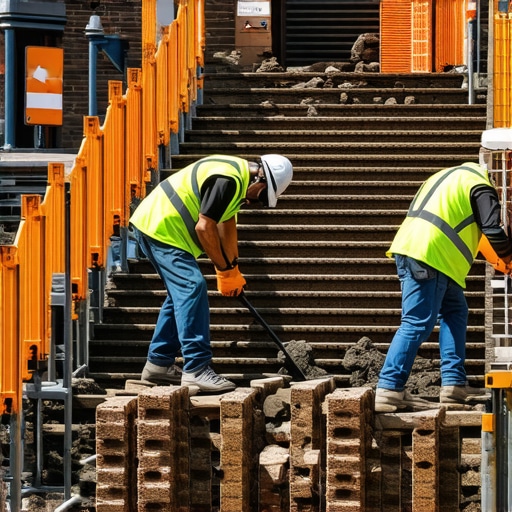
The Integrity of the Vertical Rise: Why Steps Fail
Steps are the infantry of any masonry structure; they take the constant beating of boots, the chemical assault of de-icing salts, and the relentless hydraulic pressure of groundwater. When you see a loose brick on a landing or a tread, you aren’t just looking at a trip hazard. You are looking at a fundamental breakdown of the mechanical and chemical bond between the unit and the substrate. Most ‘fix-it’ guys will just slap some hardware store caulk in the gap and call it a day. That is a crime. To truly secure brickwork in high-traffic zones, you have to understand the microscopic war happening under the tread.
My mentor, a man who could smell a bad batch of lime from fifty yards, used to make us test the ‘ring’ of every brick. He’d hold a clay unit between two fingers and tap it with his trowel. If it gave a dull thud instead of a high-pitched ‘ping,’ it went back in the pile. He knew that the internal density of the brick dictated its suction. If a brick is too dense, it won’t pull the ‘mud’ into its pores. If it’s too porous, it sucks the water out of the mortar before the hydration process can even begin, leaving you with a brittle, sandy mess that will fail the first time a heavy delivery truck rolls over it.
“Structural integrity of masonry assemblies depends heavily on the bond strength between unit and mortar. Without this bond, the individual units act as independent agents rather than a unified structural mass.” – BIA Technical Note 21
The Micro-Zoom: The Chemistry of the Bond
To fix a loose step, we have to talk about Calcium Silicate Hydrate (C-S-H). This is the ‘glue’ that forms when Portland cement and water react. In commercial masonry facade maintenance, we see failures because people don’t respect the ‘tooth.’ When a brick is laid, the wet mortar flows into the microscopic irregularities of the brick’s surface. As the C-S-H gel forms, it grows crystalline fingers that interlock with the brick. In high-traffic areas, the constant vibration of footsteps shears these crystals. Once that bond is broken, water enters the void. In northern climates, that water expands by 9% when it freezes, acting like a hydraulic jack that lifts the brick right out of its bed. This is why spalled concrete steps repair often requires a full teardown rather than a patch; if the crystal structure is shattered, the substrate is compromised.
The Restoration Reality: Structural Repointing and Adhesives
When we approach a repair, we aren’t just ‘pointing.’ We are performing structural repointing. For high-traffic stairs, especially in modular masonry construction, you cannot rely on gravity alone. We often integrate advanced masonry adhesives—not the cheap stuff in tubes, but silane-terminated polyethers that maintain flexibility while providing a tensile strength that exceeds the mortar itself. This creates a hybrid system: the mortar handles the compressive load, while the adhesive manages the shear stress of people pivoting on the edge of the step.
“ASTM C270 dictates that mortar must be selected based on the structural requirements and the exposure environment. Using a mortar that is too hard for the masonry unit will inevitably lead to localized crushing and bond failure.” – ASTM C270
The Process: Securing the Tread
First, we clear the ‘cold joint.’ Any old, crumbling mortar must be ground out to a depth of at least one inch. If you don’t give the new mud enough ‘meat’ to grab onto, it’s just a skin coat that will pop off. We use a diamond blade to create a clean, square-cut shoulder. No V-joints here; they don’t hold. After cleaning, we check the suction. If the brick is bone-dry, we pre-wet it to prevent it from ‘burning’ the mortar. We then butter the brick—applying a thick, even coat of Type S mortar (which has higher lateral strength for steps) to the sides and bottom. For the final ‘bite,’ we apply a bead of high-grade masonry adhesive to the center of the bed. This ensures that even if the mortar cycles through a brutal freeze-thaw, the adhesive core keeps the brick from shifting. This same philosophy applies to cracked brick wall repair or even chimney flue liner installation; you are only as good as your bond.
Finishing and Pointing Styles
The way you finish the joint—the brickwork pointing styles—isn’t just about looks. For steps, a ‘concave’ or ‘V-joint’ is mandatory. These styles compact the mortar into the joint with a slicker, increasing its density and water resistance. A ‘raked’ joint, which looks great on a stone veneer over brick fireplace, is a death sentence for outdoor steps because it creates a ledge where water can sit and dwell. Mortar repointing services that don’t specify the joint finish are just selling you a temporary fix. You want that water to shed away from the rise as fast as possible. Done right, the step becomes a monolithic part of the earth again, ready for another fifty years of heavy boots.