
The Deception of the Surface: A Forensic Reality Check
The homeowner thought it was just a hairline crack. But when I put my scope inside that cavity wall on a 12-story commercial loft in the West End, I saw the structural steel was rusted to dust. The ‘orange rot’ had claimed the lintels because the previous repair crew had simply smeared a 1/4-inch layer of hard Portland cement over crumbling lime mortar. It looked good from the sidewalk, but behind that ‘pretty face,’ the building was screaming. This is the tragedy of manual ‘smear jobs’ on a massive scale. When we talk about structural masonry inspection and restoration, we aren’t just talking about aesthetics; we are talking about the physics of keeping a multi-ton facade from peeling off like an old scab.
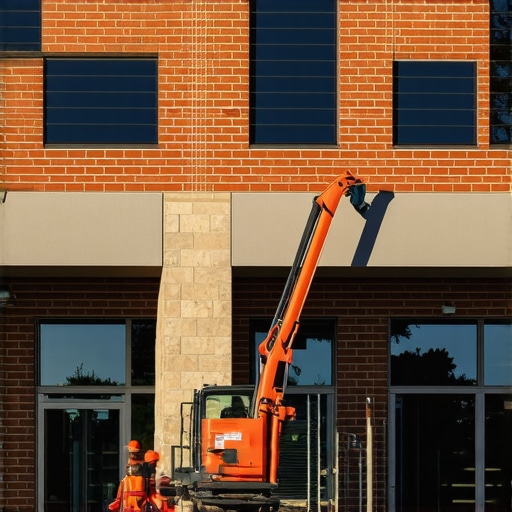
On large commercial facades, the sheer volume of mortar joints is staggering. A single warehouse wall can contain miles of joints. If you rely solely on a guy with a hawk and a slicker, you are inviting human error into every linear inch. Fatigue sets in. The ‘mud’ starts to stiffen on the hawk. The depth of the tuck decreases as the sun goes down. This is where machine-assisted delivery—what the industry often calls robotic masonry repair or pneumatic pointing—changes the game. It isn’t about replacing the mason; it’s about giving the mason a delivery system that matches the scale of the structure.
“Water penetration is the single greatest threat to masonry durability. Proper joint filling and compaction are essential to preventing moisture ingress.” – BIA Technical Note 7
The Physics of the Void: Why Hand-Packing Fails at Scale
To understand why machine tuckpointing wins, you have to understand the ‘interface zone’ between the brick and the mortar. In a stone facade restoration or a large-scale brick project, the goal is to achieve maximum bond strength. When you use a hand-trowel to ‘butter’ a joint, you are applying pressure from a single angle. This often leaves ‘honeycombing’—tiny air pockets deep in the joint. In a Freeze-Thaw climate, these pockets are death sentences. Water finds them, freezes, expands by 9%, and pops the face right off your brick. This is known as spalling.
Machine delivery systems, specifically those using a pressurized auger or pneumatic feed, inject the sustainable tuckpointing mortars from the back of the joint to the front. It’s a ‘bottom-up’ fill. The pressure forces the mortar into every microscopic pore of the masonry unit, creating a ‘mechanical key.’ You aren’t just laying mud in a hole; you are fusing the wall back together. This eliminates the ‘cold joint’ that occurs when a mason tries to patch a half-filled cavity with a second pass of the slicker.
Micro-Zoom: The Rheology of the Mud
In the world of mortar repointing services, the ‘mud’ isn’t just wet sand. On a commercial job using machine delivery, we look at the rheology—the flow characteristics. We use thixotropic additives that allow the mortar to act like a liquid when under pressure (inside the machine) but behave like a solid the moment it hits the wall. This ‘shear-thinning’ property is critical. It allows us to use sustainable tuckpointing mortars with high lime content, which are notoriously difficult to work by hand because of their ‘short’ and ‘crumbly’ nature. The machine doesn’t care if the mortar is ‘short.’ It provides the mechanical force to move the material, allowing us to use softer, breathable mixes that are historically appropriate for stone wall repair and brick arch restoration without sacrificing speed.
“Mortar should be designed to be weaker than the masonry units it binds to ensure it acts as a sacrificial element.” – ASTM C270 Standard Specification for Mortar
The High-Rise Battle: Wind, Pressure, and Performance
Commercial facades face environmental pressures that residential chimneys never see. At thirty stories up, wind-driven rain acts like a pressure washer. If your crumbling mortar joint repair wasn’t executed with perfect compaction, that rain will be inside the building envelope within minutes. Machine tuckpointing ensures a consistent density that hand-work cannot replicate over 50,000 square feet. Furthermore, when dealing with concrete masonry unit restoration (CMU), the larger voids require a volume of material that would break a mason’s wrist if done manually. The machine allows for a continuous ‘soldier course’ of pointing, maintaining the same PSI of pressure from the first floor to the penthouse.
Restoring the Bones: From Chimney Caps to Arches
Even specialized elements like chimney cap replacement or brick arch restoration benefit from mechanical precision. In a brick arch, the ‘keystone’ and the surrounding ‘voussoirs’ are under constant compression. Any void in the mortar leads to a concentration of stress on the brick edges, causing them to ‘pinch’ and crack. Using a machine ensures that the mortar is packed tight against the ‘tooth’ of the old stone or brick, distributing the load evenly across the entire surface area of the joint. It is the difference between a wall that stands for another century and one that becomes a liability in a decade.
Don’t be fooled by the ‘lick-and-stick’ contractors offering a cheap price for a fast smear. True masonry forensic analysis shows that the cheapest repair is the one you only do once. By utilizing mortar repointing services that embrace mechanical efficiency and material science, you are investing in the structural integrity of the asset. We are talking about the difference between ‘buttering’ a joint and truly restoring the ‘breathability’ and ‘flexibility’ of a commercial facade. In the end, the machine is just a tool, but in the hands of a master who understands the ‘suction’ of a dry brick and the chemistry of lime, it is the only way to achieve perfection at scale.