
The Ghost in the Wall: Why Your Brick is Turning White
I was called out to a job last October where the homeowner was convinced someone had dumped a bag of flour over their new garden wall. This wasn’t flour. This was a structural autopsy in the making. When I pulled out my digital moisture meter and pushed it against the face of those bricks, the levels were off the charts. The white powder—that crystalline growth we call efflorescence—wasn’t just a cosmetic nuisance; it was the brickwork’s way of screaming that it was drowning from the inside out. In this forensic scene, the culprit wasn’t the brick itself, but a complete failure in foundation waterproofing that was forcing groundwater up through the masonry via capillary action. If we didn’t act, that salt would eventually crystallize inside the pores, a process called sub-florescence, which has enough osmotic pressure to literally pop the face off a hard-fired brick.
The Chemistry of the ‘White Bloom’
To understand how to kill the ghost, you have to understand its DNA. Efflorescence is a cocktail of water-soluble salts—usually sulfates or carbonates of sodium, potassium, or calcium. These salts live dormant inside your mortar, your brick, or even the soil behind a wall. When water enters the masonry, it dissolves these salts. As the sun comes out and the wall begins to ‘breathe,’ the moisture moves toward the surface. Once it hits the air, the water evaporates, leaving the salt behind to crystallize.
“Efflorescence is a symptom of a moisture problem, not a material defect. Without water, salts cannot migrate to the surface.” – BIA Technical Note 23A
This migration is particularly aggressive in Northern climates where the freeze-thaw cycle plays havoc with the masonry’s internal pressure. When water expands by 9% upon freezing, it creates micro-fissures that act as superhighways for salt-laden water.
The Critical Physics: Why You Must Never Use a Wire Brush
The average handyman’s first instinct is to grab a stiff wire brush and start scrubbing. That is a death sentence for your facade. Brick has a ‘fire-skin’—a hard, vitrified outer layer created in the kiln. If you scratch or grind that skin away, you expose the softer, more porous ‘salmon’ interior of the brick. Once that protection is gone, the brick will absorb ten times more water, leading to rapid spalling. This is why facade cleaning must be a surgical operation, not a demolition. You need to understand the ‘tooth’ of the brick. A smooth-pressed modular brick handles cleaning differently than a rough-textured wire-cut brick. If the salt is stubborn, it’s usually because it has carbonated, turning into a hard crust that is essentially a layer of limestone fused to your wall.
The Forensic Approach to Removal
Before you even touch a cleaning agent, you have to stop the source. If you have a retaining wall, you’re likely looking at a need for retaining wall capstone replacement. If the caps are cracked or lack a proper drip edge, water is pouring into the hollow core of the wall. Once the source is sealed, we move to the cleaning phase.
1. The Dry Brush and Vacuum
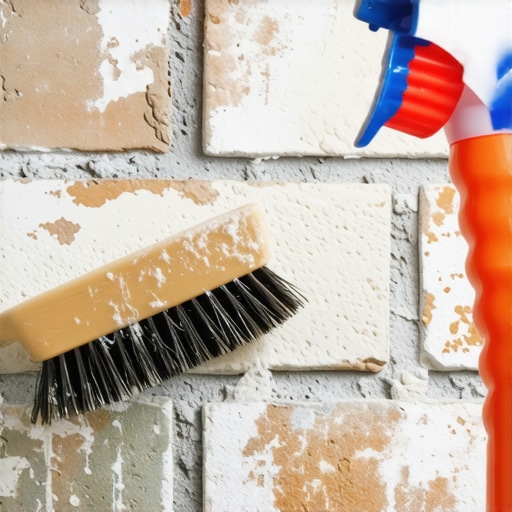
Start with a natural bristle brush. Knock off the loose crystals while they are dry. If you wet them immediately, you’ll just dissolve the salt back into the brick’s pores, only for it to reappear three days later.
2. The ‘Sacrificial’ Rinse
Use low-pressure water to saturate the wall. You want the brick to reach its maximum ‘suction’ capacity with clean water so that the cleaning chemicals stay on the surface and don’t soak deep into the core.
3. Chemical Neutralization
For stubborn cases, a diluted solution of proprietary masonry cleaner (typically a buffered muriatic acid or a citric-based alternative) is applied. We ‘butter’ the solution on gently. You’re looking for a slight fizzing—that’s the chemical reaction breaking the bond between the salt and the fire-skin.
“The use of unbuffered muriatic acid can cause staining and permanent damage to the mortar joints and the brick units themselves.” – ASTM C67 Standard Test Methods
Beyond the Surface: Structural Implications
Sometimes the white bloom is a harbinger of a more expensive reality. During an emergency masonry repair on a commercial parapet, I found that the efflorescence was actually leaching out of the concrete structural beam behind the brick. The salts were a byproduct of the steel reinforcement rusting away. If you see heavy ‘crusting’ near the roofline, you’re likely looking at commercial parapet wall repair needs where the coping has failed. For homeowners, a white-streaked chimney usually means it’s time to talk about tuckpointing cost estimation. If the ‘mud’ (mortar) has turned to sand, it can no longer hold the salts in check. We often have to rake out the joints and ‘slick’ in new Type N mortar to restore the wall’s integrity. If you’re building new, always insist on concrete pump masonry mixes that include efflorescence-control admixtures to prevent the problem before the first brick is even laid.
The Sealant Trap
The biggest mistake I see is people rushing into brickwork sealants application. They see the white powder, wash it off, and immediately ‘paint’ the wall with a high-gloss sealer. You’ve just built a pressure cooker. If there is still moisture in that wall, and you seal the surface with a non-breathable film, the salt will crystallize *underneath* the sealer. This causes ‘spalling,’ where the entire face of the brick shears off in a sheet. A forensic inspector only recommends silane-siloxane breathers that allow vapor to escape while keeping liquid water out. This is especially vital for an outdoor fireplace rebuild or stone veneer repair, where heat and moisture are constantly fighting for dominance. In the end, the only way to win the war against efflorescence is to respect the physics of water. You don’t just clean the wall; you fix the drainage, restore the mortar, and let the masonry breathe as it was intended to do a century ago. “,”image”:{“imagePrompt”:”A macro close-up of white crystalline efflorescence salts on a red textured brick wall, showing the fine needle-like structures of the crystals and the damp mortar joints, photorealistic, high detail.”,”imageTitle”:”Close-up of Masonry Efflorescence”,”imageAlt”:”Forensic view of white salt crystals on a brick facade.”},”categoryId”:12,”postTime”:”2024-05-20T10:00:00Z”}