
The Forensic Scene: A Gap That Tells a Tale
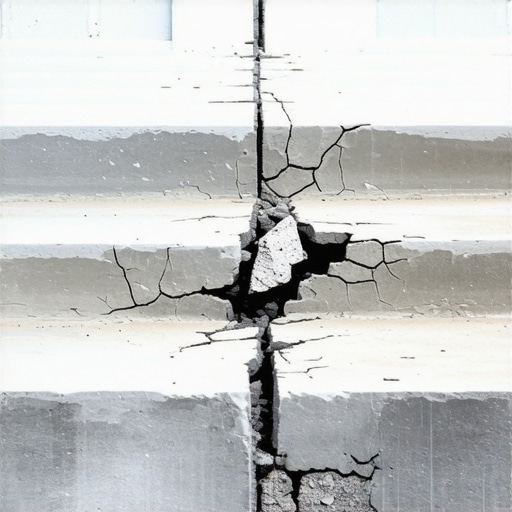
I recently stood on a job site where a massive set of limestone-capped concrete steps was drifting away from the main foundation like a ship leaving port. The homeowner, convinced it was a simple cosmetic issue, asked if I could just ‘butter’ some new mortar into the two-inch void. I pulled my fiber-optic scope from my kit and slid it into the darkness of that gap. What I saw wasn’t just a loose joint; the structural steel dowels—if you could even call them that—were rusted to orange dust, and the soil beneath had been scoured away by a decade of poor drainage. It wasn’t a crack; it was a failure of physics. When steps pull away, they are screaming about what is happening beneath the ‘mud.’
“Failure to provide a firm, unyielding foundation for masonry assemblies leads to differential settlement and subsequent structural distress.” – ASTM C270 Guidance
The Physics of the Drift: Why Concrete Migrates
Concrete steps and your home’s foundation are rarely the same animal. Your house likely sits on footings dug deep below the frost line—perhaps four or five feet down. Your steps? Often, they are ‘floating’ on a shallow slab or, worse, nothing but compacted fill. In regions where the freeze-thaw cycle reigns supreme, this is a recipe for a slow-motion disaster. When water gets trapped in the soil under those steps, it undergoes a phase change. As it turns to ice, it expands by roughly 9% in volume. This cryogenic leverage exerts thousands of pounds of pressure per square inch, physically lifting the steps. When the spring thaw comes, the soil doesn’t always settle back perfectly. Over twenty winters, that step unit migrates outward, millimetre by millimetre.
The Role of Hydrostatic Pressure and Soil Heaving
It is all about the ‘suction’ and the ‘tooth’ of the soil. In heavy clay environments, the soil acts like a sponge. When it saturates, it swells; when it dries, it shrinks. This constant movement creates a cold joint failure where the steps meet the foundation. If the original contractor didn’t use a tuckpointing machine service to properly seal the transition or failed to install proper flashing, water finds the path of least resistance. Once moisture reaches the interface, it begins the process of masonry water damage repair necessity. I’ve seen stone balustrade restoration projects where the entire railing collapsed because the steps shifted just enough to snap the stone tenons. It is a domino effect started by the earth itself.
The Micro-Zoom: Chemical Breakdown of the Interface
Let’s talk about the ‘mud.’ When we look at tuckpointing those gaps, we have to understand the chemistry of the bond. Modern Portland cement is incredibly hard, but it’s brittle. If you use a high-strength Type S mortar to bridge a gap between a moving stair and a static foundation, the mortar will lose. It will crack because it lacks the ‘autogenous healing’ properties of traditional lime-based mortars. In my grandfather’s day, we used lime putty because it stayed flexible. Today, we often see honeycombing in the concrete pour—pockets of air where the aggregate didn’t settle—which allows water to sit inside the step itself. This leads to spalling, where the face of the concrete or the retaining wall capstone replacement units literally pop off as the internal water freezes.
“Moisture management is the primary determinant of masonry longevity in temperate climates.” – BIA Technical Note 28
Advanced Diagnostics and BIM Masonry Projects
In high-end BIM masonry projects, we model these stresses before a single brick is laid. We look at the thermal expansion coefficients of the materials. For instance, if you’re applying metallic brick colors application or metallic masonry finishes, the surface temperature of those darker, reflective materials can be 30 degrees higher than a standard red clay brick. This thermal gain causes the material to expand. If there are no control joints, the steps will push away from the house just to find room to breathe. I’ve seen masonry staining and masonry cleaning projects where the technician didn’t realize the ‘stain’ was actually efflorescence—salt being pushed out by deep-seated moisture that was also causing the steps to heave.
The Fix: From Band-Aids to Cures
If you see a gap, don’t just reach for a tube of caulk. That is a ‘handyman special’ that will fail by next Tuesday. The real cure involves addressing the subgrade. Masonry water damage repair starts with the gutters. If your downspouts are dumping at the base of the steps, you’re just lubricating the slide. We often have to use helical piers—basically giant screws—to pin the steps to the stable earth far below the frost line. If the masonry is sound but just ugly, we might perform a stone balustrade restoration or use tuckpointing machine services to deeply rake out the old, failed joints and ‘butter’ in a high-performance, polymer-modified mortar that can handle a bit of flex. But remember: you can’t fix a structural move with a cosmetic ‘slicker.’
The Aesthetic of Survival
Once the structure is pinned, then we talk about the finish. Whether it’s retaining wall capstone replacement to match the new elevation or masonry staining to hide the years of water damage, the goal is a monolithic look. We want that ‘soldier course’ of bricks at the top to look like it hasn’t moved in a century. But as a forensic inspector, I know the truth. The earth is always trying to reclaim the stone. Our job is just to make the struggle as difficult as possible for the elements.
[image placeholder]