
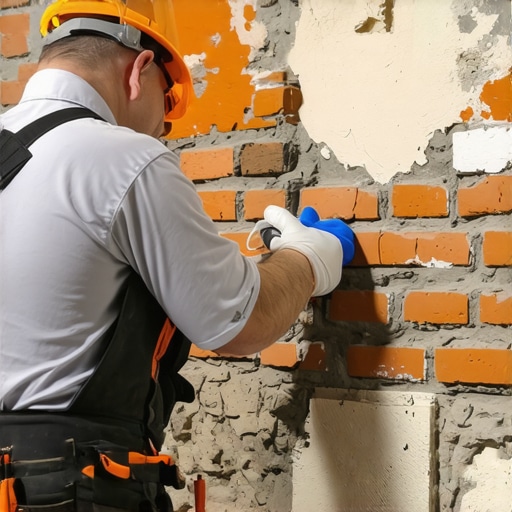
I remember a job in the old district where a homeowner had spent a fortune on what they called a ‘modern waterproofing’ solution for their 1920s Tudor. They had coated the entire exterior in a thick, rubberized elastomeric paint, thinking they were sealing out the rain forever. Six months later, I was called in because the brick faces were literally exploding off the wall. When I took my hammer and tapped a single ‘header’ brick, the entire face fell away like a scab, revealing a mushy, orange powder behind it. The homeowner thought it was just a hairline crack. But when I put my scope inside, I saw the structural steel was rusted to dust and the brick cores had turned to sand. They hadn’t protected the house; they had wrapped it in a plastic bag and let it suffocate in its own sweat. That is the reality of non-breathable sealants, and it is why we fight for the life of the stone through science, not just shortcuts.
The Physics of Vapor Permeability: Why Masonry Must ‘Breathe’
To understand why we use breathable masonry sealants, you have to understand the ‘tooth’ of the material. Whether we are talking about historic brick salvage or modern concrete, masonry is a sponge. It is full of microscopic pores and capillaries. In an environment with freeze-thaw cycles, water enters these pores. If that water is liquid, it needs a way out. If it turns to vapor due to the sun hitting the wall, it definitely needs a way out.
“Water penetration is the single greatest threat to masonry durability, but the inability for that water to escape as vapor is what causes catastrophic material failure.” – BIA Technical Note 7
When you apply a ‘film-forming’ sealer—the cheap stuff you find at big-box stores—you are creating a dam. The water gets in through microscopic cracks in the structural repointing or through the ground via capillary rise (wicking). Once the sun hits that wall, the water turns to vapor, expands, and exerts ‘hydrostatic pressure’ from the inside out. Since the vapor can’t get through the plastic coating, it builds up until it reaches 4,000 PSI—enough to pop the face off the strongest brick. This is what we call spalling.
The ‘Sacrificial’ Philosophy: Mortar Repointing Services
In my thirty years of throwing mud, the most common mistake I see is a lack of respect for the hierarchy of hardness. In any wall, the mortar must be softer than the brick. This is the ‘sacrificial principle.’ We provide mortar repointing services that utilize lime-based mixtures because they allow for ‘autogenous healing’—the ability of the mortar to actually reseal tiny cracks over time as it reacts with CO2. If you use a hard, non-breathable Portland cement on old, soft bricks, the brick becomes the weakest link. Instead of the mortar joint failing (which is easy to fix), the brick itself cracks. When we perform structural repointing, we are ensuring that the masonry joint sand repair or the new mortar ‘butters’ the joint in a way that allows moisture to wick out through the joints, not the units. We strike the joint with a slicker to compact the surface, creating a ‘weather-struck’ profile that sheds water while remaining vapor-permeable.
Foundations and the Hydraulic Trap
When dealing with concrete block foundation repair, the stakes are even higher. A basement is a bucket sitting in a hole. If the soil is saturated, you have thousands of pounds of pressure pushing against those blocks. Many ‘handymen’ will try foundation waterproofing by painting a black tar-like substance on the inside. This is a death sentence for the block. It traps the water inside the concrete cells. Over time, this water eats away at the lime in the concrete (leaching), leading to honeycombing and eventual structural failure. The correct approach often involves foundation helical pier installation to stabilize the load, followed by a breathable membrane on the exterior that keeps liquid water out but allows the block to dry toward the interior. If the wall is already bowing, we don’t just ‘slap some paint’ on it; we address the geotechnical reality of the soil heaving.
Hardscapes: Patios, Driveways, and Retaining Walls
It’s not just the walls that need to breathe. Look at a brick patio restoration or a brick paver driveway repair. Most ‘wavy’ driveways aren’t caused by the pavers; they are caused by the base. If the base doesn’t drain, the water sits, freezes, and heaves the pavers. When we do masonry joint sand repair, we use specialized polymeric sands that remain flexible and permeable, or traditional sand-and-lime dust mixes for historic accuracy. For modular retaining walls, the enemy is always hydrostatic pressure. Without a breathable face and a massive amount of ‘clean’ gravel drainage behind it, that wall is just a slow-motion landslide.
“The use of water-repellent coatings should be limited to those that are vapor permeable, as trapping moisture within a masonry wall can lead to accelerated weathering and salt crystallization (efflorescence).” – ASTM C67 Standards
We don’t ‘seal’ a retaining wall to make it waterproof; we treat it to shed surface water while ensuring the foundation waterproofing behind the scenes is doing the heavy lifting.
The Gritty Truth About Sealants
So, what do we actually use? We use silanes and siloxanes. These aren’t ‘paints.’ They are sub-surface treatments that chemically bond to the silica in the masonry. They don’t change the color, and they don’t create a ‘slick’ film. Instead, they change the surface tension of the pores. Think of it like a thousand tiny umbrellas inside the brick. Liquid water (a large molecule) can’t get in, but water vapor (a tiny molecule) can get out. This is the only way to protect historic brick salvage without destroying its soul. When I’m buttering a head joint or finishing a soldier course, I’m thinking about where that water is going to go twenty years from now. Don’t fall for the ‘wet look’ sealers or the ‘lifetime’ waterproof paints. If the wall can’t breathe, the wall will die. Do it once, do it right, and use a material that respects the physics of the stone. Anything else is just a ‘cold joint’ in your investment.