
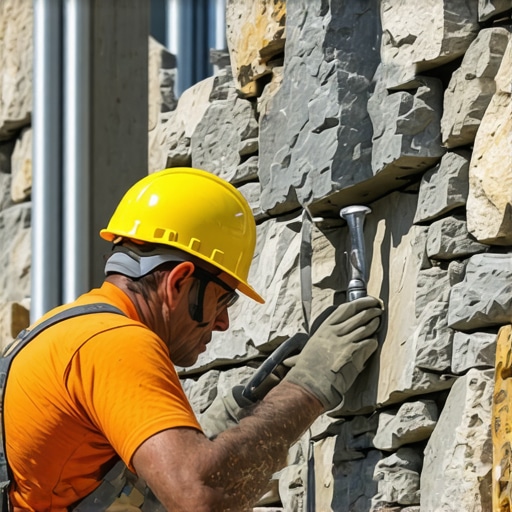
The Forensic Scene: When the ‘Curbside Appeal’ Starts to Rain Down
The homeowner called me out to a five-year-old ‘mountain-modern’ estate because she heard a sound like a gunshot in the middle of a Tuesday afternoon. When I arrived, a thirty-pound piece of manufactured ledge-stone was shattered on the stamped concrete driveway. I didn’t need to pull out the moisture meter to know what happened, but I did anyway. I put my digital scope into a gap behind the remaining stones and what I saw was a structural horror movie: the galvanized lath was a rusted orange lace, the OSB sheathing was the consistency of wet oatmeal, and the ‘structural steel’ lintel was shedding layers of oxidized flakes like a dry skin condition. The homeowner thought it was just a hairline crack. But when I saw the air-gap—or lack thereof—it was clear that the entire facade was a ticking time bomb. This wasn’t just a loose stone; this was a systemic failure of adhesion and moisture management.
“Water penetration is the single greatest threat to masonry durability, specifically when drainage planes are bypassed in thin-veneer applications.” – BIA Technical Note 28C
The Micro-Physics of Adhesion: Why Stones Fall
To understand why your stone wall is beginning to bulge or ‘slip,’ we have to look at the molecular level of the bond. Modern stone veneer is often applied using the ‘lick-and-stick’ method. You have a scratch coat—a layer of mortar spread over wire lath—and then you ‘butter’ the back of the stone and press it on. The science here relies on two things: mechanical interlocking and chemical suction. When you press that stone into the mud, the mortar is supposed to flow into the microscopic pores of the stone. This is the ‘tooth.’ As the cement hydrates, it forms needle-like crystals called calcium silicate hydrate (C-S-H). These crystals grow into the stone’s pores, locking it in place. If the stone is too dry, it sucks the water out of the mortar before the crystals can grow—we call this a ‘flash set.’ If the stone is too wet, the water-to-cement ratio at the interface is ruined, and the bond is as weak as wet flour. In the North, we deal with the brutal 9% expansion of water as it turns to ice. If moisture gets behind that stone and hits a freeze-thaw cycle, it acts like a hydraulic jack, slowly ratcheting the stone away from the wall until gravity takes over.
The Pathology of the ‘Slipping’ Wall
When we talk about brick veneer detachment repair or stone wall issues, we are often looking at a failure of the drainage plane. A wall should breathe. In traditional masonry, we have a cavity. In thin veneer, we often have a ‘drainage mat’ or at least a layer of grade-D paper. When a contractor skips this, or when they use cheap, non-modified mortar, the wall becomes a sponge. I’ve seen retaining wall capstone replacement jobs where the caps were held on by nothing but hope and a thin bead of construction adhesive. That doesn’t work. You need a self-leveling masonry lift in some commercial applications to ensure the weight is distributed, but in residential veneer, it’s about the ‘mud.’ If your wall is bowing, you might be looking at hydrostatic pressure from the soil behind a retaining wall, or it could be that the stone is actually sliding down the wall because the ‘cold joint’ formed between the scratch coat and the setting bed has failed. This is where robotic masonry repair is starting to enter the commercial field—using automated systems to inject high-strength polymers into the void—but for the average homeowner, it’s a manual forensic process.
The Restoration Reality: Fixing the Bond
To fix a slipping wall, you can’t just slap more mud on it. You have to address the substrate. If the foundation is moving, you’re looking at foundation helical pier installation to stabilize the earth before you even touch the stone. If the foundation is solid but the stone is loose, we begin the process of ‘repointing’ or, more accurately, ‘re-setting.’ We use a slicker or a tuckpointing tool to grind out the failed joints. We’re looking for ‘honeycombing’ in the mortar—those air pockets that indicate the mix was too dry or poorly consolidated. When I’m on a stone wall repair job, I insist on using a polymer-modified Type S mortar. We ‘butter’ the back of the stone, ensuring 100% coverage. No ‘doughnut’ method where you leave a hole in the middle—that just traps water. We want the ‘ooze.’ When you press the stone, the mortar should squeeze out from all sides, which we then tool into a specific brickwork pointing style, like a weather joint or a concave joint, to shed water away from the wall.
“The bond strength of masonry assemblies is directly proportional to the moisture content of the units at the time of laying.” – ASTM C270 Standards
The Hardscape Truth and Geotechnical Realities
Often, a loose stone on a wall is a symptom of a patio stone realignment issue or a settling foundation. If the soil heaves, it pushes the wall. If the wall moves even a fraction of an inch, the rigid stone veneer cannot flex. It’s not like wood siding; it doesn’t bend. It cracks. This is why foundation crack repair is often the first step in masonry restoration. If you see a stair-step crack migrating up your stone veneer, stop looking at the stones and start looking at the dirt. We look for ‘suction’ in the brick or stone. If I’m doing a commercial smokestack repair or a high-rise veneer job, the physics are the same but the stakes are higher. Thermal expansion can cause a wall to grow an inch over a hundred feet in the summer sun. Without control joints, that stone is going to ‘pop’ off the wall like a button on a tight shirt. We use ‘soft joints’ filled with backer rod and sealant instead of mortar at specific intervals to give the wall room to breathe and move.
The Master’s Verdict: Do It Once, or Do It Twice
If you see a stone that looks like it’s pulling away, don’t wait. A single loose stone allows gallons of water to enter the system. Once that water is behind the ‘sealed’ surface, it’s trapped. It will rot your studs, mold your drywall, and eventually, the weight of the water-logged assembly will pull the remaining stones down in a catastrophic sheet-failure. I’ve seen brickwork pointing styles that were chosen for aesthetics but failed because they acted like little shelves for snow to sit on. Always choose function over fashion. Use a hawk to hold your mud, butter the stone with a 1/2 inch of modified mortar, and make sure your flashing is tucked behind the house wrap. It’s not magic; it’s masonry. It’s about respecting the chemistry of the lime and the physics of the water. If you treat your stone wall like a structural skin instead of a wallpaper, it will last a hundred years. If you treat it like a ‘handyman special,’ you’ll be calling me back in two seasons to pick the stones up off your lawn.