
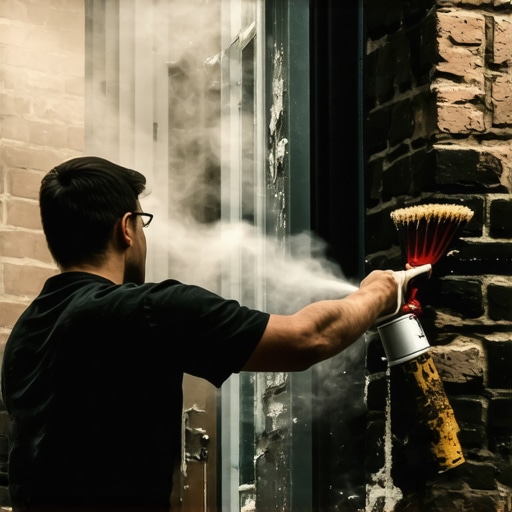
The Industrial Lung of the Building
You look at a soot-stained building and see the passage of time. I look at it and see a building with black lung. That dark, greasy film clinging to the historic masonry preservation project isn’t just dirt; it’s a century’s worth of coal smoke, diesel exhaust, and particulate matter that has chemically bonded to the clay. When you’re dealing with a facade that has survived the Great Depression and two World Wars, you don’t just ‘wash’ it. You have to understand the physics of the pore structure. If you go in there with a high-pressure nozzle and a ‘handyman’s’ sense of urgency, you’ll blow the fire-skin off the brick and leave it porous, vulnerable, and destined for a slow, crumbling death.
The Lesson of the Pore
My old mentor, a man who had more lime dust in his lungs than blood in his veins, used to take a magnifying glass to the face of a brick before he’d let us touch a drop of water to it. He’d say, ‘If you can’t see the tiny craters where the clay breathed in the kiln, you’re not looking at a wall; you’re looking at a corpse wrapped in a shroud.’ He taught me that the ‘tooth’ of the brick is what holds the history. If you scrub too hard, you lose the tooth. If you use the wrong chemical, you dissolve the binder. This is why we treat a soot-covered facade like a forensic scene. We aren’t just cleaning; we are performing historic masonry preservation.
“Water penetration is the single greatest threat to masonry durability, but improper cleaning techniques are a close second, often causing irreversible damage to the masonry unit’s surface.” – BIA Technical Note 20
The Chemistry of the Carbon Crust
Soot isn’t just resting on the surface. In many cases, particularly in cities with high sulfur content in the air, a process called sulfation occurs. The sulfur dioxide from coal smoke reacts with the calcium carbonate in the mortar or the impurities in the clay to create a gypsum crust. This crust traps the soot and, more importantly, it traps moisture. When that moisture can’t escape, it sits behind the crust. Then winter hits. In a freeze-thaw climate, that trapped water expands by 9%, and the next thing you know, your chimney repair services bill is through the roof because the brick faces are literally popping off in your hands. This is why re-pointing services must always be preceded by a careful, non-aggressive cleaning process.
The Process: Poultice vs. Pressure
I’ve seen guys pull up to a 100-year-old brownstone with a commercial pressure washer and start blasting. It makes me sick. You are essentially sandblasting the building with water. You’re stripping away the protective vitrified surface that was created when that brick was fired in the kiln. Once that’s gone, the brick becomes a sponge. Instead, we use the ‘slow and low’ method. This involves a chemical poultice or a low-pressure detergent wash. We apply the cleaning agent and let it dwell. You want the chemical to do the heavy lifting, breaking the bond between the carbon and the silica. When we’re working on mortar repointing services, we ensure the joints are cleaned out without damaging the edges (the ‘arris’) of the brick. If you round off those edges, you’ve ruined the look of the wall forever.
Dealing with Structural Decay
Often, once the soot is gone, the real horror show begins. You find that the brick lintel replacement you thought was minor is actually a structural emergency. The steel lintel above the window has rusted—we call it ‘iron oxide jacking.’ As the steel rusts, it expands, exerting thousands of pounds of pressure on the surrounding masonry. You’ll see it as a diagonal crack radiating from the corner of the window. No amount of masonry staining will hide that. You have to get in there, support the load, and replace the steel. While you’re at it, you better be looking at the foundation. If you see horizontal cracks near the grade line, you might be looking at foundation underpinning needs, especially if the soil has been saturated by decades of poor drainage from a soot-clogged gutter system.
“Mortar should be weaker than the masonry units so that any stress-induced cracking occurs in the mortar joints, where it is easily repaired, rather than in the units themselves.” – ASTM C270 Standard Specification for Mortar
The Physics of High-Performance Mortar Mixes
When it comes time to put the ‘mud’ back in the wall, don’t you dare reach for a bag of Type S Portland cement. Modern cement is too hard for historic bricks. It doesn’t breathe. If the brick is soft and the mortar is hard, the brick will lose the fight every time. We use sustainable tuckpointing mortars—usually a lime-based mix like Type O or even a pure hydraulic lime. These high-performance mortar mixes are designed to be sacrificial. They allow moisture to escape through the joint rather than the brick. When you’re using your hawk and slicker to ‘butter’ those joints, you’re ensuring that the building can cycle through the seasons for another century. If you see honeycombing in your mortar, you didn’t pack it tight enough. You need to use a jointing tool to compress the mud, creating a tight seal against the brick’s ‘tooth.’
The Hardscape Connection
While we’re talking about cleaning the facade, don’t ignore the concrete flatwork services around the base. I’ve seen beautiful restoration jobs ruined because the contractor didn’t realize the driveway was pitching water toward the foundation. When you’re doing foundation underpinning or repairing the base of a wall, you have to ensure the grade is right. The soot on the wall often mirrors the splash-back from the ground. If you don’t fix the drainage, that soot and salt will be back in five years, and you’ll be right back where you started, staring at a cold joint and wondering where your money went.
Conclusion: The Master’s Eye
Restoring a facade is about patience. It’s about knowing when to use the slicker and when to leave the wall alone. It’s about understanding that a soldier course over a window isn’t just decorative—it’s a structural element that needs proper support. If you treat your home like a machine, it will break. If you treat it like a living, breathing entity of clay and lime, it will outlast you. Don’t fall for the ‘lick-and-stick’ solutions. Do it once, do it right, and keep the grit in the wall, not in your teeth.