
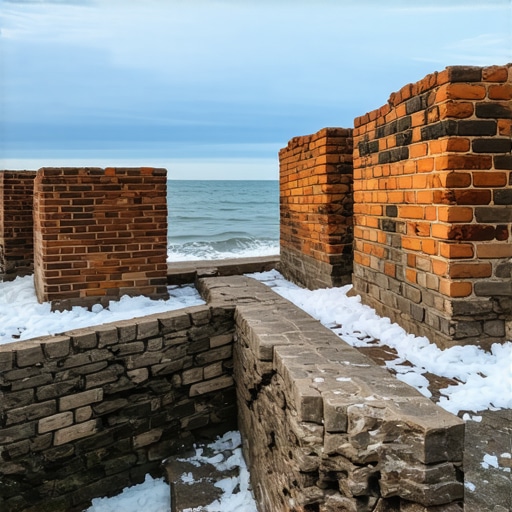
The ocean is a patient killer. Most homeowners look at a seaside property and see a sunset; I look at it and see a slow-motion chemical explosion. I was called out to a three-story colonial on the coast of South Carolina last summer—the kind of place where the owner thought a hairline crack was just ‘settling.’ But when I put my scope inside the cavity wall, I saw a nightmare: the structural brick ties had been reduced to orange dust, and the interior wythe was standing on nothing but hope and a bit of gravity. The salt air hadn’t just touched the surface; it had migrated deep into the wall’s marrow, turning a multi-million dollar structure into a precarious stack of loose clay. This is the reality of coastal masonry, and if you think a bucket of waterproofing from a big-box store will save you, you’re already in trouble.
The Invisible Terror: Subflorescence and the Physics of Salt
Everyone knows efflorescence—that white, powdery stain that appears on bricks like a ghost. It’s unsightly, but mostly harmless. The real killer is its cousin, subflorescence. In a marine environment, the air is saturated with sodium chloride. Because clay bricks are porous—basically a collection of microscopic straws—they pull that saline moisture deep into their structure via capillary action. When the sun hits the wall, the water evaporates, but the salt stays behind. As it crystallizes within the pores of the brick, it expands. We aren’t talking about a gentle expansion; we are talking about crystallization pressures that can exceed 10,000 PSI. No brick on earth can withstand that from the inside out.
“Soluble salts can migrate into the masonry and crystallize within the pores of the unit… the resulting pressure can cause the face of the unit to spall or flake off.” – BIA Technical Note 1: All About Efflorescence
This is why brick spalling prevention is a matter of chemistry, not just aesthetics. When the face of the brick pops off—that’s spalling—you’ve lost the ‘fire-skin,’ the hardest part of the unit. Once that skin is gone, the soft ‘heart’ of the brick is exposed, and the rate of decay triples. You’re no longer looking at a simple concrete patch job; you’re looking at a full-scale stone facade restoration or complete wall replacement.
The Portland Trap: Why Harder Isn’t Better
The biggest mistake I see ‘handyman specials’ make in coastal regions is using modern Type S or Type M Portland cement for tuckpointing brick walls. It sounds logical: the environment is harsh, so use the hardest mud, right? Wrong. In a historic or even a well-built 20th-century wall, the mortar must be the sacrificial lamb. It should be softer and more permeable than the brick itself. If you butter a joint with a hard, non-breathable Portland mix, you’ve essentially created a dam. The salt-laden moisture gets trapped behind the mortar. Since it can’t escape through the joint, it’s forced out through the face of the brick, leading to catastrophic spalling. For tuck pointing services near the water, I demand a high-lime mix, like Type O or even a traditional lime putty. It allows the wall to ‘breathe,’ letting the salt migrate out through the mortar joints where it can be harmlessly washed away, rather than destroying the brick units.
The Gut-Check: Structural Brick Ties and Cavity Failure
If you’re noticing stone wall repair needs or bulging in your brickwork, the problem is likely hidden. Salt air is a master at finding steel. In coastal masonry, the structural brick ties replacement is often the only way to save a building. These ties hold the decorative outer wythe to the structural frame. In the presence of salt and humidity, galvanized steel undergoes an electrochemical reaction. The zinc coating is sacrificed, and then the steel oxidizes. As steel rusts, it expands up to seven times its original thickness. This ‘oxide jacking’ can lift entire courses of brick, creating horizontal cracks that look like the building is yawning. By the time you see the crack, the tie is often gone.
“The selection of masonry wall ties for use in corrosive environments should be based on the expected life of the building and the severity of the exposure.” – ASTM C270 Standard Specification for Mortar for Unit Masonry
In these cases, we have to perform a forensic extraction. We cut into the soldier course or the bed joints, remove the rusted remnants, and install 316-grade stainless steel helical ties. It’s a surgical process. If you ignore it, the next high-wind event might just peel your facade off like an orange skin.
Ground Zero: Retaining Walls and Foundation Underpinning
The destruction doesn’t stop at the eye-level walls. I’ve seen retaining wall installation projects fail in three years because the contractor didn’t account for hydrostatic pressure combined with salt-saturated soil. Salt increases the conductivity of the soil and accelerates the degradation of any concrete footer. If your retaining wall is leaning or showing heavy salt crusting at the base, the masonry joint sand repair you’re planning is just putting a bow on a corpse. You likely need foundation underpinning to stabilize the footing before the weight of the saturated earth pushes the wall into the Atlantic. I always use a heavy-duty drainage mat and a dedicated gravel backfill to keep the saline groundwater away from the masonry. If the water doesn’t touch the brick, the salt can’t get inside.
The Master’s Methodology: Restoration and Protection
When I’m performing stone facade restoration, I follow a strict protocol. First, we ‘rake’ out the joints—not with a grinder that throws sparks and chips the brick, but with a pneumatic chisel or a hand-tooled slicker to ensure we don’t damage the ‘tooth’ of the stone. We then ‘butter’ the joints with a moisture-compatible mud, striking the joint to a ‘V’ or ‘weathered’ profile to shed water effectively. For those looking for a concrete patch on decorative elements, we use polymer-modified mortars that have been specifically engineered for high-chloride environments. But the real secret? Never, ever use a ‘sealer’ that isn’t vapor-permeable. A silane-siloxane water repellent is the only thing I’ll let near a coastal wall. It’s a ‘breathable’ barrier that keeps liquid water out but allows water vapor and salt ions to escape. Anything else is just a slow-acting poison for your masonry.