I once walked onto a commercial property where a massive $80,000 outdoor plaza looked more like a topographical map of the Swiss Alps than a level walking surface. The client was frantic, already looking at a quote for a full demolition that involved bringing in a fleet of Bobcats to rip out thousands of square feet of hand-cut pavers. I stood there, smelling the damp, stagnant air trapped beneath the slabs, and I knew exactly what happened. The original crew had ignored the ‘tooth’ of the sub-base, and the hydrostatic pressure from a leaking outdoor masonry fountain restoration project nearby had turned the subgrade into a slurry. It wasn’t a demolition job; it was a forensic stabilization job. That is the reality of modern hardscapes: either you respect the physics of the soil, or the soil will eventually claim its inheritance.
The Physics of the Sink: Why Patios Lose Their Level
When a patio sinks, it isn’t just ‘settling.’ That’s a term handymen use to hide the fact that they didn’t compact the base correctly. In the world of forensic masonry, we look at the void ratio. Most commercial masonry maintenance issues start with the base material. If you use a base with too many ‘fines’—those tiny particles of dust—they will eventually wash away, leaving behind microscopic pockets. Over a decade, those pockets aggregate into structural voids. In northern climates, the 9% expansion of water during the freeze-thaw cycle exerts a force that can lift even the heaviest bluestone. But in the summer, that water melts, leaving a cavity behind. This is where self-leveling masonry lifts and polymer injections come into play, offering a surgical alternative to the ‘rip and replace’ mentality. We are talking about the difference between open-heart surgery and a localized injection.
“The stability of any masonry assembly is directly proportional to the consistency of its subgrade support and the management of moisture within that substrate.” – BIA Technical Note 29A
The No-Dig Revolution: Polymer Injection and Mechanical Lifts
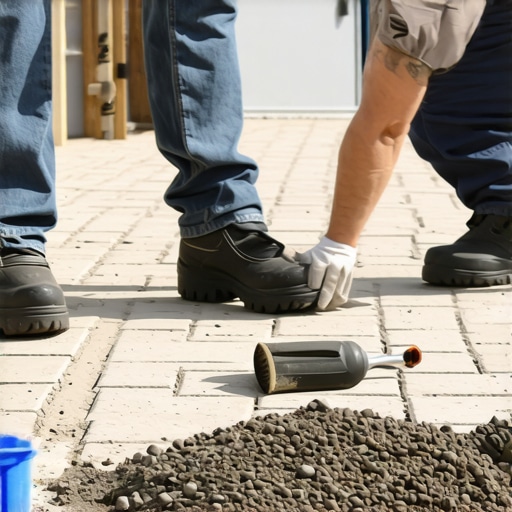
The no-dig method isn’t magic; it’s high-pressure chemistry. Instead of excavating the entire patio, we drill small, penny-sized holes through the joints—often following a historic mortar analysis to ensure we aren’t damaging the original aesthetic. We then inject a high-density, closed-cell structural polymer. This material isn’t your standard ‘mud’ or mortar. This is a two-part chemical reaction that expands with enough force to lift a soldier course of brick or a three-ton slab of granite. As the polymer expands, it finds the path of least resistance, filling those voids I mentioned earlier and compacting the surrounding soil. This increases the load-bearing capacity of the earth itself, creating a ‘digital twin masonry project’ of sorts where the underground structure is as solid as the surface.
The Critical Importance of the Base and Drainage
If you’re dealing with mortarless masonry systems, the physics change slightly. These systems rely on friction and ‘interlocking’ to stay level. When the sand in the joints washes out because someone used a pressure washer too aggressively, the slabs lose their lateral stability. They start to ‘tip.’ This is often misdiagnosed as foundation failure. In reality, it’s a surface-level management failure. I’ve seen retaining wall capstone replacement jobs where the cap was replaced but the chimney repair services crew forgot to check the flashing nearby. Water was diverted directly behind the wall, creating a cold joint where the wall met the patio. The result? A foundation wall bowing repair that could have been avoided with a simple slicker and some proper tuckpointing machine services at the right time.
The Forensic Approach to Masonry Maintenance
True masonry isn’t just about ‘buttering’ a brick and laying it down. It’s about understanding the ‘suction’ or the initial rate of absorption (IRA). When we perform historic mortar analysis, we aren’t just looking for color; we are looking for the compressive strength. If you use a high-strength Portland cement on a patio built with soft, 19th-century brick, the brick will lose its face within two seasons. The mortar must be the sacrificial lamb. In the case of sinking patios, the ‘no-dig’ lift must be performed by someone who understands that if you lift too fast, you risk honeycombing the polymer, which leaves the patio brittle and prone to cracking under the weight of a commercial vehicle. You need to ‘hawk’ the material in slowly, monitoring the elevation changes with laser precision.
“Successful masonry restoration requires a compatibility of materials, where the repair medium does not exceed the physical properties of the original substrate.” – ASTM C270 Standards
When to Use Self-Leveling Lifts vs. Traditional Methods
Not every patio is a candidate for the no-dig method. If the retaining wall capstone replacement wasn’t done and the entire hillside is sliding into your plaza, a polymer injection is just a very expensive Band-Aid. You have to address the root cause. This is where digital twin masonry projects are becoming the gold standard. We map the entire structural load of the property. If the patio is sinking because of foundation wall bowing, the ‘no-dig’ lift should be coupled with foundation wall bowing repair techniques like carbon fiber strapping or helical piers. It’s about the holistic health of the structure. I’ve seen guys try to ‘butter’ over a structural crack with some cheap caulk—the ‘handyman special.’ Within six months, the crack is back, wider and meaner than before, because they didn’t stop the hydrostatic uplift.
The Hardscape Truth: Do It Once, or Do It Twice
In this trade, you’re either a craftsman or a salesman. The salesmen want to sell you a new patio every ten years. The craftsmen—the ones who know the smell of a tuckpointing machine at 6 AM—want to fix the physics. Whether it’s outdoor masonry fountain restoration or complex commercial masonry maintenance, the ‘no-dig’ method represents a shift toward preservation. We are no longer just ‘moving mud.’ We are engineers of the earth. We are using self-leveling masonry lifts to defy gravity, ensuring that the ‘ring’ of a well-set stone remains for another century. Don’t let a sinking patio ruin the value of your property. Look for the voids, understand the water, and never, ever trust a man who doesn’t know the difference between ‘Type N’ and ‘Type S’ mortar when he’s standing on your sinking stone.
{“@context”: “https://schema.org”, “@type”: “HowTo”, “name”: “How to Level a Sinking Masonry Patio Without Digging”, “step”: [{“@type”: “HowToStep”, “text”: “Conduct a forensic soil analysis to identify voids and moisture levels beneath the patio slabs.”}, {“@type”: “HowToStep”, “text”: “Identify and map the injection points, usually at the intersections of joints to minimize aesthetic impact.”}, {“@type”: “HowToStep”, “text”: “Drill small-diameter holes through the masonry units or mortar joints using a precision diamond bit.”}, {“@type”: “HowToStep”, “text”: “Inject high-density structural polymer in incremental ‘lifts’ while monitoring the surface with laser levels.”}, {“@type”: “HowToStep”, “text”: “Patch the injection holes using a custom-tinted mortar based on a historic mortar analysis to ensure a perfect match.”}]}