
The Forensic Scene: When the Skyline Sheds Its Skin
I was standing on a steep pitch in late March, the kind of damp morning where the cold doesn’t just bite—it soaks into your marrow. The homeowner had called me because he found a few ‘red chips’ on his patio. To him, it was a minor nuisance. When I climbed up and put my borescope into the flue transition, I didn’t see a minor repair; I saw a chimney that had been murdered by its own mortar. The structural steel lintel was a swollen mass of oxidized flakes, and the mortar joints had the consistency of wet flour. This wasn’t just age. This was a forensic case of the wrong chemistry meeting a brutal wet winter.
The Physics of the 9% Expansion
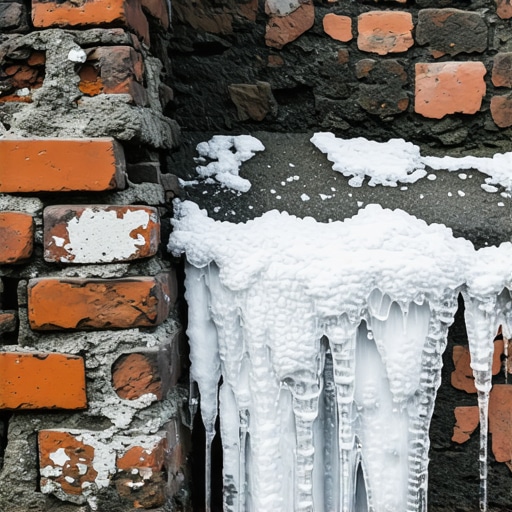
To understand why your chimney is disintegrating, you have to understand the violence of water. When liquid water enters the pores of a masonry unit or a mortar joint, it sits there, dormant, until the temperature drops below 32 degrees Fahrenheit. At that moment, the molecular structure rearranges into a crystalline lattice, and the volume expands by exactly 9 percent. In a confined space like a mortar joint, that 9 percent expansion exerts thousands of pounds of pressure per square inch. If the mortar is too hard—built with a high-strength Portland cement instead of a breathable lime mix—it won’t give. Something has to break. Usually, it is the face of the brick that ‘spalls’ or pops off, or the mortar itself shatters into dust. This is why professional mortar repointing services are not just about aesthetics; they are about managing the internal pressures of a structural stack.
“Water penetration is the single greatest threat to masonry durability. Proper selection of mortar type and joint profile is essential to mitigate moisture ingress.” – BIA Technical Note 7
The Chemistry of Efflorescence and Salt Cycles
Have you noticed a white, powdery film on your bricks after a heavy rain? That is not just ‘dirt.’ That is brick efflorescence removal territory. It is a chemical signal of a deeper sickness. Rainwater travels through the brick, dissolving mineral salts within the masonry or the mortar. As the sun comes out and the brick dries, the water evaporates, leaving the salts behind on the surface. This is ‘primary efflorescence.’ The real danger is ‘subflorescence,’ where the salts crystallize *inside* the brick’s pores. The crystalline growth creates internal ‘heave’ that mimics the freeze-thaw cycle, effectively exploding the brick from the inside out. If you see this, your chimney’s ‘tooth’—the mechanical bond between the mud and the brick—is being eaten away.
Tuckpointing vs. Repointing: The Great Confusion
In this trade, I see ‘handymen’ use these terms interchangeably, and it drives me to the brink. Repointing is the structural act of grinding out old, decayed mud and ‘buttering’ in new mortar that matches the strength and vapor permeability of the original wall. Tuckpointing is a decorative technique, often seen in historic restoration, where two contrasting colors of mortar are used—one matching the brick and a thin ‘fillet’ of white—to give the illusion of perfectly sharp, narrow joints. If a contractor offers you commercial tuckpointing but doesn’t talk about the ‘suction’ of the brick or the ASTM C270 standards for mortar types (Type N vs. Type O), walk away. You aren’t getting a repair; you’re getting a cosmetic Band-Aid over a structural wound.
The Foundation Connection: When the Earth Moves the Brick
Sometimes the crumbling mortar isn’t the fault of the winter at all; the winter just revealed a foundation failure. If your chimney is leaning away from the house or showing ‘stair-step’ cracks, the mud isn’t the problem—the soil is. Foundation underpinning or foundation slab jacking may be required to stabilize the stack before a single brick is replaced. When the ground heaves or settles due to hydrostatic pressure, it puts the masonry under tension. Brick is magnificent in compression, but it has almost zero tensile strength. When the foundation sinks, the mortar joints act as the ‘fuse’ in the system, cracking to show you where the stress is. Trying to fix a chimney without addressing the soil is like painting a sinking ship.
The Hardscape Reality: Pavers and Retaining Walls
The same physics apply to your feet. If your brick paver driveway repair involves just throwing some more sand in the cracks, you’re wasting time. Masonry joint sand repair requires polymeric sand that can handle the lateral shear of a vehicle turning. Similarly, if your backyard wall is bowing, it’s likely a retaining wall weep hole cleaning issue. Without a path for water to escape, the ‘hydrostatic pressure’ builds up behind the wall until the mud can’t hold the weight of the saturated earth. I’ve seen brick column repair jobs where the entire core was ‘honeycombing’—meaning the mortar was full of voids—because the original mason didn’t properly ‘consolidate’ the mud during the pour.
“Mortar should always be weaker than the masonry units it binds, acting as a sacrificial element to protect the integrity of the wall.” – ASTM C270 Standards
The Master Mason’s Process: Grinding and Striking
When I take on a chimney restoration, we don’t just slap new mud over the old. We use a diamond-blade grinder with a vacuum shroud to rake out the joints to a depth of at least 3/4 of an inch. We wash the joints to ensure the ‘suction’ is right; if the brick is too dry, it will suck the water out of the mortar instantly, causing it to ‘flash set’ and crumble. We then ‘butter’ the joints in ‘lifts,’ or thin layers, using a ‘hawk’ and a ‘slicker’ (a jointer tool) to compress the mortar into the joint. Compression is key. If the mud isn’t packed tight, you’ll end up with ‘cold joints’—microscopic gaps where water will find its way back in next December. We finish by striking the joint to a concave profile, which is the most effective shape for shedding water away from the stack.
The Verdict: Do It Once, or Do It Twice
A chimney is the most exposed part of your home. It takes the wind, the rain, and the thermal shock of a fireplace heating up to 800 degrees while the outside air is 20 degrees. Using cheap, ‘lick-and-stick’ materials or hiring a contractor who doesn’t understand the difference between a soldier course and a header course is a recipe for disaster. If your mortar is falling out in chunks, the clock is ticking. You can either invest in proper mortar repointing services now, or you can wait until the stack becomes a pile of debris on your roof. In this trade, there are no shortcuts—only the slow, patient work of the trowel and the hard-won knowledge of how stone and water fight their eternal war.