
The Scars of the High-Speed Blade: A Forensic Look at Masonry Sabotage
I recently stood before a 1920s Tudor revival that looked like it had been through a meat grinder. The homeowner was proud; he’d hired a crew that ‘worked fast’ to prep the walls for tuckpointing. But as I ran my fingers over the arris—the sharp edge where the brick face meets the joint—my heart sank. Every single horizontal bed joint had been over-cut. The power-hungry diamond blades of their angle grinders had jumped, biting deep into the clay units, leaving permanent ‘overshoot’ scars that no amount of sustainable tuckpointing mortars could ever truly hide. This wasn’t restoration; it was an architectural autopsy.
“Water penetration is the single greatest threat to masonry durability, and the integrity of the masonry unit’s edge is paramount to shedding that moisture.” – BIA Technical Note 7
My mentor, a man who could discern the moisture content of a wall simply by pressing his calloused palm against the shade-side of a soldier course, once showed me a wall where every brick had its ‘ears’ shorn off by a high-RPM blade. He didn’t yell. He just handed me a manual skate raker and said, ‘The machine has no soul, and it certainly has no brakes. If you want the mud to stay in the wall for a century, you have to respect the house.’ That lesson in historic masonry preservation is more relevant today than ever, as modern speed-culture continues to destroy our built heritage one spinning blade at a time.
The Physics of the ‘Tooth’: Why Hand-Raking Wins
When we talk about tuckpointing or repointing, we aren’t just filling holes. We are engineering a capillary system. The goal of removing old, failing mortar is to create a clean, square ‘U’ shaped cavity, typically to a depth of 3/4 of an inch. This depth is critical because it allows the new sustainable tuckpointing mortars to achieve a mechanical bond, or what we in the trade call ‘the tooth.’ An angle grinder, while fast, is a blunt instrument of vibration. The high-frequency oscillation of a diamond blade spinning at 11,000 RPM creates micro-fractures within the internal structure of the surrounding brick. These microscopic fissures become highways for water during the freeze-thaw cycle.
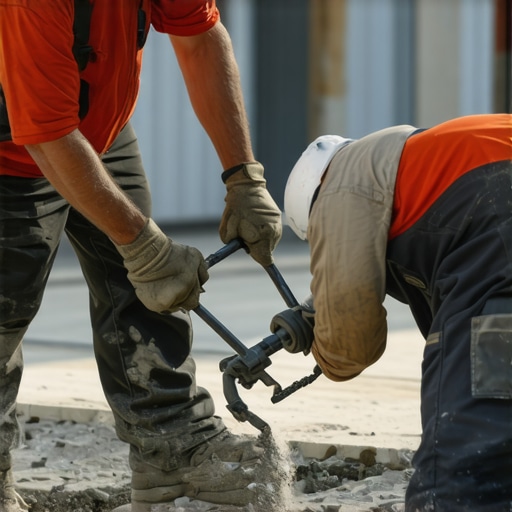
A manual joint raker, or ‘skate,’ operates on a completely different physical principle. By using a hardened steel pin or a specialized bit, the raker pulls the mortar out through sheer mechanical leverage and tension. This process respects the ‘suction’ of the brick. More importantly, the raker allows the mason to feel the resistance. If you hit a soft spot, you know the moisture is deep; if you hit a hard pocket of 1950s-era Portland cement ‘patching,’ you can adjust your pressure to avoid blowing out the face of the brick. This tactile feedback is non-existent with a grinder. Using a grinder on a brick arch restoration is like using a chainsaw for heart surgery—it’s the wrong scale of violence for the delicacy of the task.
The Chemical Trap: Portland Cement vs. Lime Putty
To understand why the tool matters, you have to understand the chemistry of the wall. Pre-1940s masonry was built using lime-based mortars. These materials are ‘breathable,’ meaning they allow water vapor to pass through the joints rather than being trapped inside the brick. The mortar is intentionally the sacrificial element of the wall. In historic masonry preservation, we adhere to the rule that the mortar must always be softer (have a lower compressive strength) than the masonry units themselves.
“Mortar should be selected based on the properties of the masonry units, ensuring the mortar is weaker than the unit to prevent stress-induced spalling.” – ASTM C270 Standard Specification
When a ‘handyman special’ crew comes in with angle grinders, they aren’t just damaging the brick edges; they are usually prepping the wall for the wrong material. Because grinders make it easy to cut through anything, they often encourage the use of high-strength Type S or Type M Portland cement. This is a death sentence for old clay. When the sun hits a south-facing wall, the bricks expand. If they are encased in a rigid, non-flexible cement cage created by a grinder and modern tile grouts on masonry, the bricks cannot expand. The pressure builds until the face of the brick literally explodes off the wall—a phenomenon known as spalling. A hand raker forces you to work at a pace where you can appreciate the existing mortar’s composition, ensuring you replace like-with-like, perhaps using a sustainable tuckpointing mortar that matches the original carbonation profile.
The Dust and the Disaster: Environmental Forensic Reality
We cannot discuss the grinder without discussing the cloud. The silica dust produced by grinding out mortar is a neurotoxin and a respiratory nightmare. Even with a vacuum shroud, the ‘fines’—the smallest particles—settle into the pores of the brick. This dust acts as a bond-breaker. If you don’t meticulously wash out every joint after grinding, your new tuckpointing will fail within five years because the ‘mud’ is sticking to dust, not brick. In contrast, a joint raker produces heavy debris that falls straight to the drop cloth. It doesn’t aerosolize the history of the building. This is particularly vital in masonry rescue after disaster, where the masonry may already be saturated or chemically compromised. You don’t want to drive dust further into a water-logged substrate.
Advanced Scenarios: From Chimneys to Retaining Walls
Consider the chimney sweep and repair sector. A chimney is the most exposed part of any structure, subject to extreme thermal shock and acidic flue gases. If you use a grinder on a chimney stack, the vibration can loosen the bond of the flue liners inside, creating a fire hazard you can’t even see. Using a hand tool ensures the structural stability of the stack remains intact while you work. The same logic applies to retaining wall batter correction. If a wall is leaning due to hydrostatic pressure, the last thing it needs is the vibratory trauma of power tools. You need the precision of a raker to clear joints without shifting the precarious balance of the stone or brick units.
For those dealing with modern catastrophes like stone veneer repair, where the ‘lick-and-stick’ stones are often fragile, a grinder will vibrated the entire stone off the lath. A hand-raking approach allows for surgical removal of the grout without compromising the tenuous adhesive bond of the neighboring stones. Even in mortarless masonry systems, where a joint might need cleaning of debris or moss, the controlled scrape of a manual tool is the only way to ensure you aren’t grinding away the interlocking lugs that keep the system together.
The Verdict of the Trowel
Is the joint raker slower? Yes. Is it harder on the forearms? Absolutely. But in the world of historic masonry preservation, speed is the enemy of longevity. When you use a raker, you are participating in a tradition of craftsmanship that views a building as a multi-generational asset, not a weekend project. You are ensuring that the brick arch restoration you perform today won’t need to be redone by someone else in ten years. You are preserving the ‘tooth,’ respecting the chemistry, and saving the arrises. Don’t let a $50 power tool ruin a $50,000 masonry facade. Put down the grinder, pick up the skate, and listen to what the bricks are telling you.