
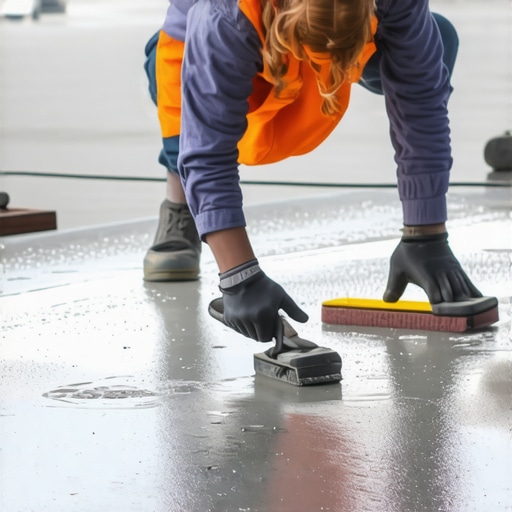
The Forensic Scene: Why Your High-End Finish Is Peeling
The homeowner called me out to a three-car garage that looked like a disaster zone. They had spent a fortune on a metallic epoxy finish that was supposed to look like molten lava. Instead, six months in, it was peeling off in sheets the size of dinner plates. When I got down on my hands and knees with a magnifying glass, the story was written in the dust. Below that shiny, expensive metallic coat was a layer of white, powdery laitance—a weak, milky layer of cement fines that had never been removed. The installer had treated the slab like a piece of furniture to be painted rather than a living, breathing mineral structure. As the vapor pressure built up from the soil beneath, it pushed against that non-breathable metallic skin. Since the bond was only as strong as that weak laitance, the whole system gave up the ghost. It’s the same story I see with a failing retaining wall repair; people look at the surface, but they ignore the physics of what’s happening underneath.
The Physics of the Slab: More Than Just Hard Rock
Concrete isn’t a solid, inert block. It’s a complex network of capillaries and interstitial voids. During the hydration process, as the water reacts with the Portland cement to create calcium silicate hydrate (C-S-H) crystals—the ‘glue’ of the concrete—excess water evaporates, leaving behind a microscopic highway of pores. If you’re in a region where the freeze-thaw damage restoration is a common part of your spring routine, you know exactly how much water these slabs can hold. When we talk about metallic finishes, we are talking about a non-permeable membrane. You are essentially capping a sponge. If that sponge is wet, or if it’s drawing moisture from the ground because of a missing vapor barrier, that finish will delaminate. This is why a retaining wall drainage upgrade is often the first step in a larger masonry project—if you don’t control the water, the water will control your results.
“Surface preparation is the process by which a sound, clean, and suitably roughened surface is produced on a concrete substrate… It is the most important factor in the long-term success of any coating or repair.” – ACI 546R-14 Concrete Repair Guide
The Mechanical Bond: Opening the Tooth
To get a metallic finish to stick, you need ‘tooth.’ In the trade, we talk about the Concrete Surface Profile (CSP). For most metallic epoxies, you’re looking for a CSP 2 or 3—something that feels like 60-grit sandpaper. You don’t get that with a mop and some soap. You get it with a diamond grinder. I’ve seen ‘handymen’ try to acid-etch a floor, thinking the chemical reaction will do the work. Acid etching is a gamble. It can leave behind salts that actually inhibit bonding, and it does nothing to remove honeycombing or deep contaminants like oil or old sealers. I use a walk-behind grinder with 30-grit diamonds to ‘open’ the slab. You can smell the silicate dust—that’s the smell of a surface that’s ready to receive mud. When you see the aggregate starting to peek through, you know you’ve stripped away the ‘butter’—that weak surface cream—and reached the structural integrity of the pour.
Moisture Vapor Transmission: The Silent Killer
Before any metallic pigment touches the floor, you have to test for MVT (Moisture Vapor Transmission). This is where the forensic side of masonry gets real. We aren’t just looking at the top; we’re looking at the geotechnical reality. If the concrete block foundation repair wasn’t done correctly or if there’s hydrostatic pressure building up against the exterior, that moisture will find a way out through the floor. We use calcium chloride tests or electronic moisture meters. If the slab is ‘breathing’ more than 3 pounds of moisture per 1,000 square feet over 24 hours, putting a metallic finish on it is professional malpractice. You might as well throw your money into a mixer. In these cases, we have to install a moisture vapor barrier—a specialized epoxy that can withstand that upward pressure without popping.
Beyond the Floor: Integrating Masonry Restoration
A high-end metallic finish often sits inside a structure that needs its own share of TLC. If you’re doing a luxury interior, you can’t ignore the brick wall restoration or the brick quoin repair on the exterior. I often see beautiful floors ruined because a crumbling mortar joint repair was ignored on the outside wall, allowing water to migrate through the envelope and under the slab. Re-pointing services and tuckpointing aren’t just aesthetic; they are the primary defense against water ingress. When we perform commercial tuckpointing, we ensure that the mortar is softer than the brick—a sacrificial joint. If you use a mortar that’s too hard (high Portland content) on old brick, the brick will spall during the freeze-thaw cycle because it can’t breathe. It’s the same principle as the floor: the materials have to talk to each other, or they’ll fight each other until something breaks.
“Water penetration is the single greatest threat to masonry durability.” – BIA Technical Note 7
The Ritual of the Pour and the Finish
Once the prep is done, the actual application of a metallic finish is a dance. You’re using a hawk and a slicker to move the material, but for a floor, it’s squeegees and rollers. You butter the floor with a prime coat first. This ‘soaks’ into those pores we opened with the grinder. If you skip the prime coat, the metallic coat will ‘outgas’—bubbles of air will rise out of the concrete and get trapped in the thick metallic resin, leaving tiny craters like the moon. Once the prime coat is tacky, you lay down the metallic base. The pigments are suspended in the resin, and as they settle, they create that 3D depth. We often use denatured alcohol or specialized solvents to ‘disrupt’ the surface, creating those swirling, galactic patterns. But remember: the beauty of the swirl is 100% dependent on the grit of the grind.
The Truth About Maintenance and Longevity
I tell my clients the same thing whether I’m doing a soldier course on a chimney or a metallic garage floor: you can do it once, or you can do it twice. Doing it once means spending 80% of your time on the prep and 20% on the ‘pretty’ stuff. If you see a contractor walk onto a job site with just a bucket and a roller, show them the door. A real mason knows that concrete block foundation repair and surface prep are about managing the invisible forces of physics—pressure, moisture, and thermal expansion. If you ignore the cold joints or the failing retaining wall repair outside, your indoor masterpiece is on a countdown to failure. Real craftsmanship isn’t just about what you see when the job is done; it’s about what you don’t see—the bond, the drainage, and the forensic integrity of the substrate.