
The Forensic Scene: When ‘Waterproofing’ Becomes a Death Sentence
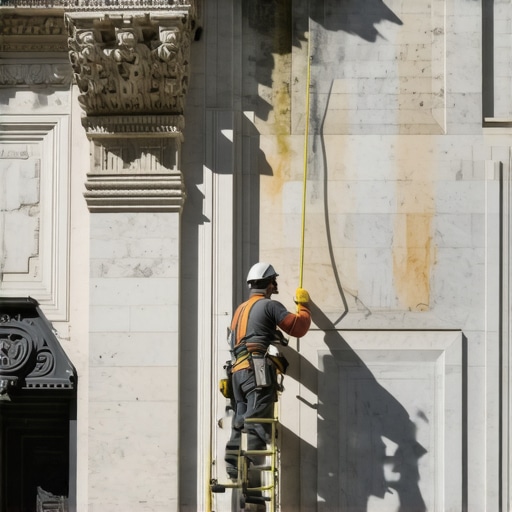
The building manager called me out because the 1920s limestone lintels on his Midtown property were ‘shedding’ like a snake. From the sidewalk, it looked like a standard case of scaling. But when I climbed the scaffolding and put my 4mm digital borescope into a weep hole, the reality was much grimmer. I saw the structural steel behind the facade was rusted to a state of red dust, a phenomenon known as ‘rust-jacking.’ The culprit wasn’t age; it was a ‘handyman special’ from five years prior. Someone had slathered the facade in a high-build, elastomeric acrylic paint—what they called a ‘waterproofer.’ They had essentially built a vertical aquarium. The limestone, a naturally breathable, sedimentary rock, was drowning in its own trapped moisture. This is why we don’t ‘paint’ stone. We use translucent mineral stains that bond at the molecular level, and we never start without a full forensic audit of the substrate.
“Water penetration is the single greatest threat to masonry durability, and the inability of a wall system to breathe is the primary cause of accelerated stone decay.” – BIA Technical Note 7
The Material Science: Why Limestone Isn’t Just ‘Hard Dirt’
Limestone is a porous network of calcium carbonate. Under a microscope, it looks like a labyrinth of interconnected voids. When we talk about masonry water damage repair, we are really talking about managing the vapor transmission rate. Weathered limestone loses its ‘quarry sap’ over decades, making it more thirsty and susceptible to the acidic bite of urban rain. If you apply a standard film-forming coating, you’re creating a surface tension nightmare. The sun hits the stone, the internal moisture turns to vapor, it hits the back of that film, and it exerts enough pressure to pop the face of the stone right off. We call this spalling, and it’s the hallmark of an amateur job. To fix this, we look toward historic mortar analysis and silicate-based stains. These aren’t ‘paints’; they are liquid stone. They use a potassium silicate binder that undergoes a chemical reaction called ‘silicification,’ essentially becoming part of the stone’s crystalline lattice.
The Critical Pre-Requisite: Tuck Pointing and Structural Integrity
Before a single drop of stain touches the facade, the ‘bones’ of the building must be right. This is where tuck pointing services become the primary line of defense. You can’t stain a building that has ‘honeycombing’ in its joints. I’ve seen contractors try to hide crumbling ‘mud’ with a thick layer of stain, but that’s like putting a tuxedo on a corpse. When we perform masonry repair services, we first identify the existing mortar’s compressive strength. In historic restoration, we strictly avoid modern Portland cement. It’s too hard. It’s a ‘cold joint’ waiting to happen. Instead, we use Type N or even Type O lime-based mortars that allow the wall to flex. For larger commercial projects, we utilize tuckpointing machine services to ensure the joints are ground out to a consistent depth of at least 3/4 of an inch—no ‘shaving’ allowed. This provides the necessary ‘tooth’ for the new mortar to bite into the stone.
The Forensic Inspection: From Drones to Borescopes
In the modern era, we don’t just guess. We use drone chimney inspections to get high-resolution eyes on the most vulnerable parts of the masonry—the ‘top-down’ saturation points. A chimney that lacks stone coping installation is a funnel for water. If the coping is cracked or improperly pitched, water migrates down through the core of the wall, manifesting as efflorescence on the interior limestone facades. We also look at the ‘hardscape’—the brick paver driveway repair needs near the foundation can often reveal soil heaving that is putting lateral pressure on the limestone plinth. If the base isn’t right, the facade will never stay stable.
“The mortar must always be weaker than the masonry units it binds, acting as a sacrificial element to preserve the stone.” – ASTM C270 Standards
The Art of the ‘Butter’ and the ‘Slicker’
Applying a translucent stain requires a master’s touch. You don’t ‘roll’ it on like you’re painting a bedroom. You ‘butter’ the stone. You have to understand the ‘suction’ of the material. If the stone is too dry, it will suck the moisture out of the stain too fast, causing it to ‘flash set’ and leave lap marks. We often mist the stone first—not to soak it, but to break the surface tension. We use a ‘hawk’ and a ‘slicker’ to manage the joints, ensuring that the concrete masonry unit restoration (if there’s a backup wall) is fully integrated. For an outdoor masonry fountain restoration, the stakes are even higher due to the constant hydrostatic pressure. In those cases, the stain must be incredibly breathable to allow the stone to dry out between cycles.
Micro-Zoom: The Chemistry of Silicification
When the potassium silicate stain is applied, it doesn’t just sit on the surface. It penetrates the pores and reacts with the carbon dioxide in the air and the calcium in the limestone. This creates a silica-gel that hardens into a mineral. It’s translucent because it doesn’t contain the heavy pigments and ‘fillers’ of opaque paints. This allows the natural ‘movement’ and variegation of the limestone to show through. It’s the difference between a cheap wig and a natural head of hair. It also provides UV resistance that no organic polymer can match. This is the only way to achieve masonry water damage repair that lasts fifty years instead of five.
Conclusion: The Master Mason’s Warning
Don’t fall for the ‘lick-and-stick’ solution. If a contractor walks onto your job site without a moisture meter and a plan for historic mortar analysis, send them packing. Weathered limestone is a legacy material. It’s a witness to the history of the building. Treating it with anything less than a chemically-bonded mineral stain is a betrayal of the craft. Whether you’re dealing with a simple stone coping installation or a full-scale facade restoration, remember: the physics of the wall always wins. You either work with the stone’s need to breathe, or you watch it crumble. Do it once, or do it twice. The choice—and the cost—is yours.