
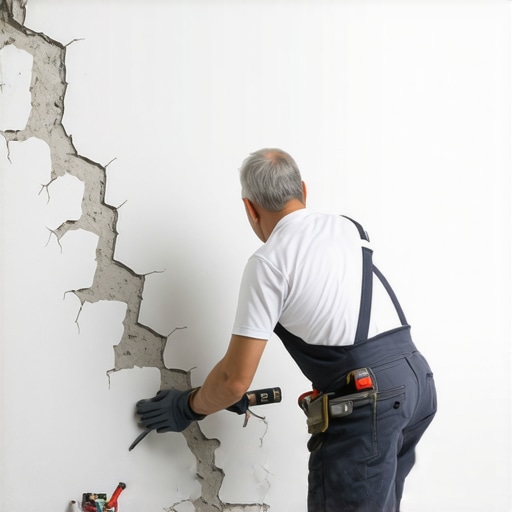
The Forensic Reality: More Than a Hairline Problem
The homeowner thought it was just a hairline crack. But when I put my scope inside the wall cavity of that 1928 Tudor, I saw the structural steel was rusted to dust. This is what we in the trade call ‘oxide jacking.’ When the internal structural brick ties replacement is neglected, moisture enters the air gap, oxidizes the metal, and that metal expands up to seven times its original thickness. That expansion exerts upwards of 10,000 psi against your masonry. It doesn’t matter how ‘solid’ you think your house is; that pressure will snap a header brick like a dry twig and send a stair-step fracture screaming up your gable. You see a cosmetic nuisance; I see a structural system in the middle of a slow-motion heart attack. Most handymen will tell you to just smear some grey goop in there and call it a day. Those are the guys I follow three years later when the wall starts to lean. To fix this right, you have to understand the physics of the ‘tooth,’ the chemistry of the mud, and why your house is trying to move in three directions at once.
“The most common cause of cracking in brick masonry is the movement of the building’s structural elements or the movement of the brick masonry itself due to moisture or temperature changes.” – BIA Technical Note 18A
The Physics of the Stair-Step: Why Your Mortar is Quitting
A stair-step crack isn’t an accident; it’s a map. It follows the path of least resistance, which in a masonry wall is always the mortar joint. If the crack goes straight through the brick, you have a massive structural settlement issue. But if it follows the bed and head joints, your mortar is failing its job as a sacrificial element. In the North, we deal with the freeze-thaw cycle. Water is a molecular wrecking ball. When it enters a porous joint and freezes, it expands by 9%. If you’ve allowed some ‘bucket-mechanic’ to use high-strength Type S Portland cement on a historic home, you’ve signed its death warrant. Historic mortar analysis shows us that old bricks are soft. They need to breathe. Modern Portland is harder than the brick itself. When the wall expands and contracts, the brick has nowhere to go, so it crushes itself against the hard cement. This is why mortar matching services are not about color; they are about ‘modulus of elasticity.’ We need the mud to be softer than the stone so the joint takes the stress, not the facade. This requires a deep understanding of lime-based binders and the carbonation process, where the mortar slowly absorbs CO2 over decades to regain its strength, a process much more complex than the quick hydration of modern concrete flatwork services.
The Geotechnical Nightmare: Hydrostatic Pressure and Soil Heave
In regions with heavy clay, your foundation is basically sitting on a giant, slow-moving sponge. When it rains, the clay minerals—specifically smectite—absorb water and swell, exerting massive lateral hydrostatic pressure against your basement or crawlspace walls. This pressure pushes the bottom of the wall inward while the top is pinned by the floor joists, creating that classic stair-step pattern. This is where we look at self-healing concrete foundations as a modern intervention, using crystalline additives that react with incoming moisture to plug micro-fissures before they become structural failures. However, if the displacement is already significant, you aren’t looking at a simple tuckpointing weatherproofing job; you’re looking at helical piers or structural reinforcement. You also have to look at the ‘soldier course’ above windows and doors. If your chimney flashing repair was botched, water is running down the interior wythe, rotting the lintels. A rusted lintel expands, lifts the bricks, and triggers the stair-step. I’ve seen ‘handyman specials’ where they just buttered over a rusted lintel. Within two winters, the expansion ‘popped’ the new mortar out like a bad tooth.
“The choice of mortar should be based on the properties of the masonry units and the exposure conditions.” – ASTM C270
The Restoration Protocol: Grinding, Matching, and Striking
When we talk about tuckpointing cost estimation, you aren’t paying for the mud; you’re paying for the ‘prep.’ A real mason uses a hawk and a slicker to pack the joint tight. But first, we have to grind out the old, failing material to a depth of at least twice the joint width. You can’t just ‘skin coat’ it. If you don’t have a clean ‘tooth’ for the new mortar to grab onto, it will delaminate within a year. We use historic mortar analysis to determine the exact sand-to-lime ratio. We look at the sand grains under magnification—are they rounded river sand or sharp pit sand? This affects the shear strength of the entire wall. Once the mud is mixed to a ‘stiff-plastic’ consistency, we ‘butter’ the joints. If the bricks are old and thirsty, we pre-wet them. If you put wet mud on a dry, historic brick, the brick will suck the water out of the mortar instantly, ‘burning’ the joint. The chemical hydration stops, and you’re left with a brittle, dusty mess that has no bond. After the mortar reaches ‘thumbprint hardness,’ we use a jointer tool to strike the joint, compressing the face to make it shedding for water. This is the difference between a wall that lasts fifty years and one that fails in five.
Weatherproofing and Long-Term Survival
Once the structural brick ties replacement is handled and the tuckpointing is finished, we have to talk about porous stone sealers. Most people want to ‘paint’ their brick. That is a sin. Brick must breathe. If you seal it with a non-breathable film, you trap vapor inside. When that vapor hits the cold outer face in winter, it turns to ice and ‘spalls’ the face of the brick off. You’ll end up with a pile of red dust on your sidewalk. We use silanes and siloxanes—penetrating sealers that change the surface tension of the pores so water beads off, but water vapor can still escape. We also look at the commercial smokestack repair techniques for residential chimneys. Chimneys are the most exposed part of your home, taking the brunt of the wind and rain. If your chimney flashing repair is leaking, it’s saturating the masonry from the inside out. No amount of tuckpointing will save a chimney that is being drowned from the top down. We ensure the ‘crown’ has a proper drip edge and that the flashing is stepped and counter-flashed correctly into the masonry joints, not just gooped with roofing tar.
The Final Assessment: When to Panic
So, when do you worry about a stair-step crack? If you can stick a nickel into the crack, it’s time to call a forensic mason. If the crack is wider at the top than the bottom, your foundation is ‘dropping.’ If it’s wider at the bottom, your foundation is ‘heaving.’ If you see ‘honeycombing’ in the concrete flatwork services nearby, or if there is a ‘cold joint’ where two pours didn’t bond, you have a water management problem. Don’t be fooled by ‘lick-and-stick’ contractors who offer a cheap price. Real masonry is a marriage of material science and manual labor. It’s about respecting the ‘suction’ of the brick and the ‘slump’ of the mud. Do it once, do it right, or be prepared to do it again when the wall starts to move. This isn’t just about aesthetics; it’s about the literal bones of your home. Keep the water out, match the modulus of the mortar, and your brickwork will outlast you and your grandkids. Fall for the handyman’s caulk tube, and you’ll be watching your equity crumble into the flowerbeds.