
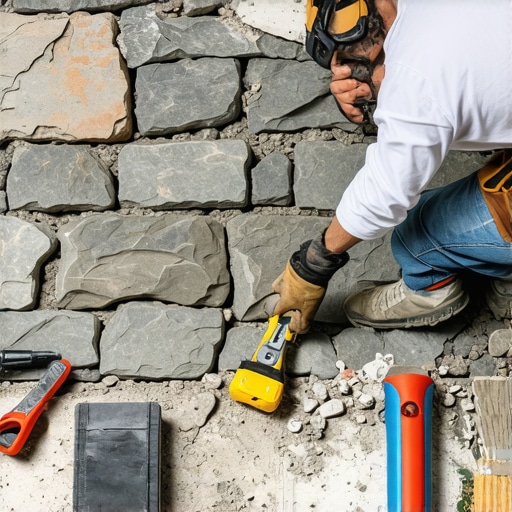
The Forensic Scene: When the Veneer Whispers a Warning
The homeowner stood on the porch, pointing at a hairline crack that traced the top edge of a stone wainscot. It looked like a minor cosmetic nuisance, the kind of thing a cheap handyman would fill with a tube of caulk and call it a day. But when I slid my borescope through a small gap in the mortar near the soldier course, the true horror was revealed. Behind the facade, the structural steel was rusted to a fine orange dust, and the OSB sheathing had the consistency of wet oatmeal. The entire stone veneer wasn’t just ‘pulling away’; it was a 4,000-pound sheet of masonry waiting for the right vibration to detach and collapse. This wasn’t a repair job; it was a masonry rescue after disaster. What we are seeing across modern suburbs is an epidemic of ‘lick-and-stick’ stone failures caused by a fundamental misunderstanding of hydrology and the physics of the bond. Whether you are dealing with a residential entryway or large-scale commercial masonry facade maintenance, the principles of gravity and water never change. If you don’t respect the suction, the stone will eventually seek the ground.
“Water penetration is the primary cause of masonry distress, leading to efflorescence, spalling, and the eventual failure of the bond between the unit and the substrate.” – BIA Technical Note 28B
The Physics of the Slide: Shear Stress and Hydrostatic Pressure
In the cold North, where the freeze-thaw cycle rules with an iron fist, the physics of stone veneer is a battle of expansion. When water gets behind a stone that has been improperly buttered, it occupies the voids. As that water freezes, it expands by 9% in volume. This exerts an outward force—hydrostatic pressure—that pushes against the back of the stone. Over a single winter, that stone might move a fraction of a millimeter. Over five winters, the bond is snapped. This is why sustainable masonry materials are becoming more popular; they often have better thermal compatibility with modern mortars. The failure usually starts at the top. Without a proper chimney crown repair or adequate flashing at the roofline, water cascades behind the lath. Once the wire lath begins to oxidize, it loses its ‘tooth.’ The scratch coat, which should be a rugged, textured surface that the mortar can grab onto, becomes a smooth, failing plane of brittle concrete. This is where the ‘slide’ begins.
The Chemistry of the Bond: Why Your Mud Is Failing
Modern masonry often fails because the ‘mud’—the mortar—is mixed too lean or applied to a dry substrate. I’ve seen it a thousand times: a contractor ‘butters’ the back of a manufactured stone and slaps it onto a dry scratch coat. The dry scratch coat immediately sucks the moisture out of the fresh mortar. This is known as ‘flash setting.’ Instead of a chemical hydration process where the cement crystals grow into the pores of the stone, you get a cold joint. It looks stuck, but there is no structural integrity. For high-quality mortar matching services, we look for the right balance of portland cement, lime, and sand. Lime is the secret weapon; it gives the mortar ‘autogenous healing’ properties and improves the suction bond. If you’re working on a stone balustrade restoration or a vertical facade, you need that ‘hawk’ and ‘trowel’ to work in harmony, ensuring the mortar is ‘slick’ enough to flow but ‘stiff’ enough to hold. Without proper ‘buttering’—the act of covering the entire back of the stone with a consistent layer of mud—you create honeycombing, which are air pockets where water will inevitably sit and rot your structure.
“Installation of lath and its attachments must be capable of resisting the weight of the masonry veneer and the environmental loads imposed upon it.” – ASTM C1063
The Restoration Process: A Step-by-Step Fix
Fixing a sliding veneer isn’t about more glue; it’s about rebuilding the system. First, we must address the drainage. A proper weep screed at the base of the wall is non-negotiable. It allows the moisture that inevitably gets behind the stone to escape. If the stone is already pulling away, the only permanent fix is to strip it back to the sheathing. We replace the rotted substrate with a high-grade moisture barrier, then apply a heavy-gauge galvanized lath. When we apply the scratch coat, we ‘scarify’ it—creating deep horizontal grooves that provide the mechanical bond for the stone. This is much like how we approach failing retaining wall repair: you don’t just fix the surface; you manage the water behind it. During the re-installation, we use mortar matching services to ensure the new joints look identical to the original work. We avoid using tile grouts on masonry, as they lack the breathability and compressive strength needed for exterior stone. Once the stones are set, we use a slicker to tool the joints, compacting the mortar to keep the water out. For larger projects, we are seeing the rise of robotic masonry repair to ensure precision in mortar application, but even a robot can’t replace the ‘feel’ of a master mason checking the suction of a brick.
The Long-Term Care: Maintenance and Facade Cleaning
Once the ‘slide’ is stopped, the job isn’t over. Commercial masonry facade maintenance requires annual inspections. Look for ‘efflorescence’—that white, powdery salt that indicates water is moving through the wall. If you see it, you have a leak. Regular facade cleaning with low-pressure water and mild detergents can prevent the buildup of biological growth that traps moisture against the stone. Don’t let a small crack in the chimney crown turn into a full-scale rebuild; timely chimney crown repair is the cheapest insurance policy you can buy for your stone veneer. Remember, masonry is meant to last centuries, but only if it can breathe. When you treat stone like a sticker, it will fall off like one. When you treat it like a structural system, it will stand for generations. Do it once, do it right, and keep your mud wet and your lath tight.