The Crack Whisperer: Reading the Silent Language of Foundation Failure
I’ve spent forty years listening to concrete talk, and usually, it’s screaming. Most folks see a foundation as a static, dead slab of rock. They’re wrong. Concrete is a living, breathing respiratory system that never truly stops changing. I remember a forensic scene on a hillside estate outside of Seattle—a place where the rain doesn’t just fall; it colonizes. The homeowner called me because of a ‘hairline’ blemish in the mechanical room. But when I slid my high-definition bore scope into that fissure, I didn’t see just a crack. I saw a subterranean river. The structural steel was bleeding rust, expanding with enough force to blow the face off the footer from the inside out. It was a classic case of hydrostatic pressure meeting poor compaction, but it was also a turning point in how I viewed the future of my trade. If that concrete could have healed itself, that $200,000 repair bill would have been a twenty-cent chemical reaction.
“Cracking in concrete is a natural phenomenon, but its control is essential for the durability of the structure. Self-healing mechanisms represent a paradigm shift in lifecycle management.” – ASTM International, Subcommittee on Durability of Concrete
The Physics of the Failure: Why Foundations Give Up
To understand why we need self-healing concrete foundations, you have to understand the ‘honeycombing’ effect and the sheer arrogance of modern pours. When a crew is in a hurry, they don’t vibrate the mud properly. You get air pockets. You get cold joints where one truck sat too long in traffic and the first layer started to set before the second arrived. In the freeze-thaw cycles of the north, water finds these microscopic voids. Water is the only substance that expands by 9% when it freezes, and that expansion is a slow-motion explosion inside your walls. This leads to brick spalling prevention issues higher up the facade, as the shifting foundation puts stresses on the masonry that the mortar was never meant to handle. If you’ve got a hard, high-Portland mortar, it won’t give. The brick face just pops off like a scab.
The Biological Revolution: How the Bacteria Wake Up
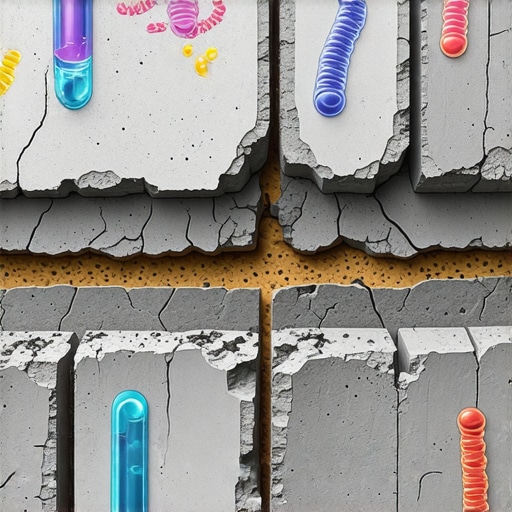
We are now testing the limits of what I call ‘Lazarus Concrete.’ This involves embedding Bacillus pseudofirmus—a hardy bacterium—into the mix, usually encapsulated in tiny clay pellets with a side of calcium lactate. These spores stay dormant for decades, sleeping inside the dry concrete. But the moment a crack forms and moisture seeps in, the ‘mud’ wakes up. The water dissolves the capsule, the bacteria eat the calcium lactate, and through a beautiful bit of chemistry, they excrete limestone. It’s called microbiologically induced calcite precipitation (MICP). They literally knit the crack shut from the inside. This is the pinnacle of sustainable masonry materials because it extends the life of a foundation by fifty to a hundred years, reducing the carbon footprint of future demolition and reconstruction.
“Water penetration is the single greatest threat to masonry durability, acting as a vehicle for almost all forms of physical and chemical degradation.” – BIA Technical Note 7
The Forensic Diagnosis: Stair-Step vs. Horizontal Threats
When I walk into a basement, I’m looking for the ‘Stair-Step.’ If I see cracks following the mortar joints in a jagged pattern, the house is settling. It’s heavy, and the soil beneath—likely uncompacted fill—is giving way. However, a horizontal crack midway up the wall is a different beast entirely. That’s lateral pressure. That’s the earth outside trying to push the wall into the room. Traditional foundation waterproofing involves digging out the exterior and applying a membrane, but that’s a ‘Band-Aid.’ The ‘Cure’ involves structural stabilization like helical piers. But imagine a world where modular masonry construction utilizes self-healing blocks that seal those lateral micro-fissures before they become structural failures. We aren’t just talking about keeping the basement dry; we’re talking about maintaining the ‘tooth’ of the structure—the mechanical bond between the material and the earth.
Preservation and Maintenance: Beyond the Foundation
Even with a self-healing foundation, the rest of the envelope needs respect. You can’t ignore stone coping installation or the quality of your mortar matching services. I’ve seen guys use a slicker to finish a joint on a 100-year-old building using modern Type S mortar. It’s a crime. The mortar should always be the sacrificial lamb—softer than the brick so it takes the stress. That’s why historic brickwork repointing requires a master who understands lime-to-sand ratios. And if you’ve got white, crusty salt bleeding out of your walls, you need brick efflorescence removal that doesn’t involve high-pressure washing, which just drives the water deeper. Proper facade cleaning is a surgical procedure, not a power-wash job. You have to respect the capillary action of the material. If you treat your masonry like a living organism, it will protect you. If you treat it like a cheap commodity, it will crumble under the first hard frost. This new bio-concrete is just the latest tool in a 3,000-year-old game of outsmarting the elements.