
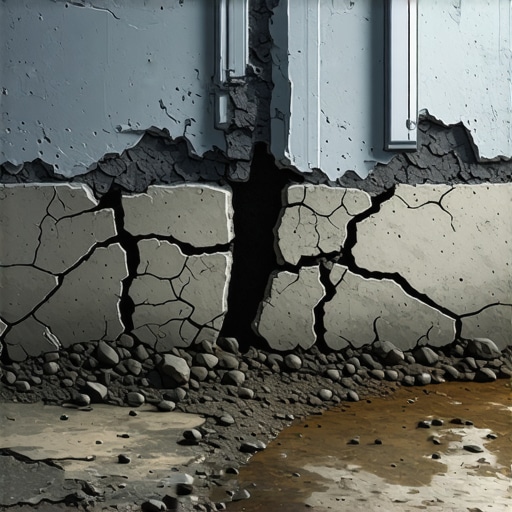
The Forensic Scene: A Slow-Motion Structural Collapse
The homeowner pointed to a jagged hairline crack running through the mortar joints in her basement corner. “Just a settlement crack,” she told me, hoping for a cheap fix. I pulled out my fiber-optic scope and threaded it into a weep hole of the exterior brick veneer installation. What I saw wasn’t settlement; it was a slow-motion car crash of oxidized steel and saturated clay. The structural steel lintel was bloated with rust—expanded to nearly three times its original thickness—literally lifting the house from its seat. This wasn’t a job for a caulk gun; it was a full-scale brick lintel replacement. A sump pump is a mechanical prayer. It waits for the water to already be inside your home before it starts working. It does nothing to stop the hydrostatic pressure that is currently crushing your foundation walls like an empty soda can. If you think your basement is dry because the pump is clicking, you’re ignoring the fundamental physics of soil saturation and masonry porosity.
“Water penetration is the single greatest threat to masonry durability.” – BIA Technical Note 7
The Physics of Hydrostatic Pressure and Soil Heaving
To understand why your foundation is failing, you have to understand the ‘mud.’ When we talk about soil, we aren’t just talking about dirt; we are talking about a hydraulic jack. In regions with heavy clay, the soil behaves like a sponge. As it absorbs water, it expands. This creates hydrostatic pressure—thousands of pounds of force pushing against your basement walls. Your sump pump handles the water that makes it under the footing, but it does nothing for the water pressing against the sides. This pressure leads to horizontal cracking, often found in the middle third of the wall height where the stress is greatest. This is where self-leveling masonry lifts and helical piers come into play, but those are surgical interventions for a disease that should have been prevented with proper drainage and brickwork sealants application.
The 9% Rule: Freeze-Thaw Damage Restoration
In the North, we deal with the most violent force in masonry: the freeze-thaw cycle. When water enters a porous brick or a hairline crack in a chimney crown, it waits. When the temperature drops, that water expands by exactly 9%. That expansion is enough to shatter granite. If your chimney crown repair was done with cheap mortar instead of a dedicated cast-in-place concrete cap with a drip edge, that water is migrating down the internal flues, blowing out the faces of your bricks. This is called spalling. I’ve seen historic brick salvage projects where 100-year-old bricks were turned to dust because a modern contractor used high-strength Portland cement for flush pointing services. The cement was too hard, trapped the moisture, and the brick became the sacrificial lamb during the first frost. We use Type N or even Type O lime-based mortars for a reason—the ‘mud’ must be softer than the stone it holds.
“The mortar shall be the sacrificial element of the masonry assembly, being weaker and more permeable than the masonry units.” – ASTM C270 Standards
The Anatomy of a Failing Lintel and Veneer
When I’m ‘buttering’ a brick for a brick veneer installation, I’m thinking about the air gap. Modern masonry is a rain-screen system. Water is expected to get behind the brick. The failure occurs when the weep holes are clogged or the flashing is non-existent. Without a path to exit, the water sits on the steel lintels. Rust is an expansive force. As the steel lintel over your window or door oxidizes, it undergoes ‘rust jacking.’ It lifts the bricks above it, creating stair-step cracks. At this point, no amount of masonry water damage repair will save the facade; you have to cut out the soldier course, support the load, and perform a total lintel swap. This is the gritty reality of forensic masonry—fixing the sins of the ‘handyman special’ who forgot that steel and water are mortal enemies.
Restoring the Hearth: Outdoor Fireplace Rebuilds
Even your outdoor fireplace rebuild is subject to these laws. I recently looked at a fireplace where the hearth was sinking into the patio. The contractor hadn’t accounted for the ‘tooth’ of the soil or the compaction physics. They poured a thin slab without a proper frost footer. Now, every time the ground heaves, the masonry separates. We have to use a slicker to clean out those deep joints and repoint with a high-lime content mix that can handle the thermal shock of a roaring fire followed by a freezing night. It’s about material science, not just slapping mud on a hawk and hoping for the best.
When to Panic: The Crack Whisperer’s Guide
If you see a horizontal crack, panic. That is the wall bowing under pressure. If you see a stair-step crack in the mortar, breathe—it might just be settlement, provided the ‘ring’ of the brick still sounds true. If you see ‘honeycombing’ in your concrete foundation, your waterproofing failed before the first floor was even framed. You don’t need a bigger pump; you need a better envelope. This means brickwork sealants application that actually breathes and flush pointing services that respect the original masonry’s compressive strength. Do it once, or do it twice. The choice is usually written in the cracks of your foundation.