
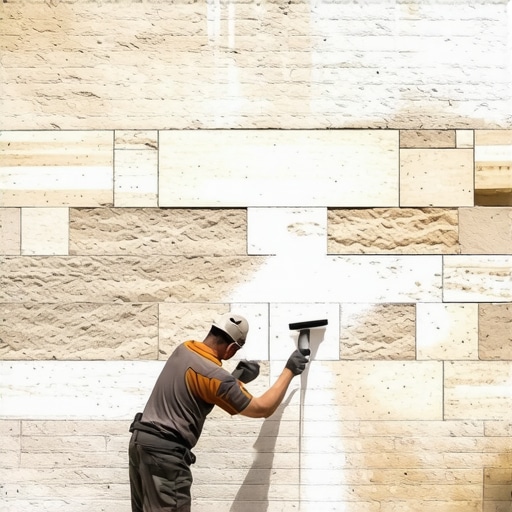
The Tragedy of the Suffocating Stone
I remember walking onto a site in the historic district where a homeowner had just spent a fortune on a limestone facade restoration. To ‘protect’ it, they hired a local handyman who rolled on a thick, glossy acrylic sealer he found at a big-box store. Within two winters, the face of that beautiful Indiana limestone was popping off in sheets. It looked like the stone was molting. My mentor, a man who could tell the density of a block just by the way his chisel bounced off it, used to say, ‘A stone needs to breathe just like you do. Wrap it in plastic, and it’ll drown in its own sweat.’ That is the fundamental physics of masonry damage assessment. When you seal a porous material like limestone with a film-forming product, you trap internal moisture. When the temperature drops, that water freezes, expands by 9%, and shatters the stone’s surface. To protect limestone without changing its look, you have to move away from ‘coatings’ and into the world of molecular impregnators.
“Water penetration is the single greatest threat to masonry durability.” – BIA Technical Note 7
The Micro-Physics of Porosity and Capillary Suction
Limestone is a sedimentary rock, a compressed graveyard of marine skeletal fragments. On a microscopic level, it is a labyrinth of interconnected pores. This is why brick efflorescence removal is so common in limestone-heavy structures; the stone literally sucks salts and minerals out of the mud (mortar) and the soil, depositing them on the surface as unsightly white powder. If you want to stop this without turning your wall into a shiny plastic mess, you need a penetrating sealer—specifically a Silane or Siloxane blend. These are not ‘paints.’ They are reactive treatments. Silane molecules are incredibly small, allowing them to penetrate deep into the substrate’s capillaries. Once inside, they chemically bond with the silica in the stone, creating a hydrophobic barrier that changes the surface tension of the pores. Water can no longer ‘wet’ the stone; it beads up and rolls off, yet the vapor transmission rate remains almost 100%. The stone can still ‘exhale’ water vapor, preventing the dreaded spalling seen in brick veneer detachment repair.
The Restoration Reality: Preparation is 90% of the Battle
You cannot seal a dirty wall. If you apply a high-grade impregnator over dirt, biological growth, or existing salts, you are just locking the rot inside. A proper masonry cleaning protocol is mandatory. This isn’t just a quick blast with a pressure washer—in fact, high pressure is the enemy of limestone. It opens up the pores too much and can cause ‘honeycombing’ of the surface. We use low-pressure chemical cleaning to neutralize pH levels and remove years of atmospheric pollutants. This is also the time to address the ‘bones’ of the wall. If your mortar joints are crumbling, you need mortar repointing services before the sealer goes on. In historic restoration, we never use modern Portland cement. It’s too hard. We use a soft lime mortar, often Type O or K, because the mortar must be the ‘sacrificial lamb’ of the wall. It needs to be softer and more permeable than the limestone itself so that any structural stress or moisture finds its way out through the joints, not the stone.
“The masonry unit should always be stronger and less permeable than the mortar used to bed it.” – ASTM C270 Standards
Beyond the Facade: Foundations and Patios
Often, a ‘wet’ limestone wall is a symptom of a deeper geotechnical failure. If you see horizontal cracks or a ‘wavy’ appearance in your stone work, sealing is a Band-Aid. You might be looking at a need for foundation helical pier installation if the soil is heaving, or comprehensive foundation waterproofing if hydrostatic pressure is pushing water through the stone from the inside out. Similarly, when we handle a brick patio restoration or patio stone realignment, we aren’t just looking at the surface. We are looking at the ‘tooth’ of the base. If the compaction physics are off, the stone will shift regardless of the sealer. A porous limestone patio requires a breathable sealer that won’t create a slip hazard when wet—another reason why film-formers are a disaster in the trade. For vertical walls, we ‘butter’ our repairs with precision, ensuring the slicker tool creates a concave joint that sheds water efficiently. This attention to detail, from the soldier course at the top to the drainage at the base, separates a master mason from a ‘lick-and-stick’ amateur.
The Application: Striking the Balance
When applying an invisible sealer, the ‘wet-on-wet’ method is the industry standard. You apply the first coat of siloxane with a low-pressure sprayer, starting from the bottom and working up, allowing a 6-inch ‘rundown.’ Before that first coat dries, you hit it again. This ensures maximum saturation of the stone’s capillaries. Because there is no acrylic resin, there is no ‘buildup’ on the surface, meaning the natural ‘tooth’ and color of the stone remain unchanged. It won’t look like a wet glazed donut; it will look like the day it was quarried. This is the only way to preserve value in high-end brick wall restoration and historic stone projects. Doing it once with the right chemistry is always cheaper than doing it twice after a cheap sealer fails. In this trade, we don’t ‘elevate’ or ‘unlock’ anything; we simply respect the physics of the material and the legacy of the craft.