
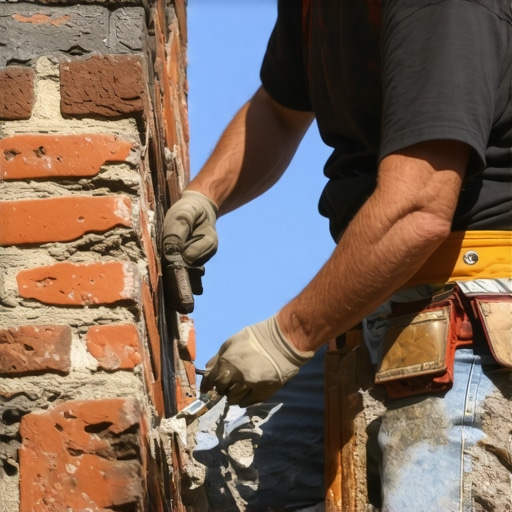
The Forensic Scene: When the ‘Minor Leak’ is a Structural Crisis
I recall a job last February on a hundred-year-old Victorian. The homeowner complained about a small damp spot on the ceiling near the fireplace. They thought a quick smear of caulk would fix it. I didn’t even pull my ladder out yet; I launched a 4K drone for a drone chimney inspection. What the screen showed was a nightmare. The entire chimney crown had spider-webbed, and the mortar joints had turned into a powdery silt. The masonry wasn’t just leaking; it was undergoing a slow-motion collapse. When I finally got up there and poked a joint with my slicker, the mud didn’t just crumble—it fell out in chunks, revealing that the internal structural integrity was basically nonexistent. This wasn’t a ‘handyman special’ fix; this was a forensic restoration case.
The Physics of the Freeze-Thaw Cycle
In the trade, we talk about the ‘tooth’ of the masonry, but the real enemy in northern climates is the 9% expansion. When water finds a micro-fissure in your chimney crown repair area or within the mortar bed, it sits. When the temperature drops, that water expands by nearly a tenth of its volume. This creates internal hydraulic pressure that the brick cannot withstand. Over time, this leads to spalling—where the face of the brick literally pops off like a scab. If you’ve used a high-strength Portland cement on old, soft clay bricks, you’ve signed their death warrant. The mortar must be the sacrificial lamb. It needs to be softer than the brick so that the moisture can escape through the joint, not the masonry unit itself.
“Water penetration is the single greatest threat to masonry durability. Proper drainage and moisture management are essential for long-term performance.” – BIA Technical Note 7
Tuckpointing vs. Repointing: Know the Difference
People use these terms interchangeably, but they aren’t the same thing. Mortar repointing services involve the physical removal of damaged mortar and the replacement with fresh, compatible mud. Professional tuckpointing services go a step further for aesthetics—we use two different colors of mortar to create a crisp, thin-looking joint that mimics the appearance of high-end, precision-laid masonry. It’s about more than just looks; it’s about creating a weather-tight seal that manages the thermal expansion of the stack. When we butter the joints, we aren’t just slapping material in. We are ensuring a mechanical bond that survives the 100-degree swings between a July sun and a January blizzard.
The Material Science of Modern Masonry
In commercial tuckpointing, we’ve moved toward fiber-reinforced mortars. These aren’t your grandfather’s mixes. The micro-synthetic fibers act as a secondary reinforcement, bridging micro-cracks before they become structural failures. We also see a rise in modular masonry construction and mortarless masonry systems in new builds, but for those of us in the restoration trenches, the challenge remains the same: compatibility. You cannot slap stone veneer over brick without addressing the vapor drive. If you trap moisture between a non-breathable stone veneer and a structural brick wall, you are creating an incubator for rot and foundation crack repair issues down the line.
“The choice of mortar should be based on the strength and porosity of the masonry units to be joined. Using a mortar that is too hard can cause irreversible damage to historic brickwork.” – ASTM C270 Standards
The Anatomy of a Failing Retaining Wall
We see the same physics at play in failing retaining wall repair. Hydrostatic pressure is a silent killer. If your wall doesn’t have weep holes or a proper gravel backfill, the weight of the water-saturated soil will eventually bow the masonry. I’ve seen 12-inch thick blocks snapped like toothpicks because the installer forgot that water needs a place to go. Whether it is a foundation crack repair or a garden wall, the goal is always the same: control the water, or the water will control you.
The Process: Striking the Joint Like a Master
When I’m on the hawk, mixing up a batch of Type N or Type O mortar, I’m looking for that perfect consistency—like thick peanut butter. We grind out the old joints to a depth of at least twice the width of the joint to ensure the new mud has enough ‘grab.’ We don’t just fill it; we pack it in layers. This prevents honeycombing—those nasty air pockets that trap moisture. We then use a slicker to strike the joint, compressing the mortar to create a dense, water-shedding surface. This isn’t just about ‘finishing’ a wall; it’s about the chemistry of carbonation. Over the next several weeks, the lime in the mortar will absorb CO2 from the air, slowly turning back into limestone and locking the bricks together for another fifty years.
The Scam of the ‘Quick Fix’
Beware the contractor who wants to spray a clear sealant over your crumbling chimney and call it a day. Those sealants often trap moisture inside the brick, accelerating the very decay they claim to prevent. Real mortar repointing services require sweat, dust, and a deep understanding of structural loads. If your chimney has a soldier course that is leaning, or if you see cold joints where a previous repair has separated, you need a forensic approach, not a cosmetic one. From commercial tuckpointing on high-rise stacks to a simple residential chimney crown repair, the physics don’t change. You respect the materials, or you pay the price in rubble.