
The Ghost in the Staircase
In this trade, we don’t just see cracks; we see the history of a structure’s struggle against the elements. I remember my first mentor, a man who had spent forty years buttering joints in the biting winds of the Great Lakes. He used to carry a small spray bottle of water. He wouldn’t look at the crack first; he’d spray the surface around it. If the water vanished instantly into the ‘thirsty’ pores of the concrete, he knew the internal matrix was shot. ‘It’s a sponge, kid,’ he’d say. ‘You can’t build a house on a sponge, and you sure as hell can’t patch one without quenching its thirst first.’ That lesson on ‘suction’ and the ‘tooth’ of the masonry has saved more steps from the landfill than any fancy epoxy injection ever could. Most homeowners see a hairline fracture on their front porch and think it’s a cosmetic blemish. To a forensic mason, that crack is the exhaust pipe for a much larger engine of destruction. We are talking about the relentless physics of the freeze-thaw cycle, a process that turns a minor oversight into a structural liability when the mercury drops.
The Molecular War: Why Concrete Fails in Winter
In the North, we live and die by the 9% expansion of water. When liquid water infiltrates the capillary pores of your concrete steps, it sits there, dormant, until the temperature hits 32 degrees Fahrenheit. At that moment, it undergoes a phase change, expanding its volume by nearly a tenth. This creates internal hydraulic pressure that exceeds the tensile strength of the concrete. It’s like a million tiny jackhammers working from the inside out. This is where the ‘spalling’ or ‘scaling’ comes from—the face of the step simply pops off because it has nowhere else to go.
“Concrete that is not air-entrained is not durable in freezing and thawing environments.” – ASTM C94 Standard Specification
Modern concrete relies on air-entrainment—billions of microscopic bubbles that act as ‘pressure relief valves’ for freezing water. If your steps were poured with a cheap mix or over-finished (which kills the air-void system at the surface), they are essentially a ticking time bomb. The addition of road salt only accelerates the gore. Salt is hygroscopic; it attracts more water into the concrete, increasing the saturation level and the resulting pressure during the next freeze.
The Forensic Audit: Identifying the Root Cause
Before you grab a bag of ‘patch-all’ from the big-box store, you need to understand why the step moved in the first place. Is it a surface scaling issue, or is it a structural settlement? If you see a ‘stair-step’ crack migrating toward the house, you aren’t just looking at a step repair; you are looking at a concrete block foundation repair scenario. When the soil beneath the steps heaves due to frost or settles due to poor compaction, the masonry will snap. This is where foundation slab jacking becomes the only permanent solution. Injecting high-density polyurethane or cementitious slurry beneath the slab can level the structure, closing the gap before the patch is even applied. Without addressing the ‘base,’ any patch you apply will simply be ‘sacrificial’—it’ll pop out within two seasons because the underlying movement hasn’t been stopped. For those dealing with larger structural failures, a retaining wall drainage upgrade is often necessary to divert the hydrostatic pressure that is pushing against the foundation and the steps simultaneously.
Preparation: Creating the ‘Mechanical Tooth’
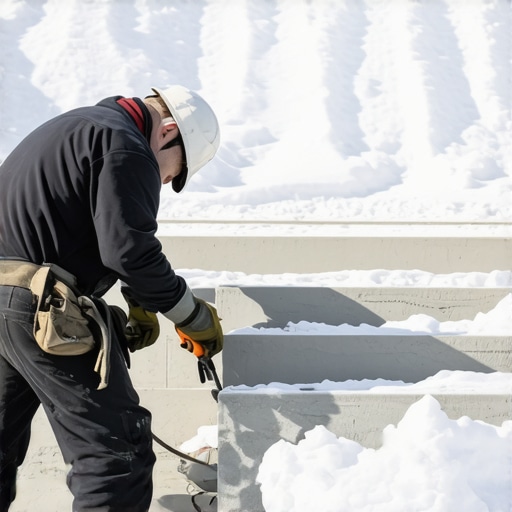
The most common mistake ‘handymen’ make is ‘buttering’ fresh mud over a dirty, smooth surface. Concrete doesn’t ‘stick’ to concrete through magic; it sticks through a mechanical bond and chemical hydration. You need to create a ‘tooth.’ I use a hammer and chisel—or a small pneumatic scaler—to remove every last bit of ‘punky’ or ‘honeycombing’ material. If it sounds hollow when you tap it with a hammer, it has to go. You want to reach ‘sound’ concrete where the aggregate is still firmly locked in the cement paste. Once the loose material is gone, you must clean the area. I’m not talking about a light dusting. You need to remove all carbonation and oils. Then comes the critical step: the Saturated Surface Dry (SSD) condition. You soak the repair area with water until it stops ‘drinking,’ then wipe away the standing puddles. This prevents the old concrete from sucking the moisture out of your new patch, which would ‘burn’ the cement and leave you with a brittle, dusty mess.
The Chemistry of the Patch: Mud and Bonding Agents
We don’t use standard mortar for step nosing. You need a high-strength, polymer-modified repair mortar. The polymer acts like a microscopic glue, increasing the bond strength and providing a degree of flexibility that standard Portland cement lacks. In some high-end forensic restorations, we are even seeing the advent of self-healing concrete foundations and repair materials that use embedded bacteria or micro-capsules to seal future cracks. For the average repair, however, the focus is on the C-S-H (Calcium Silicate Hydrate) gel. This is the ‘glue’ that forms when water meets cement. To enhance this, we often use a bonding slurry—a mix of pure cement and a liquid bonding agent—scrubbed into the ‘tooth’ of the old concrete with a stiff brush right before we apply the patch. This ensures that the interface between the old and new is the strongest part of the step, not the weakest.
Modern Innovations in Masonry Maintenance
The industry isn’t just about trowels and hawks anymore. We are seeing a massive shift toward robotic masonry repair for large-scale infrastructure, where drones and robotic arms can precisely grind out failed joints and 3D print new sections of concrete. In fact, 3D printed masonry repairs are becoming a reality for restoring intricate Victorian-era decorative nosing that would be too expensive to hand-carve today. Even the finishes are evolving. Gone are the days of boring grey slabs. We now have metallic masonry finishes that can be integrated into the top layer to provide a slip-resistant, ultra-durable, and aesthetically striking surface. For those who prefer a traditional look, using high-performance tile grouts on masonry steps can provide a waterproof barrier that prevents the very water infiltration we’ve been discussing.
“The durability of a repair is more dependent on the preparation of the substrate than on the material used for the repair itself.” – ICRI Guideline No. 310.2R
The Execution: Slickers, Hawks, and Soldier Courses
When you start to ‘throw the mud,’ timing is everything. You load your hawk, ‘butter’ the back of the repair area, and then build the patch in layers. If the repair is deep, don’t try to do it all at once or you’ll face ‘slumping.’ For the edges, use a corner tool or a ‘slicker’ to get that sharp, professional nosing. If you’re working on the risers, you might consider full repointing services if the mortar joints between the bricks or blocks are failing. Use a ‘jointing tool’ to compress the mortar; this ‘compacts’ the surface and makes it more water-resistant. For the most sustainable approach, especially when replacing entire sections, look into sustainable block cutting techniques that minimize waste and utilize recycled aggregates. This isn’t just about ethics; it’s about the density and thermal properties of the material.
The Hardscape Truth: Do It Once or Do It Twice
I’ve seen too many ‘tailgate contractors’ come through a neighborhood, slap some ‘lick-and-stick’ mortar over a structural crack, and disappear before the first frost. That is a scam, plain and simple. Real masonry is forensic work. It’s about understanding soil chemistry, the physics of water expansion, and the long-term hydration of cement. If your steps are sinking, you don’t need a patch; you need a lift. If your steps are scaling, you don’t need a coating; you need to remove the ‘dead’ concrete and rebuild the surface with the right ‘tooth.’ Don’t let a ‘handyman special’ turn your home’s entrance into a hazard. Invest in the chemistry, respect the physics, and your masonry will outlive you. If you skip the prep, the winter will find your weakness and exploit it with 9% more force than you ever anticipated.