
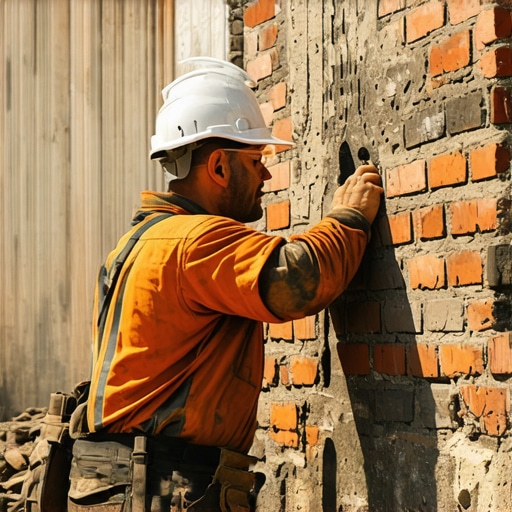
The Ruined Facade: A Master’s Lament
I recently walked past a 1920s Tudor revival that made my stomach turn. A crew was out there with high-speed grinders, kicking up clouds of dust and eating into the soft edges of the original clay units. They were ‘buttering’ the joints with a hard, gray Type S mortar—a high-strength Portland cement mix that has no business being within ten miles of a historic building. That homeowner is paying thousands for a slow-motion demolition. In five years, the faces of those bricks will start popping off like scabs. This isn’t just a bad aesthetic choice; it’s a failure to understand the physics of the wall.
“Water penetration is the single greatest threat to masonry durability. Proper selection of mortar and joint profile is the first line of defense.” – BIA Technical Note 7
The Forensic Scene: Beneath the Hairline Crack
The homeowner thought it was just a hairline crack near the second-story lintel. They called me in for a second opinion after a handyman suggested just smearing some caulk over it. But when I put my borescope inside that crack, I saw the true horror: the structural steel angle was rusted to dust. The ‘weather’ didn’t just happen outside; it had moved inside the wall. Over decades, the lack of a proper drip edge and the use of impermeable mortar had trapped moisture against the steel. The oxidation expanded the metal, a phenomenon known as ‘rust jacking,’ which was literally lifting the brickwork off the frame. This is the reality of forensic masonry; what you see on the surface is rarely the whole story.
The Physics of the ‘Sacrificial Joint’
In historic masonry preservation, we follow one immutable law: the mortar must be softer and more vapor-permeable than the brick. Old-world bricks were fired at lower temperatures, making them porous and relatively soft. When you use a modern, high-Portland mortar, you create a rigid, air-tight seal. When the building shifts—and all buildings shift—the brick has to give because the ‘mud’ won’t. This leads to spalling. Furthermore, when moisture enters the wall (and it always does), it needs a way out. In a lime-based system, the mortar acts as a wick, drawing the water out to evaporate. When you seal that off with ‘lick-and-stick’ stone veneer repair or hard cement, the water gets trapped. In the North, that water freezes, expands by 9%, and blows the face of your historic brick salvage right off the building.
Climate Logic: The Freeze-Thaw and the Flash Set
If you are working in a freeze-thaw climate, your enemy is the phase change of H2O. I’ve seen retaining wall batter correction projects fail in a single season because the contractor didn’t account for the expansion of the soil behind the wall. Without retaining wall weep hole cleaning and a proper gravel backfill, the hydrostatic pressure is enough to tilt a 10-ton wall. On the flip side, in the scorching heat of the South, the danger is ‘flash setting.’ If you don’t ‘wet the tooth’ of the brick before laying, the dry clay will suck the moisture out of your mortar before it can properly hydrate. You end up with a ‘cold joint’ that has no bond strength. It looks fine for a month, then it crumbles into sand when you touch it with a slicker.
“Mortar should be designed to be sacrificial to the masonry units it binds, ensuring that stresses are relieved within the joint rather than the unit.” – ASTM C270 Standards
The Chemistry of Efflorescence and Cleaning
That white, powdery ghost haunting your chimney is brick efflorescence. It’s not just a stain; it’s a symptom of internal hemorrhaging. Soluble salts are being carried to the surface by moisture. If you just go at it with a facade cleaning pressure washer, you’re likely making it worse by driving more water into the masonry. You have to find the source. Is it a failing chimney cap? Does the chimney interior parging have cracks that are letting combustion gases condense inside the flue? I’ve seen guys try to cover efflorescence with stone veneer over brick, only to find the entire veneer falling off two years later because the salts crystallized behind the stone, pushing it away from the substrate.
Modern Tools vs. Old World Wisdom
I’m not a Luddite. I use tuckpointing machine services when the job calls for it, especially on massive industrial blocks where the joints are consistent. But a machine doesn’t have the ‘feel’ for the suction of the stone. A master mason knows by the sound of the trowel on the hawk if the mix is right. Whether you’re performing a retaining wall batter correction or delicate historic masonry preservation, you have to respect the materials. Don’t let a ‘handyman special’ ruin your heritage. If your mason doesn’t talk about the ‘permeability’ or the ‘MPa’ of the mortar, pack up their tools and send them home. You do it once, or you do it twice—and the second time always costs triple. Use the right mud, watch the weather, and respect the stone.