
The Forensic Reality: When ‘Minor’ Becomes Structural
The facility manager at the regional distribution center thought it was just a hairline crack in the south-facing soldier course. He called me in for a routine check, probably hoping for a quick patch-and-paint job. But when I put my scope inside the cavity, I saw the structural steel was rusted to dust. The brick wasn’t just decorative anymore; it was the only thing holding up the lintel by sheer friction and a prayer. If we hadn’t caught it, that wall would have folded like a card table during the next high-wind event. This is the reality of commercial masonry maintenance: what you see on the surface is rarely the whole story.
The Physics of Commercial Decay in Cold Climates
In the northern corridors where freeze-thaw cycles are a seasonal ritual, masonry doesn’t just age; it undergoes a brutal physical assault. When water enters a cracked brick wall repair site, it isn’t just sitting there. It’s a ticking time bomb. Because water expands by approximately 9% when it turns to ice, it exerts internal pressure that can reach thousands of pounds per square inch. If your contractor used a high-strength Portland cement on a 1920s building, they’ve signed its death warrant. The hard mortar traps the moisture, and instead of the mortar breathing, the brick face pops off—a process we call spalling. For stone facade restoration, we must respect the sacrificial principle: the mortar must always be softer than the masonry unit itself.
“Water penetration is the single greatest threat to masonry durability. Proper drainage and material selection are paramount to long-term structural integrity.” – BIA Technical Note 7
Strategic Structural Repointing Without the Noise
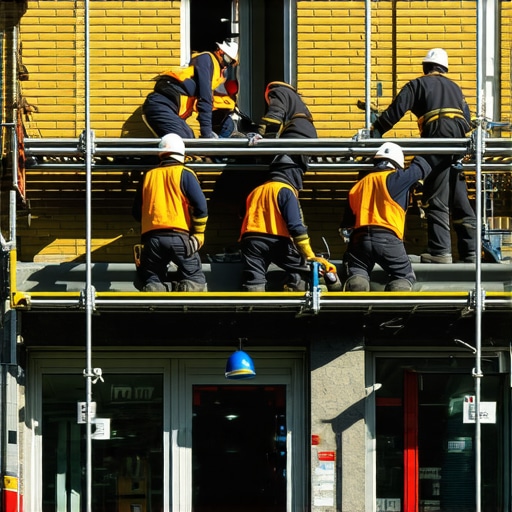
Repairing a high-traffic retail front or a busy office complex requires more than just a hawk and a trowel; it requires a surgical plan. Structural repointing isn’t just about ‘slapping some mud’ in the gaps. We use dust-shrouded vacuum grinders to clear out the old, failing joints to a depth of at least 3/4 inch, ensuring the new mortar has enough ‘tooth’ to bite into the brick. To avoid disrupting business, we phase the work—moving scaffolding during off-hours and using low-VOC additives. When we butter the joints, we’re looking for a specific consistency in the ‘mud’—not so wet that it smears, not so dry that it burns. We use a slicker to pack the mortar in layers, ensuring no voids are left behind where moisture could congregate.
The Engineering of Modern Retaining Systems
When dealing with modular retaining walls in a commercial parking lot, the failure usually starts at the footings. I’ve seen 20-foot walls start to lean because the original installer ignored hydrostatic pressure. Retaining wall batter correction isn’t just about pulling a wall back; it’s about re-engineering the drainage. We look for ‘honeycombing’ in the backfill—a sign that the fines have washed out. Using BIM masonry projects, we can now model the soil pressure and determine exactly where the failure point lies before we even move a single block. Sometimes, it’s a simple retaining wall block replacement; other times, we have to excavate and install geogrid reinforcement to tie the mass of the wall back into the earth.
“Masonry units must be laid with full head and bed joints to ensure the transfer of compressive loads across the entire assembly.” – ASTM C270 Standards
Concrete Flatwork and Modular Efficiency
For walkways and loading docks, concrete flatwork services must account for the rapid-set requirements of a 24/7 business. We don’t just pour and hope. We analyze the sub-base compaction. A ‘cold joint’ in a sidewalk is a future trip hazard and a lawsuit waiting to happen. For new builds, modular masonry construction allows us to bring pre-fabricated sections to the site, dropping them into place with a crane. This reduces onsite labor by 60% and eliminates the mess of a traditional masonry site. Whether it is cracked brick wall repair or a full-scale stone facade restoration, the goal is the same: restore the structural integrity without letting the customer see the ‘seams’ of the operation. You want a wall that ‘rings’ when you hit it—solid, dense, and built to outlast the next three generations of tenants.