
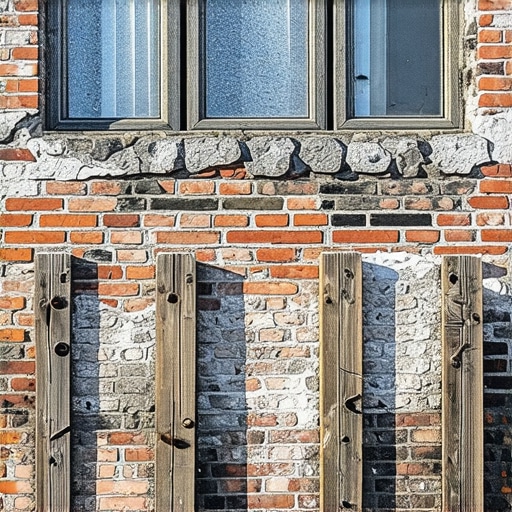
I remember a job in the dead of February, standing before a 1920s Tudor that looked like it was shedding its skin. The homeowner was distraught, sweeping up red dust and shards of brick from her porch every morning. My old mentor, a man who could tell the moisture content of a wall just by the smell of the basement, picked up a flake of the masonry, bit it, and spat. ‘Salt,’ he said. ‘They fed it salt like a poisoned steak, and now the wall is eating itself from the inside out.’ That was my first real lesson in the chemistry of failure. It wasn’t just the cold; it was the physics of osmotic pressure and the arrogance of thinking a 100-year-old wall behaves like a modern concrete slab. Most folks see a crack and think it’s just age. I see a crime scene where the primary suspects are sodium chloride and the wrong choice of mud.
The Physics of the Freeze-Thaw Devil
When we talk about the freeze-thaw cycle, we aren’t just talking about cold weather. We are talking about the 9% volume expansion of water as it transitions from liquid to solid. In a healthy brick wall, this expansion is managed by the pore structure of the masonry and the breathability of the mortar joints. However, when you introduce winter salts, you’re not just melting ice; you’re creating a super-saturated brine. This brine gets sucked into the brick’s capillaries through a process called hygroscopic action. As the water evaporates, the salt recrystallizes inside the brick. This is subflorescence—the silent killer. The pressure of these growing crystals can exceed the internal tensile strength of the brick, causing the face to pop off in a process we call spalling.
“Water penetration is the single greatest threat to masonry durability, but when coupled with de-icing salts, the rate of deterioration increases exponentially due to osmotic and crystallization pressures.” – BIA Technical Note 7
This isn’t a job for a handyman with a tube of silicone. This requires masonry water damage repair that understands the molecular level of the substrate.
The Portland Poison: Why Your Modern Repair is Failing
The biggest mistake I see in cracked brick wall repair is the use of modern Type S or Type M Portland cement on historic structures. Old bricks, fired in kilns that didn’t always reach uniform temperatures, are relatively soft and porous. They were designed to be laid with lime-based mortars. Lime is the ‘sacrificial lamb’ of the wall. It’s softer than the brick, meaning when the wall moves or the water expands, the mortar takes the hit, not the brick. When you shove a hard, non-breathable Portland ‘mud’ into those joints, you’ve effectively created a dam. The water gets trapped behind that hard cement, freezes, and because it can’t escape through the mortar, it blows the face of the brick right off. This is why mortar matching services are not a luxury; they are a structural necessity. You need a mix that matches the original’s compressive strength and vapor permeability. If your mason isn’t talking about the ‘carbonation of lime’ or the ‘modulus of elasticity,’ they’re just buttering a sandwich, not fixing a building.
The Chimney: A Vertical Disaster Zone
If the walls are the body, the chimney is the radiator, and it’s usually the first thing to fail. I’ve seen chimney interior parging so degraded that carbon monoxide was seeping into the attic space because the flue tiles had cracked under thermal shock. The exterior isn’t much better. Chimney flashing repair is often botched with ‘gunk’—thick layers of roofing tar that crack in six months. A proper lead or copper counter-flashing, let into a reglet joint, is the only way to stop the ‘slicker’ from becoming a waterfall inside your walls. When the rain hits that stone balustrade restoration project or a chimney stack, it needs to be shed away, not absorbed. If the parging inside is failing, the moisture from the furnace exhaust condenses, freezes, and begins a slow-motion explosion of the masonry from the inside out. This often leads to a full masonry rescue after disaster scenario where the stack has to be rebuilt from the roofline up.
Sustainable Block Cutting and the Art of the Fix
When we get into sustainable block cutting for restoration, we aren’t just hacking away. We are surgical. We use diamond-tipped blades and vacuum-shrouded grinders to remove failed mortar without nicking the ‘skin’ of the brick. Once that skin is gone, the brick’s heart is exposed, and it will decay ten times faster. For those facing a retaining wall installation that’s bowing, the issue is almost always hydrostatic pressure. If you don’t have weep holes and a proper drainage plane of clean gravel, that wall is just a very expensive sail waiting for a gust of frozen soil to knock it over. Soil heaving in the North can exert thousands of pounds of pressure per square foot. No amount of ‘buttering’ the joints will save a wall without a heart of drainage.
The Truth About Facade Cleaning
Everyone wants their house to look new, but facade cleaning can be the death knell for old masonry if done wrong. Power washing at 4000 PSI is like using a cheese grater on your skin. It blasts away the fire-hardened face of the brick and leaves it wide open to the next freeze-thaw cycle. We use low-pressure chemical mists that break the surface tension of the carbon crust and salt deposits without violating the integrity of the brick itself.
“The use of high-pressure water blasting or sandblasting can cause irreparable damage to the protective outer skin of the brick, leading to accelerated weathering.” – ASTM C270 Standards Commentary
Following a cleaning, we look at stone balustrade restoration or tuckpointing to ensure the envelope is sealed. Remember, there’s a difference between ‘tuckpointing’—which is a cosmetic line of contrasting mortar—and ‘repointing,’ which is the structural replacement of the mud. Don’t let a ‘truck-and-a-ladder’ guy tell you otherwise.
When to Call the Forensic Mason
If you see a soldier course of bricks over a window sagging, or a stair-step crack that you can fit a dime into, don’t wait. That’s the building telling you its skeleton is shifting. We look for ‘honeycombing’ in the concrete and ‘cold joints’ where the original pour failed to bond. My job isn’t just to make it look pretty; it’s to ensure that when the next polar vortex hits, your home doesn’t become a pile of red dust. Do it once, do it right, and use the right mud. Anything else is just a ‘handyman special’ that I’ll be charging you double to fix in three years.