
The Forensic Discovery: A Microscopic Failure
The developer called me out to a thirty-story tower because the commercial parapet wall repair done just three years ago was already weeping white calcium steaks like a funeral shroud. The homeowner’s association was looking at a seven-figure assessment. I climbed the scaffolding, pulled out my high-resolution borescope, and threaded it into a hairline 1/16th-inch grout line. What I saw wasn’t just a crack; it was a cavern. The human mason had ‘bridged’ the joint. On the surface, it looked like a clean strike, but behind that thin veneer of mud, the mortar had never reached the back of the joint. In a city where the freeze-thaw cycle hits like a sledgehammer, that air pocket became a reservoir. When water freezes, it expands by roughly 9%, and that internal pressure is what blew the faces off these bricks. A robot doesn’t get tired at 3:00 PM on a Friday. A robot doesn’t shortcut the depth of a joint because his wrist is aching from the ‘buttering’ motion. This is where the industry is changing, and for the sake of our skyline, it’s about time.
The Physics of the ‘Tight’ Joint
When we talk about tile grouts on masonry or precision brick quoin repair, we are fighting a war against capillary action. Traditional masonry joints are typically 3/8ths of an inch because that’s what a human thumb and a slicker can reliably pack. But modern architecture demands tighter, sharper lines. Humans simply cannot maintain the pneumatic pressure required to force fiber-reinforced mortars into a 1/8th-inch gap without leaving voids. Those voids, or honeycombing, are where the structural integrity dies.
“The durability of a masonry wall is inversely proportional to the volume of unfilled voids within the mortar joints.” – BIA Technical Note 7B
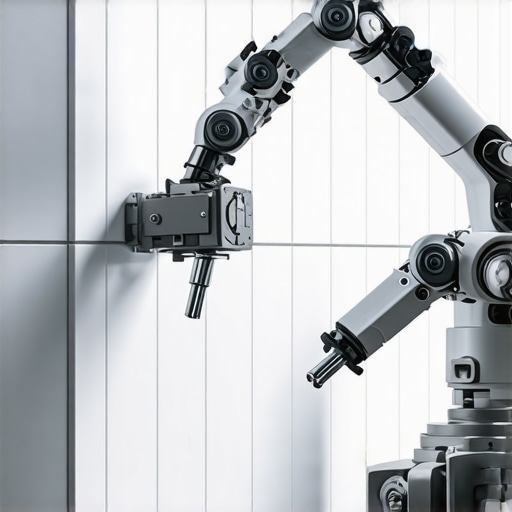
Robotic systems use a continuous-feed extrusion process that monitors the ‘back-pressure’ of the grout. If the robot senses a drop in resistance, it knows there is a void and slows its travel speed to ensure 100% saturation. This isn’t just about looking pretty; it’s about the molecular bond. We are talking about the C-S-H (Calcium Silicate Hydrate) gel formation within the mortar. If that hydration process is interrupted by air pockets, the crystalline structure of the bond is brittle and prone to shear failure.
Mechanical Superiority in Retaining Wall Batter Correction
I’ve walked onto too many jobs where a retaining wall batter correction was needed because a human crew used a ‘close enough’ eyeball approach to the incline. A retaining wall isn’t just a pile of stone; it’s a gravity-defying machine. When you are dealing with patio stone realignment or structural wall stabilization, the ‘batter’—that slight backward lean—must be mathematically perfect to counteract hydrostatic pressure from the soil. Precision robotics use LIDAR to map the soil’s angle of repose and then calculate the exact millimeter-offset for every course. This level of accuracy is critical when you are integrating foundation helical pier installation into the fix. If the pier’s torque isn’t perfectly aligned with the masonry’s center of gravity, you’re just creating a new pivot point for a future collapse. Robots ensure that every stone is placed within a 0.5-millimeter tolerance, something no human with a string line and a level can ever hope to match over a hundred-foot span.
The Chemistry of Fire and Parging
Inside the chimney, the stakes get even higher. I’ve inspected thousands of flues where chimney interior parging was done by hand. The mason reaches up with a long-handled trowel, ‘slapping’ mud onto the smoke chamber walls. The result? A bumpy, uneven surface that creates turbulence in the exhaust gases. That turbulence leads to creosote buildup, which leads to house fires. A robotic parging system, however, uses a 360-degree centrifugal applicator. It applies a uniform layer of refractory mortar that is smooth as glass. This smoothness isn’t just for show; it’s fluid dynamics. A smooth flue draws better. When combined with a chimney flue liner installation, the robotic application ensures that the fire-rated masonry installation meets every ASTM code without the risk of human error.
“Properly parged smoke chambers are essential for the efficient evacuation of combustion byproducts and the reduction of fire hazards within the dwelling.” – NFPA 211 Standard for Chimneys and Fireplaces
We are talking about the difference between a chimney that lasts fifty years and one that becomes a liability in five.
The Gritty Reality of Modern Mud
Let’s talk about the ‘mud’ itself. Traditional mortar is a mix of sand, lime, and Portland cement. But for high-precision robotic work, we use fiber-reinforced mortars. These aren’t your grandfather’s mixes. These mortars contain micro-strands of glass or polymer that act like internal rebar. They have a higher ‘suction’ and a different ‘tooth’ than standard Type N mortar. A robot can handle these high-viscosity mixes because it doesn’t rely on the physical strength of a forearm to push the trowel. This allows us to use mixes that have a much higher compressive strength and lower permeability. In the North, where the salt from the roads and the freezing wind eat away at brick quoin repair, these advanced materials are the only thing that stands a chance. Humans hate working with them because they ‘flash set’ too quickly and are a nightmare to clean off the brick face. A robot, synchronized with a water-jet cleaning system, can strike the joint and clean the brick in one pass, ensuring the mortar never ‘burns’ the masonry surface.
The Final Inspection
I’m a third-generation mason. I still have my grandfather’s slicker in my truck. But I’m not a sentimental fool. When I see a retaining wall batter correction that is laser-straight or a commercial parapet wall repair that won’t leak for a century, I know a machine was involved. We are moving away from the era of ‘hand-troweled charm’ and into the era of structural certainty. Whether it’s foundation helical pier installation or the delicate application of tile grouts on masonry, the precision of robotics removes the ‘Friday afternoon’ factor. It ensures that the physics of the wall are respected, the chemistry of the mortar is optimized, and the safety of the structure is guaranteed. The ‘ring’ of a good brick is one thing, but the data-driven placement of a robotic arm is the future of forensic masonry. If you want it done twice, hire the guy with the lowest bid and a bucket of cheap mud. If you want it done once, you look for the precision that only a machine can provide.