
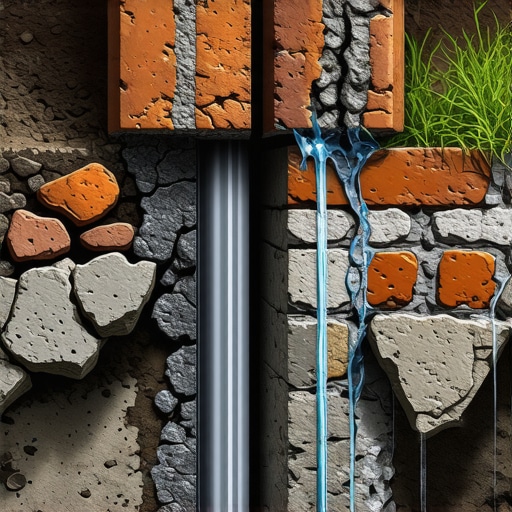
I remember a forensic call I took in the dead of a wet November. The homeowner was a DIY enthusiast who thought he had solved a basement seepage issue with a few tubes of silicone from a big-box store. He called me because the ‘hairline’ crack near his laundry room had started to weep a rust-colored sludge. When I arrived, I didn’t just look at the crack; I brought out a high-definition borescope and snaked it into the cavity behind the brick veneer. What I saw on the monitor wasn’t just a gap; the structural brick ties had essentially been reduced to orange dust through decades of galvanic corrosion. The veneer was standing by the grace of gravity alone, completely detached from the backup wall. It was a $60,000 collapse waiting to happen, all because the primary defense—the mortar—had failed forty years prior. This is the reality of forensic masonry: by the time you see the water, the structural damage is often already measured in inches, not millimeters.
The Physics of the Pore: Why Mortar Fails First
To understand why your foundation is leaking, you have to understand the chemistry of the ‘mud.’ As a third-generation mason, I’ve seen the industry pivot from the beautiful, flexible lime-based mortars of the 19th century to the rigid, brittle Portland cement mixes of today. Mortar is not just a glue; it is a sacrificial element. In historic masonry preservation, the mortar must always be softer than the brick. If the mortar is too hard, the natural expansion and contraction of the building—driven by thermal cycles—will crush the edges of the bricks, a process we call spalling.
“Water penetration is the single greatest threat to masonry durability. Moisture entering the wall system can cause efflorescence, freeze-thaw damage, and corrosion of embedded metals.” – BIA Technical Note 7
When you are dealing with crumbling mortar joint repair, you aren’t just filling a hole. You are restoring the wall’s ability to ‘breathe.’ In northern climates, the freeze-thaw cycle is the ultimate interrogator. Water occupies roughly 9% more volume when it turns to ice. If your mortar joints have lost their ‘tooth’—that mechanical bond between the cementitious material and the masonry unit—water sits in the microscopic voids. When it freezes, it exerts thousands of pounds of pressure per square inch. This isn’t just a leak; it’s a slow-motion explosion. This is why historic masonry preservation requires Type N or even Type O mortars, which have higher lime content to allow for autogenous healing—the ability of the mortar to actually reseal micro-cracks over time through carbonation.
Weak Point 1: The Failure of Structural Brick Ties
Most modern homes aren’t solid brick; they are a brick veneer held to a wooden or CMU frame by thin metal straps. These are your brick ties. When brick veneer detachment repair becomes necessary, it is usually because of a failure in the drainage plane. If the ‘weep holes’ at the bottom of your wall are clogged or weren’t installed by a mason who knew his trade, water builds up in the air cavity. This creates a humid micro-climate that eats away at the zinc coating on the ties. Once that coating is gone, the steel begins to oxidize. Oxidation is an expansive process; the rust can take up ten times the volume of the original steel. This creates ‘jacking’ forces that push the brick away from the house. If you see a horizontal crack in your mortar joints every few feet, you aren’t looking at settlement; you are looking at structural brick ties replacement needs. This is where robotic masonry repair is starting to change the game, allowing us to inject new helical ties with surgical precision without tearing down the entire facade. However, until that technology is ubiquitous, we rely on the old-fashioned ‘hawk’ and ‘slicker’ to manually restore the integrity of the veneer.
Weak Point 2: Hydrostatic Pressure and Modular Retaining Walls
Foundation leaks are often symptoms of what’s happening ten feet away from the house. I see it constantly with modular retaining walls that were ‘handyman specials.’ If a wall doesn’t have a dedicated drainage layer of clean 57 stone behind it, the soil becomes saturated. This leads to hydrostatic pressure—the weight of the water-logged earth pushing against the masonry. A square foot of water-saturated soil can weigh over 100 pounds. Multiply that by the height of your foundation, and you have a literal bulldozer pushing against your basement. This is why patio stone realignment is often just the tip of the iceberg. If your patio is sloping toward the house, you’ve created a funnel for every gallon of rain. This water migrates down, hits the footing, and finds the ‘cold joint’—the area where the vertical wall meets the horizontal floor. Proper concrete flatwork services must account for this by ensuring a positive grade away from the structure. Without it, you are asking the masonry to act as a submarine hull, which it was never designed to do.
Weak Point 3: Chimney Flashing and Capillary Action
The highest point of your masonry is often the most neglected. Chimney flashing repair is the most common forensic fix I perform. Water doesn’t just fall down; it ‘wicks’ up. Through capillary action, moisture can travel through a tiny crack in a chimney crown and migrate four stories down into your living room.
“The selection of mortar should be based on the properties of the masonry units, the weather exposure, and the structural requirements of the building.” – ASTM C270
If your chimney was built with a hard Type S mortar but the bricks are soft, the chimney will literally tear itself apart from the top down. We see this manifested as masonry staining—those white, salty streaks known as efflorescence. This isn’t just an aesthetic issue; it’s the ‘cry’ of a wall that is saturated with mineral-rich groundwater. If you ignore the staining, the next stage is the total disintegration of the joint.
The Forensic Solution: Beyond the Band-Aid
Fixing a leak isn’t about more caulk. It’s about restoring the original engineering. If you have a crumbling joint, don’t just ‘butter’ over it—that’s a ‘handyman special’ that will pop off in two seasons. You have to grind out the joint to a depth of at least twice its width to ensure the new ‘mud’ has enough surface area to bond. In cases of severe structural movement, we look toward concrete flatwork services to stabilize the subgrade or helical piers to stop the settlement. Masonry is a game of patience and physics. You cannot rush the hydration of a lime-based mortar any more than you can stop the sun from rising. Do it once, do it right, or expect to see me back in five years with a much larger bill.