
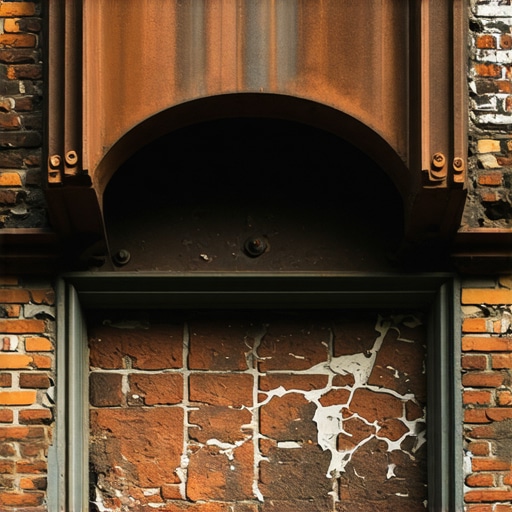
The Forensic Reality of the Expanding Lintel
I was standing on a shaky scaffold in a wet November drizzle when I saw the first sign of a building’s slow-motion heart attack. The homeowner thought he just needed some basic re-pointing services for a few ‘cosmetic’ stair-step cracks above his garage. I took my hammer and tapped the underside of the steel angle iron—the lintel—supporting the bricks. Instead of a sharp, metallic ping, it sounded like a wet cardboard box. I slid a thin probe into the bed joint, and a chunk of rust the size of a silver dollar fell out, followed by a shower of orange dust. The steel wasn’t just rusting; it was growing. This is Oxide Jacking, and if you think it’s just a paint job away from being fixed, you’re about to have a very expensive lesson in structural physics.
“Corrosion of metal embedded in masonry can cause the masonry to crack or spall due to the expansive forces of the corrosion products.” – BIA Technical Note 18A
The Micro-Chemistry of the Silent Explosion
To understand why your brick is splitting, you have to look at the atomic level. When we talk about steel lintels, we are talking about carbon steel. In the presence of moisture and oxygen—which every exterior wall has—the iron (Fe) begins a chemical dance. The resulting iron oxide, or rust, isn’t just a color change; it is a physical expansion. Iron oxide occupies anywhere from six to ten times the volume of the original unoxidized steel. Think about that. You have a rigid steel plate tucked into a tight bed of mortar. As that steel oxidizes, it thickens. It’s like a hydraulic jack being pumped one millimeter every year. Eventually, the force of this expansion exceeds the tensile strength of the masonry. Since brick is strong in compression but weak in tension, it snaps. This isn’t just a crack; it’s a structural failure caused by a metal that no longer fits in the space we carved for it.
Why the Freeze-Thaw Cycle Accelerates the Ruin
In our northern climates, the situation turns from bad to catastrophic during the winter months. We deal with freeze-thaw damage restoration constantly because of the 9% expansion of water. When you have a rusted lintel, it creates microscopic voids in the mortar. Water enters these voids through capillary action—what we old-timers call ‘suction.’ When that water freezes, it hits the rusted steel and expands. This creates a cycle where the rust pushes the brick up, the ice pushes it further, and the resulting gap allows even more water to settle in next to the steel. It’s a feedback loop of destruction. I’ve seen brick arch restoration projects where the original builders didn’t even use steel, and those arches stood for a century. Then, some ‘modern’ contractor comes in, replaces a section with a cheap, ungalvanized angle iron, and the whole facade is ruined in fifteen years because they didn’t understand the chemistry of the moisture barrier.
The Anatomy of a Lintel Failure: What to Look For
When I’m performing a forensic inspection, I look for three specific indicators. First is the ‘Horizontal Lift.’ If the mortar joint directly above the steel lintel is significantly wider than the joints three courses up, the steel is jacking. Second is brick efflorescence removal needs. If you see white, powdery salt deposits specifically around the corners of your windows or doors, it’s a sign that water is trapped behind the brick and is actively corroding the steel. The third is the ‘Soldier Course Lean.’ When the vertical bricks (the soldiers) start to kick out at the bottom, the lintel has lost its seat and is twisting under the weight of the expansion. At this point, professional masonry restoration is no longer optional; it’s an emergency.
The Fallacy of the DIY Patch
I see guys all the time buying tuckpointing tools for DIY at the big-box stores, thinking they can just smear some new ‘mud’ into the crack and call it a day. That is like putting a Band-Aid on a bullet wound. If you don’t address the rusted steel, the new mortar will just pop out in two seasons. You’re trapping the moisture in, which actually speeds up the rust. I’ve seen people use high-performance mortar mixes that are way too hard—Type S or even pure Portland cement—on old, soft bricks. Because the cement is harder than the brick, the Oxide Jacking doesn’t just crack the mortar; it crushes the brick itself. You end up with spalling that requires total replacement instead of just a lintel swap.
“Water penetration is the single greatest threat to masonry durability.” – BIA Technical Note 7
The Solution: Proper Flashing and Material Selection
The fix isn’t just a new piece of steel. It’s a system. When we do a professional masonry restoration, we don’t just ‘butter’ the ends of the bricks and slide in a new lintel. We install an end-dam flashing system. This ensures that any water that penetrates the brick wythe is diverted out through weep holes rather than sitting on the steel. We use hot-dipped galvanized steel or, in high-end coastal jobs, stainless steel. We also look at retaining wall drainage upgrade principles—applying those same concepts to the facade. If the water has a way out, the steel stays dry. If the steel stays dry, it doesn’t grow. It’s a simple rule that 90% of modern builders ignore because it takes an extra twenty minutes per window.
Modern Tech vs. Old World Craft
We are seeing some interesting shifts with 3D printed masonry repairs for decorative elements, but when it comes to the structural lintel, you can’t beat physics. You need a solid bearing. You need to understand how the tuckpointing process interacts with the thermal expansion of the building. In the heat of the summer, that steel lintel is going to expand linearly. If your mortar is too stiff and you haven’t left room for movement, you’ll see vertical cracks at the corners of the openings. This is where the ‘Art’ of the trade comes in—knowing exactly how much ‘give’ to leave in the mud.
Summary of the Master Mason’s Warning
Don’t be fooled by a ‘handyman special’ price. If your lintels are rusting, you aren’t just looking at a masonry problem; you’re looking at a structural liability. The weight of the brick above that window—the ‘triangle of loading’—is resting on a piece of metal that is actively disintegrating. Do it once, do it right. Get the moisture out, use the right mortar, and for heaven’s sake, make sure your lintels are galvanized. Your building’s bones depend on it.