
The Graveyard Behind the Brick: A Forensic Reality
The property manager pointed at a single missing mortar joint on the twelfth floor of the downtown office complex. He thought it was a nesting spot for a bird, maybe a minor nuisance. I pulled the borescope out of my truck, a tool that has seen more failures than a suburban subdivision, and when I snaked it into that cavity, I didn’t see a wall. I saw a graveyard. Behind the face brick, the structural shelf angles were rusted to a flaking, orange dust. The wall was essentially free-standing, held up by nothing but gravity and hope. This wasn’t a case for a bucket of mud and a tuckpointer’s slicker. This was a structural emergency that required surgical precision.
When we talk about commercial masonry facade maintenance, most people think about a guy on a swing stage with a hawk and a trowel, slapping some mortar into a joint. That is a cosmetic fix for a systemic disease. In the high-stakes world of commercial facades, the real damage happens where the human eye can’t see: the interstitial space between the exterior wythe and the backup wall. This is where brick infill panel repair becomes a game of physics rather than just aesthetics. If you have honeycombing in your structural grout or voids in your backup wall, traditional gravity-fed grout is a joke. It follows the path of least resistance, leaving massive air pockets that trap moisture and invite the freeze-thaw cycle to tear the building apart from the inside out.
“Water penetration is the single greatest threat to masonry durability. Proper drainage and the integrity of the internal cavity are paramount to preventing structural collapse.” – BIA Technical Note 7
The Physics of the Void: Why Manual Methods Fail
In the North, where the thermometer swings like a pendulum, water is a demolition crew. When water gets behind a stone veneer over brick or into a poorly consolidated cavity, it expands by 9% upon freezing. That expansion pressure can reach thousands of pounds per square inch, easily popping the face off a brick or snapping a wall tie. Traditional tuckpointing curved walls is even more difficult because the geometry creates irregular pressure points. If a mason is manually “buttering” these joints, they cannot guarantee the density of the mud deep within the wall.
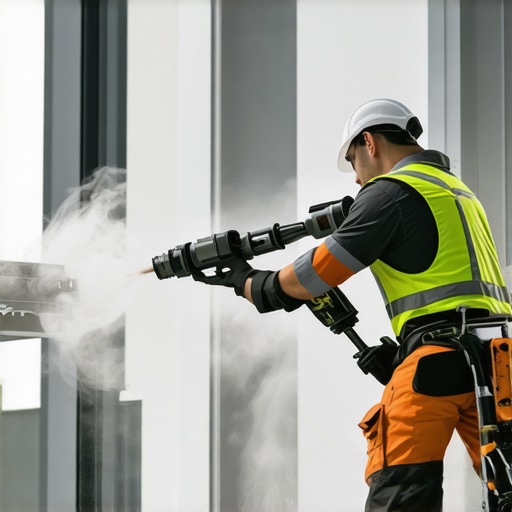
This is where robotic grout injection changes the math. Unlike a human who gets tired or skips the hard-to-reach spots, a robotic system uses pressure-sensitive sensors to ensure every cubic centimeter of a void is filled. We are talking about the difference between “filling a hole” and “restoring structural monolithic integrity.” The robot monitors the back-pressure of the grout as it is injected. If the pressure drops, it knows there is a hidden void or a cold joint. It continues the flow until the exact required PSI is reached, ensuring that the retaining wall reinforcement or the facade stabilization is total. We are injecting at the molecular level, ensuring the grout has enough “tooth” to bond with the existing substrate, whether it is 100-year-old common brick or modern concrete flatwork services.
Micro-Zooming into Grout Chemistry and Flow Dynamics
Let’s talk about the chemistry of the “mud.” We aren’t just using bags of pre-mix from the big-box store. For high-precision robotic injection, we use polymer-modified, non-shrink grouts with specific rheology. The viscosity must be low enough to flow through a 1/4-inch injection port but high enough to stay in place without bleeding out of lower joints. This is a delicate balance of thixotropic properties. When the grout is under the shear force of the pump, it becomes more fluid; once it enters the void and the pressure stabilizes, it thickens. This prevents the grout from running down the back of the brick and clogging weep holes—a common failure in manual “gravity-pumping.”
For historic tuckpointing projects, this technology is a godsend. We can’t just blast high-strength Portland cement into a building built in 1910. The old bricks are soft, and the new grout must be softer—the sacrificial principle of masonry. Robotic injection allows us to use lime-based, breathable grouts that have the consistency of heavy cream. It fills the internal cracks that have developed over a century without creating a hard point that will cause the brick to spall during the next winter. We are essentially 3D printing the internal structure of the wall back to its original state.
“Mortar should be designed to be weaker than the masonry units it binds, ensuring that stresses are relieved through the joints rather than the masonry units themselves.” – ASTM C270 Standard Specification for Mortar for Unit Masonry
The Curved Wall Conundrum and 3D Printed Masonry Repairs
One of the most difficult tasks in forensic masonry is tuckpointing curved walls. The radius of the curve creates wedge-shaped joints that are notoriously difficult to pack tightly. If you don’t get the grout all the way to the back of the joint, you create a shelf for water to sit on. Robotic nozzles can be programmed to follow the specific arc of the wall, delivering a consistent bead of material that a human hand simply cannot replicate over an eight-hour shift. Furthermore, as we move into the era of 3D printed masonry repairs, we can now scan a missing decorative terra cotta piece or a custom-shaped stone, print a replacement with structural-grade mortar, and then use robotic injection to fuse that new piece into the existing facade. It is the marriage of old-world geometry and new-age material science.
When dealing with stone veneer over brick, the danger is “lick-and-stick” syndrome. Most contractors just slap some thin-set on the back of a stone and press it against a wall. Within five years, the bond fails because of thermal expansion. The stone heats up faster than the brick behind it, creating shear stress. Robotic injection allows us to install mechanical anchors and then grout the space behind the stone, creating a unified structural mass that can handle the 120-degree summer days and the -20 degree winter nights of the northern climate. It stops the stone from acting like a sail in high winds and keeps the moisture out of the tile grouts on masonry.
The Commercial Masonry Facade Maintenance Protocol
If you own a commercial building, you need to stop looking at masonry as a “set it and forget it” material. It is a living skin. Brickwork sealants application is often marketed as a cure-all, but if you seal a wall that already has moisture inside, you’ve just built a greenhouse for rot. You have to fix the internal voids first. Robotic grout injection is the diagnostic and curative tool that ensures your retaining wall reinforcement actually works. It identifies where the wall is hollow by monitoring the volume of material intake. If a section of the wall takes three times the expected amount of grout, you know you have a major structural separation that a visual inspection never would have caught.
This isn’t about being fancy; it’s about being right. I’ve seen too many “handyman specials” where they tried to fix a structural crack with a tube of caulk. All they did was hide the problem until the day the bricks started falling on the sidewalk. Do it once, or do it twice. If you do it with a robot and a forensic mind, you only do it once. You ensure the concrete flatwork services and the vertical masonry are bonded, the brick infill panel repair is solid, and the building stands for another hundred years. That is the difference between a mason and a master.