
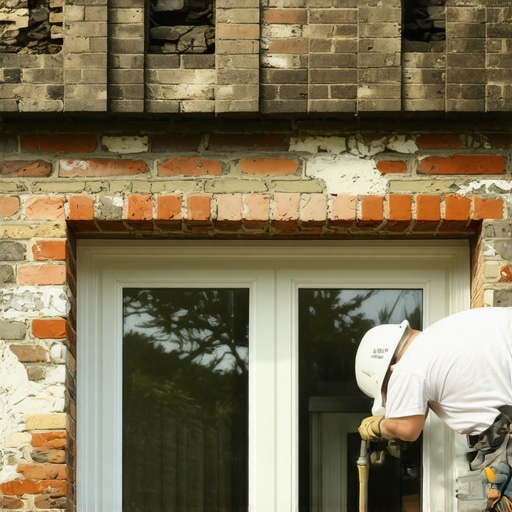
I walked into a Victorian-era parlor last October where the homeowner was worried about a ‘hairline crack’ above her original sash windows. She thought a bit of caulk would fix it. I pulled out my digital scope, threaded it through a mortar void, and what I saw was a horror show. The structural steel lintel wasn’t just rusted; it had undergone such severe oxidation that it looked like a stack of burnt potato chips. The steel had expanded to nearly five times its original thickness—a process we call ‘rust jacking’—and was literally prying the soldier course of bricks apart while the weight of the two stories above was simultaneously crushing the window frame. This wasn’t a cosmetic issue; it was a structural countdown. If you see a ‘frown’ in your brickwork, you aren’t looking at a minor settling issue. You are looking at the physics of failure.
The Anatomy of a Failing Header
In masonry, the ‘header’ or the soldier course—those bricks standing vertically above your window—isn’t just there for aesthetics. It’s supposed to bridge the gap. But brick has zero tensile strength. It’s great in compression, pushing down on itself, but it can’t hang in mid-air. To bridge the opening, old-timers used masonry arches, while modern builders (post-1900) used steel angle irons or ‘lintels.’ When these lintels fail, the header sags. The first sign is often a stair-step crack in the mortar joints starting at the corners of the window and moving upward and outward. This is the wall trying to redistribute the load because the center support is gone. If you ignore it, the next step is a crushed window frame, shattered glass, and eventually, a partial collapse of the facade.
“Water penetration is the single greatest threat to masonry durability, particularly when it reaches embedded structural steel members which are prone to expansive corrosion.” – BIA Technical Note 31B
The Chemistry of Rust Jacking and Material Conflict
Why does that steel fail? It’s usually a combination of poor flashing and the wrong mortar. In my years of forensic structural inspection, I’ve seen thousands of ‘repairs’ where a handyman used modern Type S Portland cement to ‘fix’ a historic wall. This is a death sentence for old brick. Historic mortar is lime-based. It’s breathable and soft. Modern Portland cement is hard, brittle, and waterproof. When you butter a joint with Portland on an old wall, you trap moisture inside the brick. That moisture has nowhere to go but back toward the steel lintel. As that steel stays damp, the iron atoms react with oxygen. This isn’t just a surface stain. This is a molecular transformation. The resulting iron oxide occupies significantly more volume than the original steel. This internal pressure is what causes the brick to heave and the header to sag. We call this a ‘material conflict’ where the very material meant to protect the wall ends up destroying it from the inside out.
The Forensic Approach: Historic Mortar Analysis
Before we even touch a slicker or a hawk, we perform a historic mortar analysis. We take a sample of the original ‘mud’ and break it down to find the sand-to-lime ratio. If we don’t match the compressive strength of the original mortar, the new repair will pop out within two winters. We’re looking for the ‘suction’—how the brick pulls moisture from the mortar. In older homes, the bricks are often ‘soft-fired.’ They are like sponges. If you use a high-strength mortar, the brick will actually crack before the mortar does. In the trade, we say the mortar must be ‘sacrificial.’ It’s meant to weather away over 50 years so the brick doesn’t have to.
The Surgical Repair: Step-by-Step Recovery
Fixing a sagging header isn’t about slapping some goop in a crack. It’s surgery. First, we install temporary shoring to hold the weight of the house. Then, we carefully remove the soldier course, one brick at a time, cleaning each one for reuse. We don’t throw away 100-year-old bricks; you can’t buy that ‘tooth’ and patina at a big-box store. Once the steel is exposed, we usually find it’s a rusted mess. We replace it with new, hot-dipped galvanized steel, but we don’t just ‘lick-and-stick’ it. We install proper end-dams and flashing so that any water that gets behind the brick is channeled back out through ‘weep holes.’ If you don’t have weeps, you’re just building a bathtub inside your wall. Once the new lintel is set, we relay the bricks using the analyzed lime mortar, carefully striking the joints to match the original profile. Whether it’s tuckpointing brick walls or tuckpointing curved walls over a radius window, the goal is a seamless transition where the repair is invisible to the eye but structurally superior to the original.
“Mortar should always be weaker than the masonry units it binds, acting as a sacrificial element to accommodate movement and moisture without causing distress to the masonry units.” – ASTM C270 Standards
Modern Tech in Old Walls: Digital Twins and Geogrids
While I love the old ways, I use new tech to verify them. For complex restorations, we use digital twin masonry projects—creating a 3D model of the wall to simulate how loads will shift during the repair. This is especially critical when dealing with retaining wall batter correction or large-scale foundation waterproofing nearby, as any shift in the ground can telegraph up to the window headers. If the soil is the culprit, we might look into retaining wall geogrid installation to stabilize the earth before we even think about the brickwork. It’s all connected. A sagging header is often just the loudest symptom of a silent foundation problem.
When to Panic: Assessing the Damage
Not every crack is a catastrophe, but a horizontal crack in a header is a red alert. If you see ‘honeycombing’—where the mortar is falling out in chunks—or if your window is suddenly hard to open, the masonry is already resting on the frame. Do not call a window guy. A window guy will sell you a piece of vinyl that will buckle in six months. You need a mason who understands chimney repair services, stone veneer repair, and chimney sweep and repair because the physics of a failing chimney flue are identical to the physics of a failing window header. Both involve vertical loads, thermal expansion, and moisture management. Don’t let a ‘handyman special’ ruin your home’s value with a ‘cold joint’ that will leak and crack the first time the temperature drops. Do it once, do it right, and preserve the craftsmanship that has stood for a century. In this business, the cheapest repair is the one you only have to do once.