
The Ghost in the Wall: A Forensic Post-Mortem
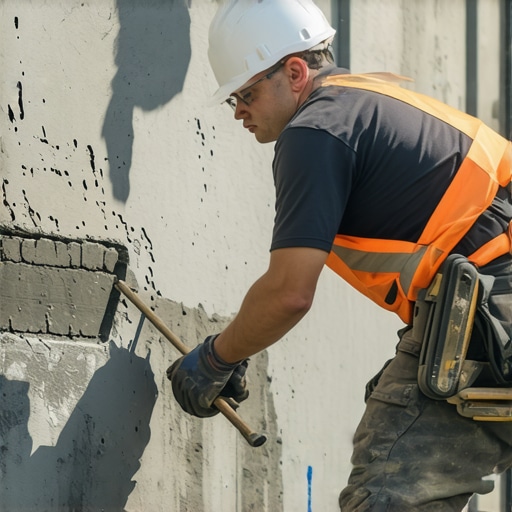
I recently walked a site in the bitter November wind, inspecting a commercial tuckpointing project that had gone sideways before the first joint was even struck. The homeowner—a developer who thought he could save a few pennies—showed me a sprawling brick veneer installation that was literally weeping. It wasn’t just water; it was the sound of failure. I took my inspection hammer and gave a series of light taps along the soldier course. The sound wasn’t the sharp, resonant ‘ping’ of a structural bond; it was a dull, hollow thud—the sound of ‘drummy’ brick. Beneath that thin brick, the concrete substrate was as smooth as glass. The installer had buttered his mud directly onto form-finished concrete still slick with paraffin-based release agents. He might as well have been trying to stick a stamp to a block of ice. This is the reality of modern masonry repair services: we spend half our lives fixing the ‘lick-and-stick’ disasters of the last decade.
“The bond strength of masonry units to a substrate is significantly influenced by the surface texture and cleanliness of the backing material.” — BIA Technical Note 28C
The Molecular Saboteur: Laitance and Surface Tension
To understand a lasting brick veneer installation, you have to stop looking at the brick and start looking at the concrete at a microscopic level. When concrete is poured, the heavy aggregates settle, and a weak, milky layer of cement paste and water—called laitance—rises to the top. If you don’t grind that off, your bond isn’t with the structural concrete; it’s with a dusty skin that has the tensile strength of a wet cracker. In northern climates where the freeze-thaw cycle is a brutal reality, water finds its way into the microscopic void between the veneer and the concrete. Water expands by 9% when it turns to ice. That 9% is a hydraulic jack that will pop 500 square feet of stone or brick off a wall in a single season. This is why we insist on a Concrete Surface Profile (CSP) of at least 3 or 4, achieved through mechanical scarification or diamond grinding. You need ‘tooth’ for the mud to bite into.
The Chemistry of the Bond: Why Sustainable Tuckpointing Mortars Matter
We don’t just use ‘mud’ anymore. We use engineered cementitious systems. For a proper brick veneer installation, especially on curved walls where the shear stresses are unevenly distributed, the mortar needs to be more than just a glue. It needs to be a bridge. Sustainable tuckpointing mortars are now being formulated with post-consumer recycled glass and natural hydraulic limes that offer superior vapor permeability. This ‘breathability’ is critical. If you seal the wall with a high-strength Portland cement that’s too brittle, you trap moisture behind the veneer. This leads to efflorescence—that white, salty stain—and eventual delamination. When we perform full repointing services or brick quoin repair, we are looking at the modulus of elasticity. The mortar must be slightly softer than the masonry unit itself, acting as a sacrificial element that absorbs the building’s natural movement.
“Surface preparation for thin-bed masonry must remove all laitance, curing compounds, and form release agents to ensure a mechanical key.” — ASTM C1060
The Anatomy of the Prep: From Grinding to Buttering
The process of preparing for a brick veneer installation is grueling. First, we strip the concrete. If there was an old finish, it’s gone. We use a hawk and trowel to apply a scratch coat, but only after the substrate has been brought to a Saturated Surface Dry (SSD) condition. If the concrete is bone-dry, it will suck the moisture out of your mortar before the crystals can grow into the pores of the concrete. This ‘flash setting’ creates a cold joint that will fail under the slightest thermal stress. For an outdoor fireplace rebuild, this is even more critical. The thermal expansion of the firebox means the bond between the stone coping installation and the backup masonry must be absolute. We use a slicker to ensure the joints are packed tight, leaving no voids where water can congregate. In commercial tuckpointing, we often see failures at the transition points—where the brick meets the stone or the concrete slab. These areas require specific brick quoin repair techniques to ensure the load is transferred without cracking the veneer face.
The Physics of the Curve: Tuckpointing Curved Walls
Tuckpointing curved walls presents a unique forensic challenge. The radial geometry means the outer wythe is under tension while the inner face is under compression. Standard brick veneer installation techniques often ignore this, leading to vertical cracks that follow the weakest point of the mortar joint. We use specialized masonry repair services that include stainless steel reinforcement ties embedded into the concrete substrate before the veneer is even buttered. This creates a mechanical tie-back that prevents the veneer from ‘peeling’ away from the curve. Whether it’s a decorative garden wall or a massive commercial radius, the physics don’t change: you cannot fight gravity and moisture; you can only manage them through superior surface preparation and material selection.