
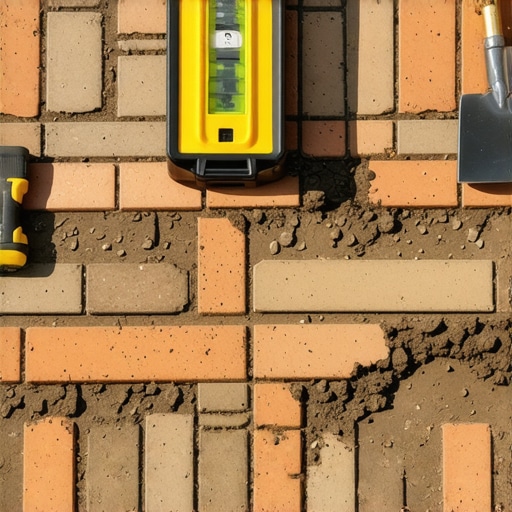
The Ghost in the Subgrade: Why Patios Sink
I remember watching my old man on a job site back in the late seventies. He didn’t use a laser level; he used a bucket of water and a keen eye for how the earth breathed. He used to say that if you don’t treat the dirt like it’s a living, moving beast, it’ll eat your work within five winters. He’d throw a brick onto the bedding sand, and if it didn’t make a specific ‘thud’—a dead, solid sound—he knew the compaction was a lie. Most of the ‘potholing’ you see in modern brick patios isn’t a brick problem; it’s a failure of the invisible architecture beneath the surface. You’re looking at a structural collapse in miniature, often caused by contractors who treat stone dust like it’s a magical elixir rather than the drainage nightmare it actually is.
“Water penetration is the single greatest threat to masonry durability, leading to cyclical expansion and contraction that destabilizes the sub-base.” – BIA Technical Note 7
The Physics of the Pothole: Micro-Zooming into Sub-Base Failure
To understand why your patio looks like a topographical map of the Ozarks, we have to look at the Proctor Density of your soil. When we talk about potholing, we are usually describing localized subsidence. This happens when the capillary action of the soil pulls moisture upward into the sub-base. In northern climates, this moisture undergoes the freeze-thaw cycle. Since water expands by approximately 9% when it turns to ice, it exerts massive upward hydrostatic pressure. When it thaws, it leaves behind a void. If your base consists of ‘fines’—those tiny particles often found in cheap stone dust—they wash away into the sub-soil, creating a cavity. Eventually, the weight of the soldier course or the traffic above causes the pavers to bridge that void until they snap or sink. This is the same mechanical failure we see in failing retaining wall repair where the hydrostatic pressure hasn’t been relieved by proper ‘weep holes’ or drainage aggregate.
The Forensic Scene: Diagnosing the Base
When I walk onto a site to perform masonry rescue after disaster, the first thing I look for is the ‘edge restraint.’ If your patio is spreading laterally, your retaining wall block replacement strategy might be the real culprit. Without a solid vertical stop, the interlock between the bricks—which is purely a function of friction—dissolves. I’ve seen stone wall repair jobs where the homeowner tried to use tuckpointing brick walls techniques on a dry-stacked garden wall, only to find the mud cracked and fell out because the wall was still moving. You can’t butter a joint and expect it to hold a moving mountain. You need to address the geotechnical reality. In the South, you deal with thermal expansion; in the North, it’s the heave. If you’re in a freeze-thaw zone, your base needs to be at least 6 to 8 inches of #57 stone (crushed, washed limestone) that allows water to move through it, not sit in it like a sponge.
The Restoration Reality: Why ‘Lick-and-Stick’ Fails
Many ‘handymen’ will tell you to just throw some more sand in the hole and call it a day. That’s a ‘Band-Aid’ on a bullet wound. For a permanent fix, you need structural repointing of the entire system. This starts with a mortar matching service if you have a wet-set patio, or a complete excavation for dry-laid. If you are dealing with historic brick, you must use sustainable tuckpointing mortars—specifically Type O or Type N lime-based mixes. Modern Portland cement is too hard for old, hand-pressed bricks. If you use a high-strength mud on a soft brick, the brick will become the ‘sacrificial lamb’ and spall (the face pops off) because the mortar didn’t give. We see this constantly in concrete masonry unit restoration; the materials must be compatible in compressive strength and vapor permeability.
“The selection of mortar should be based on the strength of the masonry units; a mortar that is stronger than the brick will lead to irreversible structural damage during thermal cycles.” – ASTM C270 Standards
The Permanent Cure: A Step-by-Step Forensic Leveling
- Excavation and Soil Stabilization: Remove the affected pavers and dig out the failed sub-base. If the soil is heavy clay, you need a geotextile fabric to separate the sub-grade from your new stone base. This prevents the ‘pumping’ action that mixes dirt into your clean gravel.
- The Base Layer: Install 4-6 inches of 3/4-inch crushed stone. Compaction is non-negotiable. You need a vibratory plate compactor. If you don’t feel it in your teeth, you haven’t compacted enough.
- Bedding Sand: Use 1 inch of coarse concrete sand. Do not use stone dust. Stone dust holds water; concrete sand lets it drain. Screed this level with a 1-inch pipe to ensure a perfectly flat ‘table.’
- Re-laying and Interlock: Replace your bricks. If you’re doing tuckpointing brick walls nearby, ensure the patio grade slopes away from the foundation at a rate of 1/4 inch per foot.
- Polymeric Stabilization: Use a high-quality polymeric sand to lock the joints. This prevents honeycombing of the joints and keeps weeds out, which are the primary biological cause of base destabilization.
Beyond the Patio: Chimneys and Retaining Walls
Often, a sinking patio is a symptom of a larger drainage issue affecting the whole property. I’ve seen chimney flue liner installation jobs where the chimney was leaning because the patio next to it was saturated and causing soil liquefaction. If your stone wall repair isn’t holding, check the hydrostatic pressure behind it. Use retaining wall block replacement units that allow for integrated drainage. Always remember: in the world of masonry, water is the only enemy that never sleeps. You don’t fight it; you lead it where you want it to go. Whether you are performing structural repointing on a 100-year-old facade or leveling a 10-year-old patio, the physics of suction and compression remain the same. Don’t be a victim of the ‘leftover material’ scam where a guy offers to fix your driveway with ‘extra asphalt.’ There are no shortcuts in the forensic world of stone and brick.