
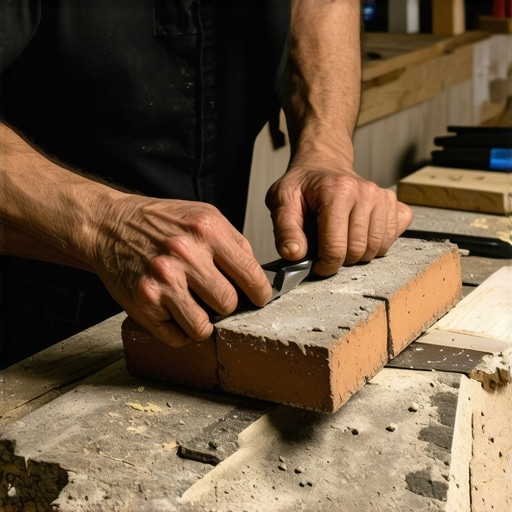
The Anatomy of the Arch: Why the Birdsmouth Cut Defines Structural Longevity
I remember watching my mentor, a man named Silas who had been laying brick since the Truman administration, handle a template for a jack arch. He didn’t use a laser; he used a piece of weathered oak and a scribe. He told me, ‘If your birdsmouth is off by a whisker, the gravity of the whole building will eventually find that mistake and punish it.’ He was right. In my thirty years of historic masonry preservation, I’ve seen arches that stood for a century crumble in a decade because a modern ‘contractor’ tried to shim a poor cut with extra mud. The birdsmouth cut—that precise V-shaped notch that allows a brick to sit flush against a skewback or a curved centering—is the literal pivot point of masonry physics. When we talk about brick arch restoration, we aren’t just talking about aesthetics; we are talking about the management of compressive forces and the redirection of thrust.
“The stability of a masonry arch depends on the proper transfer of loads through the voussoirs to the abutments, requiring precise geometry in every unit.” – BIA Technical Note 31
The Physics of the Birdsmouth: Beyond the Visual
To understand the birdsmouth, you have to understand the ‘thrust line.’ An arch is a machine made of stone. It takes vertical weight and pushes it outward and downward. If the birdsmouth cut is sloppy, you create a ‘point load.’ This is where masonry water damage repair often begins. When a brick isn’t seated perfectly, it develops micro-fissures. Water enters those fissures, and in our freeze-thaw climates, that water expands by 9% when it turns to ice. That pressure pops the face off the brick, a process we call spalling. For commercial tuckpointing projects involving historic arches, we often find that the original masons understood this ‘tooth’ of the stone better than modern crews using high-speed grinders. We’re not just ‘buttering’ a joint; we’re creating a structural seal. This is why sustainable tuckpointing mortars—typically lime-based rather than high-Portland mixes—are non-negotiable. A hard mortar against a soft, hand-carved brick is a death sentence for the arch; the mortar must be the sacrificial element.
The Geotechnical Foundation: From the Ground Up
You can’t have a perfect arch on a failing base. Often, when I’m called for concrete block foundation repair, the homeowner is actually worried about a crack in the brickwork above. They don’t realize the arch is ‘smiling’ because the footing has dropped. Before we even strike a tool against the arch, we look at the soil. Is it heaving? Is there hydrostatic pressure? In some cases, we utilize self-leveling masonry lifts to stabilize the substrate before we begin the delicate work of historic masonry preservation. If the foundation isn’t true, the birdsmouth cuts in your arch will eventually pinch, leading to a catastrophic shear. We often see this in commercial tuckpointing where heavy vibration from city traffic has accelerated the settlement of poorly compacted backfill.
The Forensic Process: Executing the Cut
When executing a birdsmouth cut for a custom arch, the ‘mud’ (mortar) is your best friend and your worst enemy. I prefer fiber-reinforced mortars for the structural core of the arch because they provide the tensile strength that raw lime sometimes lacks in high-stress curves. The process starts with a ‘hawk’ and a ‘slicker.’ You layout your voussoirs on the ground first. You scribe the angle. When you take that brick to the saw, you aren’t just cutting clay; you’re managing the ‘suction.’ A dry brick will suck the hydration right out of your mortar, ‘burning’ the bond before it can even set. This is why we pre-wet the units. If you’re doing a chimney cap replacement or a chimney damper repair alongside your arch work, the same rules apply: respect the material’s porosity.
“When the arches are completed and the centers removed, if the materials are well-chosen and the joints are thin, the work will be firm and everlasting.” – Vitruvius, De Architectura
Modern Failures and Forensic Realities
The biggest scam in modern masonry is the ‘lick-and-stick’ veneer arch. They use a piece of angle iron and glue thin slices of brick to it. There is no birdsmouth. There is no structural integrity. When that iron rusts—and it will—the ‘brick’ falls off like scabs. In true brick arch restoration, we are rebuilding the skeletal system of the opening. We use ‘soldier courses’ and ‘header courses’ to tie the arch back into the wythes of the wall. This prevents the ‘honeycombing’ effect where the interior of the wall turns to dust while the outside looks fine. We also look at the chimney cap replacement needs; often, a failing arch over a fireplace is a direct result of water pouring down from a cracked crown 30 feet above. All these systems are connected. If you ignore the masonry water damage repair at the top, your beautiful birdsmouth cuts at the bottom will be under water—literally.
The Long Game: Maintenance and Protection
Once the arch is set and the centering is pulled, the work isn’t done. The striking of the joint is where the ‘Old World’ magic happens. A grapevine joint or a weathered strike isn’t just for looks; it sheds water. When we talk about sustainable tuckpointing mortars, we’re talking about the CaCO3 cycle—the way lime re-absorbs CO2 from the air to harden over decades. This is the opposite of modern ‘bag mix’ that gets brittle and cracks. For commercial tuckpointing, using the wrong PSI mortar is the most common forensic failure I document. I’ve seen concrete block foundation repair jobs where the contractor used Type S mortar on 100-year-old blocks, and the blocks literally shattered because they couldn’t breathe. Don’t let your arch become a statistic. Do it once, do it right, and let the gravity do the work.