
The Deception of the Surface: Why Concrete Steps Flake and Fail
When I walk up to a property and see the front steps looking like they’ve survived a mortar attack, I don’t see a cosmetic eyesore; I see a forensic crime scene. That flaking, pitting, and scaling—what we in the trade call spalling—is the physical evidence of a microscopic war between the elements and the chemistry of the pour. Most homeowners, and unfortunately many ‘tailgate contractors,’ think they can just buy a bag of cheap patch from a big-box store, slap some ‘mud’ over the holes, and call it a day. That’s a fool’s errand. Within two seasons, that patch will pop off like a scab because they ignored the physics of the bond.
“Surface preparation is the most critical step in the repair of concrete surfaces. Without removing the carbonated layer and exposing sound aggregate, no overlay can achieve a permanent bond.” – ASTM C1059 / C1059M Standard Specification for Adhesive Agents
My mentor, a man who had more grit in his fingernails than most people have in their whole lives, used to say that concrete has a memory. He’d take his hammer and tap the riser of a step; if it gave a hollow, ‘thudding’ sound instead of a sharp, metallic ‘ping,’ he’d tell the owner the concrete had ‘lost its soul.’ He was talking about delamination—the internal separation of the cement paste from the aggregate. If you’re going to use fiber-reinforced mortars or high-performance overlays, you have to understand that you aren’t just painting over a problem; you are performing a skin graft on a living, breathing structural element.
The Physics of the Pop: Why the North Destroys Concrete
In regions where the thermometer bounces across the freezing mark like a rubber ball, concrete lives in a state of constant stress. Concrete is naturally porous, filled with a network of capillaries. When water enters those pores and freezes, it expands by exactly 9 percent. This isn’t a gentle nudge; it’s a hydraulic sledgehammer from the inside out. If the concrete wasn’t air-entrained—meaning it doesn’t have billions of microscopic bubbles to act as ‘expansion tanks’—the internal pressure exceeds the tensile strength of the concrete. The surface simply gives up. This is exacerbated by the ‘lick-and-stick’ mentality of modern construction where the finishing was done too early, trapping bleed water under the surface and creating a weak, thin layer of laitance that is destined to fail.
When we get into masonry repair services, we aren’t just looking at the steps. We look at the whole system. Is there a failing retaining wall drainage upgrade needed nearby? If the soil behind a flanking wall is saturated, that hydrostatic pressure can push moisture laterally into your steps, fueling the freeze-thaw cycle from the backside. This is the same reason we often see stone veneer repair needs on the sides of concrete stairs—the moisture gets trapped behind the stone, freezes, and pops the veneer right off the scratch coat.
The Restoration Reality: Prep, Prime, and Pour
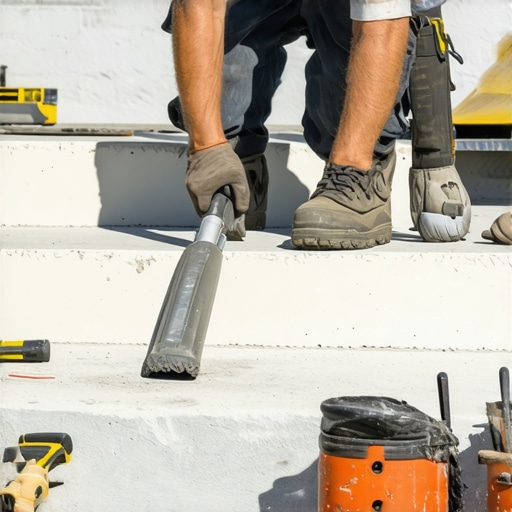
To fix spalled steps correctly, we start with the ‘tooth.’ You cannot butter a smooth, dirty surface and expect it to hold. We use mechanical grinders or high-pressure water blasting to reach a Concrete Surface Profile (CSP) of at least 3 or 4. This means removing every bit of loose material, oil, and the carbonated concrete that has a lower PH. If you don’t get down to the sound aggregate, your new high-performance overlay is just sticking to dust.
“Water penetration is the single greatest threat to masonry durability and the primary cause of masonry deterioration.” – BIA Technical Note 7: Water Resistance of Brick Masonry
Once we have the ‘tooth,’ we look at the chemistry. Fiber-reinforced mortars are the gold standard here. These aren’t your grandpa’s sand-and-cement mixes. They are infused with alkali-resistant glass or polymer fibers that act like microscopic rebar, knitting the overlay together and providing the tensile strength that plain concrete lacks. We often use a ‘slurry coat’—a liquid version of the overlay—and scrub it into the pores with a stiff brush before applying the thicker repair material. This ensures that there is no honeycombing at the interface and that the ‘mud’ actually shakes hands with the old substrate.
The Forensic Inspection: Beyond the Surface
Sometimes the spalling is just a symptom of a deeper structural rot. During a full repointing services job on an adjacent brick wall, I’ve found that structural brick ties replacement was necessary because the moisture that caused the steps to spall had also migrated into the wall cavity, rusting out the steel ties. If your steps are pulling away from the house, you might be looking at a retaining wall batter correction issue or a foundation settlement problem that a simple overlay won’t fix.
For those dealing with historic properties, mortar matching services and re-pointing services are critical. You cannot use a hard, modern Portland-based overlay on steps that are integrated into a soft lime-mortar brick porch. If the repair material is harder than the original material, the original material will be the one to crack when the house shifts or expands in the sun. We call this the ‘sacrificial principle.’ The mortar must always be slightly weaker than the units it holds together. When we perform sustainable block cutting for custom step heights, we ensure every edge is crisp and every joint is struck with a slicker to compact the surface and shed water effectively.
The High-Performance Finish
The final stage of a high-performance overlay isn’t just smoothing it over with a trowel. It’s about managing the ‘flash set.’ In the heat, concrete wants to dry too fast, which ‘burns’ the mix and leaves it brittle. We use evaporation retardants or wet-curing techniques to ensure the hydration process happens slowly and completely. This creates a dense, impermeable surface that resists salt penetration and water absorption. We don’t just want it to look good for the closing of the contract; we want it to look good twenty winters from now. If you’re tired of the ‘handyman special’ that lasts one season, it’s time to respect the chemistry of the stone and do it right the first time. Don’t let a cold joint or poor drainage turn your home’s entrance into a pile of rubble. Professional masonry is an investment in the structural integrity of your life’s biggest asset.