
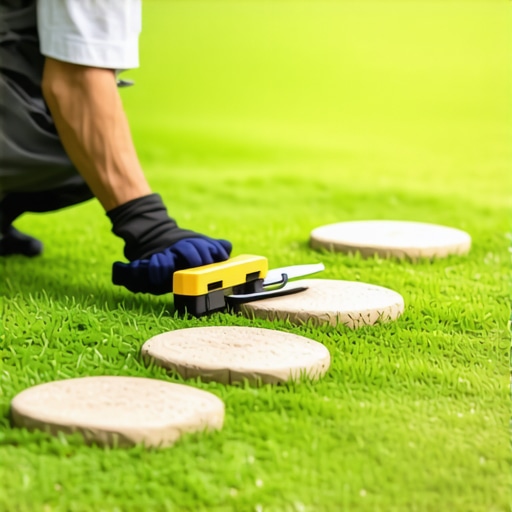
The Wavy Walkway: A Forensic Autopsy of Hardscape Failure
I remember the first time my uncle let me hold a slicker. We were looking at a walkway that looked like a roller coaster—ridges of slate jutting up, valleys of brick holding stagnant water. He pointed at the mess and said, ‘Kid, if you can’t tell me why the earth is spitting these stones out, you’re just a laborer, not a mason.’ He made me watch the path for a full season. I saw how the rain turned the soil to soup and how the winter frost pushed those stones up like tectonic plates. That lesson stayed with me through every patio stone realignment project I’ve tackled in thirty years. When a garden path goes crooked, it isn’t a problem with the stone; it’s a structural failure of the invisible engineering beneath it. Most handymen will just pull the stone, throw a handful of sand under it, and call it a day. That is a ‘lick-and-stick’ mentality that guarantees you’ll be doing the same job next spring.
The Geotechnical Reality: Why Your Base Is Failing
To understand why your garden path looks like a relief map of the Himalayas, you have to look at the physics of the base. In our northern climate, we deal with the brutal reality of the freeze-thaw cycle. When water gets trapped in the voids of a poorly compacted base, it expands by approximately 9 percent when it freezes. That expansion exerts thousands of pounds of pressure per square inch. If your stones are sitting on a bed of ‘dirty’ sand or uncompacted topsoil, they don’t stand a chance. This is the same reason why commercial smokestack repair is so specialized—it’s about managing the expansion and contraction of materials under stress. For a patio, we have to look at the ‘angle of repose’ for our aggregate. If you use rounded pea gravel, those little stones act like ball bearings, sliding past each other and allowing the path to sink. We use angular, crushed stone—stuff that interlocks when you hit it with a plate compactor.
“Water penetration is the single greatest threat to masonry durability. Proper drainage must be established to prevent hydrostatic pressure from displacing structural units.” – BIA Technical Note 7
The Science of Sub-Grade Compaction
The secret to a path that stays straight for a century is the ‘sub-grade.’ I’m talking about the raw earth under the gravel. If you don’t strip away the organic material—the roots, the peat, the black dirt—you are building on a sponge. I’ve seen modular retaining walls collapse because the contractor thought 4 inches of gravel was enough. It’s never enough. For a proper brick paver driveway repair or a heavy stone path, we excavate deep enough to reach ‘virgin’ soil. Then, we introduce a geotextile fabric. Think of this as a structural skin that separates the sub-grade from our clean aggregate. Without it, the heavy gravel will eventually migrate down into the soft mud, a process known as ‘soil pumping.’ Once the gravel is gone, the stones sink. It’s basic physics, yet I see it ignored on every ‘handyman special’ I’m hired to fix.
The ‘Mud’ and the ‘Butter’: When to Use Mortar
In some cases, especially in historic brick salvage or formal garden paths, we aren’t just dry-laying stones; we are setting them in a mortar bed. But you can’t just use any bag of Portland cement from the big-box store. If you’re working with older, softer stones, a hard modern mortar will act like a vice. When the stone tries to expand in the sun, the mortar won’t give, and the stone will ‘spall’ or pop its face off. We mix a softer ‘mud’—often a Type N or even a Type O lime-based mix—to ensure the mortar is the sacrificial element, not the stone. When we are structural repointing a wall or a path, we use the hawk and slicker to drive that mortar deep into the joints, ensuring there are no air pockets. If you leave a void, you’re just leaving a bucket for water to fill and freeze. This is particularly critical in commercial masonry maintenance, where the scale of the work means a single failure point can lead to thousands of dollars in damages.
“The strength of the masonry assembly depends not on the hardness of the mortar, but on the completeness of the bond between the unit and the bedding material.” – ASTM C270 Standard Specification
The Anatomy of Drainage and Efflorescence
Have you ever seen that white, salty crust on bricks? That’s efflorescence. It’s a sign that water is moving through the masonry, dissolving salts, and depositing them on the surface as it evaporates. When we do brick efflorescence removal, we don’t just scrub it off; we look for the source of the water. On a garden path, if the stones are ‘dished’—sloping toward the center—they are funnelling water into the base. We relevel stones with a slight ‘pitch’ or ‘crown’ to shed water toward the landscaping. We also pay attention to the joints. Flush pointing services are great for vertical walls, but for paths, we often use a polymeric sand that creates a flexible, water-resistant bond. This prevents the ‘honeycombing’ effect where water washes out the fine particles from under the stone, leaving it hollow and prone to cracking under a ‘soldier course’ or heavy foot traffic.
The Structural Anchor: Why Ties Matter
Sometimes, garden stones are part of a larger system, like a tiered walkway connected to a home’s foundation. This is where we get into structural brick ties replacement. If the masonry veneer isn’t properly anchored to the backup wall, the entire path or stairs can peel away. I’ve performed forensic inspections where the original ties were nothing but rusted bits of wire. We replace these with stainless steel helical ties that bite into the backup material and provide a permanent mechanical bond. It’s the difference between a path that looks good for a photo and a path that stands up to a decade of heavy winters. Whether it’s patio stone realignment or a full-scale commercial smokestack repair, the principles of gravity and moisture management never change.
The Scam: Avoiding the ‘Leftover Material’ Trap
I’ve seen it a thousand times. A guy pulls up in a beat-up truck and says he has ‘leftover stone’ from a job down the street and can fix your wavy path for five hundred bucks. Don’t walk away—run. They will throw some stone dust over the weeds, ‘butter’ the edges of the stones to make them look set, and be gone before the first rain. Within a month, the ‘cold joints’ will open up, the stones will shift, and you’ll be left with a bigger mess than you started with. Professional masonry is about the work you *don’t* see—the compaction, the drainage, the chemical composition of the mortar, and the integrity of the base. If you want it done once, you do it right. If you do it cheap, you’ll be doing it twice. My uncle’s old trowel still rings when I hit a good brick, and that’s the sound of a job that’s going to last a lifetime.