
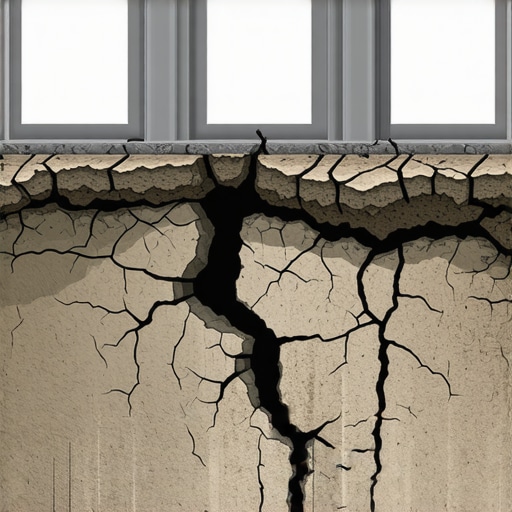
The Anatomy of a Hidden Failure
The property owner pointed at a thin, vertical fissure near the corner and called it a ‘settlement line.’ I didn’t say a word. I pulled my fiber-optic scope out of my kit and threaded it through a weep hole in the brick veneer installation. What the inspector before me missed was the terrifying reality: the galvanized wall ties had completely dissolved due to a chemical reaction with the high-sulfate soil. The brick facade wasn’t just ‘settling’; it was a 4,000-pound curtain of clay hanging by a thread of friction, waiting for one good wind gust to peel off like wet wallpaper. This is why I don’t trust a guy who shows up with just a flashlight and a clipboard. If you aren’t looking at the chemistry of the mud and the physics of the soil, you’re just guessing.
1. The Inspector Ignored the ‘Tears’ on the Facade
When I walk a job site, I look for the salt first. If you see white, powdery crusting on the brickwork, that’s not just ‘masonry staining’—it’s a diagnostic roadmap. We call it efflorescence. It happens when water migrates through the brick, dissolves internal salts, and deposits them on the surface as the moisture evaporates. A brief inspection notes it as an aesthetic issue. A forensic inspection asks: where is the hydrostatic pressure coming from? In many cases, it’s a failure of the through-wall flashing or a lack of weep holes in the brick veneer installation. If those salts are coming from the ground up, your foundation is wicking moisture like a sponge.
“Water penetration is the single greatest threat to masonry durability, leading to efflorescence, spalling, and corrosion of embedded metals.” – BIA Technical Note 7
2. They Didn’t Check the ‘Tooth’ of the Mortar
A major red flag is an inspector who doesn’t touch the joints. I carry a carbide scribe to every foundation check. If I can scratch the mortar and it turns to sand, we have a problem of ‘flash setting’ or improper mix. In concrete masonry unit restoration, you often see where a previous ‘handyman’ used a high-strength Portland cement to patch an old lime-based joint. This is a death sentence for the wall. The physics are simple: the mortar must be the sacrificial element. It needs to be softer than the block or brick it holds. When you use a hard, brittle mortar, the thermal expansion of the wall can’t be absorbed by the joints. Instead, the pressure builds until the face of the brick pops off—a process called spalling. If your inspector didn’t check the hardness of the pointing, they missed the fact that the wall is literally eating itself from the inside out.
3. The Retaining Wall Was Treated as a Decoration
Foundations don’t exist in a vacuum; they exist in a relationship with the surrounding grade. I’ve seen countless ‘inspections’ that completely ignore a failing retaining wall fifty feet away. If that wall is leaning, your foundation is next. Many modern builders skip the retaining wall geogrid installation—those layers of high-tenacity polyester mesh that pin the soil back. Without that geogrid, the soil exerts lateral pressure that can hit 1,000 pounds per square foot during a heavy rain. When that pressure becomes too much, the soil ‘heaves’ against your basement walls. If the inspector isn’t looking for bulging in the concrete masonry unit restoration or checking for retaining wall block replacement needs, they aren’t giving you a structural report; they’re giving you a fairy tale.
4. They Overlooked the ‘Drunken’ Soldier Course
Look at your soldier course—those bricks standing vertically like little guards. If they are tilting or if the mortar joints between them are opening up at the top, the building is rotating. A quick walk-through might call this ‘cosmetic cracking,’ but I call it a sign that you need foundation underpinning. When the soil underneath a footing fails—whether it’s due to clay shrinkage or poorly compacted fill—the foundation ‘rolls.’ We often see this in stone veneer repair jobs where the ‘lick-and-stick’ stones start falling off because the substrate is twisting. Real forensic work involves checking the plumb of the wall with a long level, not just glancing at the cracks. If the wall is out of plumb by more than 1/4 inch over four feet, the physics of gravity are no longer on your side.
“Structural integrity of masonry depends on the controlled distribution of loads through the assembly; any deviation in alignment can lead to catastrophic shear failure.” – ASTM C270 Standards
5. The Pavers Tell the Story of the Sump
The last sign of a lazy inspection is ignoring the hardscape. Your brick paver driveway repair needs or settling patio stones are the ‘canary in the coal mine.’ If the pavers near the foundation are sinking, it usually means the backfill around the foundation was never properly compacted. This creates a ‘bathtub effect’ where water pools against the foundation wall, increasing the freeze-thaw pressure. I check the masonry joint sand repair; if the sand is constantly washing out, you have a subterranean water flow issue that is likely undermining your footings. In cases of historic brick salvage, you can’t just throw more mud at the problem. You have to stabilize the soil first.
The Physics of the Fix
When we find these issues, we don’t just ‘butter’ the cracks and call it a day. We look at the ‘suction’ of the materials. If we are doing a historic brick salvage project, we have to pre-wet the bricks so they don’t suck the moisture out of the new mortar too fast, which causes a ‘cold joint.’ If the foundation is truly failing, we look at helical piers for foundation underpinning—literally screwing steel pillars into the stable earth below the ‘active’ soil zone. This isn’t a job for a guy with a bucket of premix and a trowel. This is a job for someone who understands that a building is a living organism, constantly fighting against gravity, water, and the slow grind of the earth.
When to Panic
If you see a horizontal crack in a basement wall, that is a structural emergency. That is the wall bowing inward under hydrostatic pressure. If you see stair-step cracks that are wider at the top than the bottom, your house is splitting in two. Don’t let a brief inspection convince you that a bit of epoxy is the cure. Epoxy is a Band-Aid; if the house is still moving, the epoxy will just crack again, or worse, cause the concrete around it to shatter. You need to address the root—whether it’s through better drainage, geogrid reinforcement, or deep-tissue underpinning. Do it once, or do it twice. The second time always costs triple.