
The Forensic Scene: A Fifty-Thousand-Dollar Lean
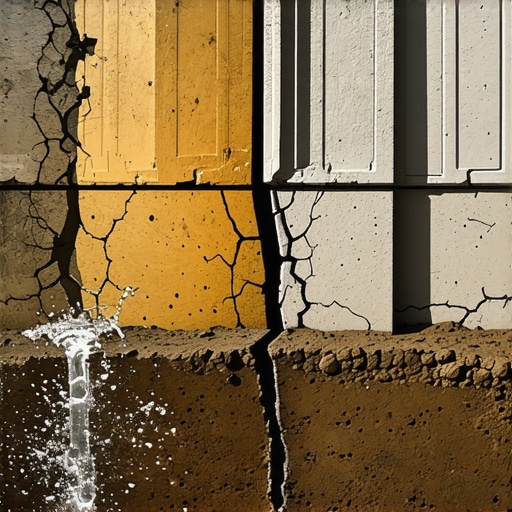
I recently walked onto a job site in the North where a homeowner was staring at a modular retaining wall that had shifted six inches off-plumb in just three seasons. From ten feet away, it looked like a standard failure. But when I pulled my specialized bore scope and looked behind the face units, the horror story revealed itself. There wasn’t a single grain of clean drainage stone. The contractor had backfilled with the same heavy, expansive clay he excavated. Hydrostatic pressure had turned that soil into a hydraulic ram, slowly shoving ten tons of modular masonry construction into the yard. The homeowner thought it was just a surface issue, a bit of cosmetic ‘settling.’ In reality, the structural integrity was zero. The wall wasn’t just leaning; it was breathing, moving with every rain, and waiting for the right saturation point to become a landslide.
The Physics of Fluid Dynamics Behind the Wall
To understand why these walls fail, you have to stop thinking of dirt as a solid and start thinking of it as a sponge. In modular masonry construction, the blocks are often held together by gravity and fiberglass pins. They have no tensile strength. When rainwater hits the ground, it seeks the path of least resistance. If you haven’t provided a dedicated ‘highway’ of 57-stone (clean, angular crushed rock), that water saturates the soil. Saturated clay can weigh over 120 pounds per cubic foot. Multiply that by the height of a six-foot wall, and you’re dealing with thousands of pounds of lateral force pushing against the back of your ‘mud’ or dry-stack units.
“Water penetration is the single greatest threat to masonry durability, accounting for nearly 90% of all masonry failures.” – BIA Technical Note 7
In colder climates, this problem is compounded by the Freeze-Thaw Cycle. Water expands by roughly 9% when it turns to ice. If that water is trapped in the pores of the block or behind the wall, it creates internal pressure that causes honeycombing and surface spalling. When the ice expands behind the wall, it delivers a punch that no gravity wall can withstand. This is often when we see the need for cracked brick wall repair or total concrete block foundation repair in adjacent structures. The earth is a powerful lever, and water is the grease that makes it move.
The Anatomy of a Drainage System
A proper retaining wall is actually a drainage system disguised as a wall. First, you need a perforated pipe at the heel of the wall, sloped to ‘daylight’ (where it can dump water away from the structure). This pipe must be wrapped in a non-woven geotextile fabric to prevent ‘fines’—tiny silt particles—from clogging the system. Without this, your drainage pipe becomes a buried plastic tube filled with mud. Second, you need a minimum of 12 inches of clean, angular stone behind the block. This stone acts as a vertical chimney, allowing water to drop straight down to the pipe rather than sitting against the back of the units. This prevents the moisture from migrating through the block and causing efflorescence, or worse, triggering brick veneer detachment repair needs on nearby facades where the moisture levels are sky-high.
Micro-Zooming into Material Science: Beyond the Block
When we talk about the longevity of these systems, we have to look at the chemistry of the components. Modern modular blocks are often made with dry-cast concrete. While durable, they are incredibly porous. If you don’t use porous stone sealers on the caps, water will sit in the aggregate, freeze, and eventually pop the face of the block off like a bottle cap. The same logic applies to chimney cap replacement; if the top of the structure isn’t shedding water, the rest of the masonry below is doomed. We see this often in chimney heat shield installation where the internal masonry is protected from heat, but the external envelope is failing due to water ingress from a cracked crown.
The Role of Structural Ties and Mortar
In some hybrid modular systems, we use structural brick ties replacement techniques to anchor veneer to a backup wall. If the drainage fails here, the ties—often made of galvanized steel—sit in a bath of constant moisture. This leads to oxidation (rust). Rusting steel expands to nearly seven times its original thickness, a phenomenon known as ‘oxide jacking.’ This can lift entire courses of brick, necessitating intensive tuckpointing and structural stabilization. I’ve seen ‘handyman specials’ where the metallic brick colors application looked great on day one, but because they ignored the ‘tooth’ of the mortar and the drainage behind it, the whole facade started peeling like a bad sunburn within five years.
The Myth of the ‘Quick Fix’
I’m often asked if we can just ‘inject’ something to stop a wall from moving. The answer is almost always no. You can’t fight geology with a caulk gun. If your wall is failing due to poor drainage, the only real cure is excavation. You have to get behind the wall, remove the expansive soils, and install the drainage ‘chimney’ that should have been there from the start. This is similar to concrete block foundation repair; you have to address the hydrostatic pressure before you can worry about the cracks. If you just patch the crack without fixing the water issue, the earth will simply open a new crack two feet away next spring.
“Retaining walls should be designed to resist the lateral pressure of the retained material, including any surcharge and hydrostatic pressure.” – ASTM C90 Standard Specification for Loadbearing Concrete Masonry Units
The Master’s Checklist for Longevity
If you’re overseeing a modular masonry project, watch the ‘mud’ work and the ‘butter’ application on any stone veneer elements. But more importantly, watch the gravel. If the contractor isn’t bringing in loads of clean stone, they are building a temporary structure. Ensure that tuckpointing is done with a mortar that is slightly softer than the unit itself to allow for thermal movement. If you’re dealing with a hot climate, make sure they are wetting the units to prevent ‘flash setting,’ which leaves the mortar brittle and crumbly. For those in the North, ensure air-entrained concrete is used to provide microscopic ‘rooms’ for water to expand into when it freezes. Whether it’s a chimney cap replacement or a massive retaining wall, the rule of the Master Mason is always the same: Control the water, or the water will control you.
Final Thoughts: Do It Once, or Do It Twice
I’ve spent thirty years fixing ‘saving money’ mistakes. A wall without drainage is just a very expensive pile of rubble in waiting. Don’t get distracted by the metallic brick colors application or the fancy texture of the block. Look at the pipe, look at the stone, and look at the soil. If those three aren’t handled with forensic precision, your wall is a ticking clock. In the world of masonry, there are no shortcuts—only long, expensive detours back to doing it the right way.