
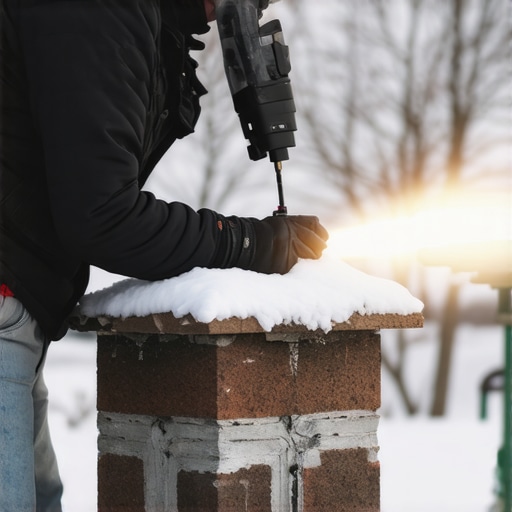
The Anatomy of a Hidden Disaster
I remember my first year as a journeyman, standing on a steep pitch in a late October drizzle. My mentor, a man who had more limestone dust in his lungs than oxygen, pointed at a chimney crown that looked, to my untrained eyes, perfectly fine. He didn’t speak; he just took a small spray bottle of water and misted the surface. Within seconds, the water didn’t bead; it vanished into a network of invisible micro-fissures. ‘That chimney is screaming,’ he told me. ‘By February, it’ll be a pile of loose rubble.’ He was right. That winter, the freeze-thaw cycle turned those invisible capillaries into jagged canyons, and the entire shoulder of the stack blew out. This is the reality of the chimney crown: it is the most abused piece of masonry on your property, and if you aren’t performing a masonry damage assessment before the first frost, you are effectively inviting a structural collapse into your living room.
The Physics of the Freeze-Thaw Cycle
In the trade, we talk about ‘the 9% rule.’ When water enters a liquid state into a porous substrate like a poorly mixed mortar wash, it sits in the voids. When the temperature drops below 32 degrees Fahrenheit, that water undergoes a phase transition, expanding by approximately 9% in volume. This generates internal hydraulic pressure that exceeds the tensile strength of most standard masonry materials. If your chimney crown is made of ‘lick-and-stick’ mortar—that thin, cheap smear of Type N mud that many cut-rate contractors use—it doesn’t stand a chance. It will spall, meaning the face of the material literally pops off, leaving the soft common brick beneath exposed to the elements. This is why tuckpointing weatherproofing isn’t just an aesthetic choice; it is a sacrificial layer of defense. You need to understand the ‘tooth’ of the material. A proper crown isn’t just a lid; it’s a reinforced concrete slab that must be decoupled from the flue liner to allow for thermal expansion.
“The chimney crown should be sloped to shed water and provide a 2-inch overhang to protect the masonry below from saturation.” – BIA Technical Note 19B
The Forensic Inspection: Finding the Ghost Cracks
When you go up there—or when you hire a professional for a chimney sweep and repair—you aren’t just looking for holes you can fit a finger into. You are looking for ‘stair-step’ patterns in the mortar joints and ‘crazing’ on the crown surface. Crazing looks like a spiderweb of fine lines. This is often the result of ‘flash setting,’ where the sun evaporated the water out of the mud before the hydration process could complete, leaving a brittle, dusty matrix. If you find these, you are already in the danger zone. We now use robotic masonry repair systems for internal flue inspections, but the exterior crown still requires the tactile touch of a master. You want to feel for ‘hollow’ sounds. Tap the crown with the handle of your slicker. If it sounds like a drum, the crown has delaminated from the masonry core. At this point, no amount of tuck pointing services will save it; you are looking at a full concrete masonry unit restoration or a complete tear-down.
Chemistry and the Modern Toolkit
Modern masonry has evolved past the simple lime and sand buckets of my grandfather’s era. Today, we utilize advanced masonry adhesives that have a high modulus of elasticity, allowing the chimney to breathe and move during the radical temperature swings of a winter fire. When the interior of a chimney hits 800 degrees and the exterior is 10 degrees, the sheer stress on the masonry is immense. If your stack is leaning, we don’t just ‘slap some mud on it’ anymore. We look at the substrate. Often, the weight of a massive masonry stack on a poorly compacted soil lead to foundation helical pier installation to stabilize the entire structure before we even touch the brickwork. We also look at structural brick ties replacement; if the veneer is pulling away from the framing, the crown will crack no matter how well it’s built because the house is literally breathing away from the chimney.
“Mortar joints shall be struck when the mortar is thumbprint hard to ensure a proper weather-tight seal and maximize density.” – ASTM C270
The Strategy for Concrete Block Foundation Repair
Many chimneys are supported by a concrete block foundation. If you see horizontal cracks in the basement or crawlspace directly beneath the fireplace, the crown cracks you see at the top are just the symptom. The disease is hydrostatic pressure at the base. You can perform all the concrete block foundation repair in the world, but if the water is still pouring off a flat, cracked chimney crown, you are fighting a losing battle. The water travels down the ‘voids’ in the CMU (Concrete Masonry Unit) and pools at the footer. This is why a forensic approach is necessary. We don’t just look at the crack; we follow the water. In the North, where the freeze-thaw cycle is relentless, we use air-entrained concrete for crowns. These contain billions of microscopic bubbles that act as ‘pressure relief valves’ for expanding ice. It’s the difference between a chimney that lasts ten years and one that lasts a century. Don’t be fooled by ‘handyman specials’ who want to smear silicone over a crack. Silicone traps moisture inside, which is the fastest way to rot a chimney from the inside out. You need a breathable, silane-based water repellent and a structural repair that respects the physics of the stone.
How to Inspect Your Chimney Crown for Winter Readiness
Surface Cleaning
Use a stiff wire brush to remove moss, lichen, and loose debris from the crown surface to expose the bare masonry.
The Saturation Test
Spray a small amount of water on the crown. If it soaks in immediately, the masonry is porous and requires a professional-grade sealer or replacement.
Check the Flue Bond
Inspect the junction where the clay flue liner meets the crown. If the seal is broken, water will run down the inside of your chimney walls.