
The Anatomy of a Separation: When Your Entryway Abandons Your Home
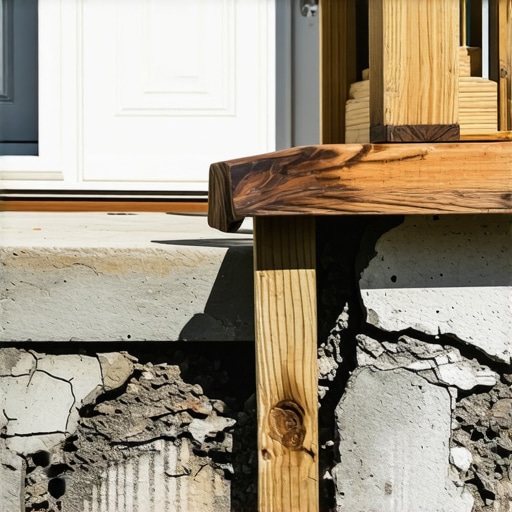
I was standing on a porch last November, a high-end property in a neighborhood where the lawns are manicured and the brickwork usually looks pristine. But this house had a secret. I slid my fiber-optic scope into a two-inch chasm between the landing and the front door sill. What I saw wasn’t just a crack; it was a total systemic failure. The structural steel lintel was rusted to a fine orange dust, and the masonry was hanging by a prayer. The homeowner thought they just needed a bit of caulk. They were wrong. This wasn’t a cosmetic blemish; it was a geological event happening in their front yard. When concrete steps begin their slow, agonizing retreat from the main structure, they are telling a story of soil physics, hydrologic pressure, and often, the sheer incompetence of the original builder. We are going to look at why these heavy masses move and why a ‘handyman special’ patch job is like putting a band-aid on a broken femur.
The Physics of Settlement and the ‘Active Zone’
To understand why a 2,000-pound block of concrete is moving, you have to look at the ‘mud’—not just the mortar, but the earth beneath it. Most steps fail because they are sitting on uncompacted backfill. When a house is built, the area around the foundation is excavated, and then filled back in. Unless that soil is mechanically compacted in six-inch ‘lifts,’ it remains loose. Over a decade, gravity and water do the work the contractor skipped. This is where we see the most common structural divergence. As the soil settles, the steps follow the path of least resistance: down and away.
“Water penetration is the single greatest threat to masonry durability, leading to efflorescence, subflorescence, and structural instability through freeze-thaw cycles.” – BIA Technical Note 7
This displacement creates a ‘cold joint’—a gap where two separate pours of concrete meet but don’t bond. Once that gap opens, it becomes a funnel for every drop of rain. This is particularly lethal in northern climates where the freeze-thaw cycle takes hold. Water enters that gap, and because water expands by roughly 9% when it turns to ice, it exerts thousands of pounds of lateral pressure. It’s a slow-motion hydraulic jack, pushing your steps further away every single winter. This is why tuckpointing weatherproofing isn’t just about aesthetics; it’s about sealing the envelope before the ice starts its work.
The Micro-Chemistry of the Bond and Why New ‘Mud’ Fails
When I talk about ‘mud,’ I’m talking about the lifeblood of masonry. Most modern contractors use high-strength Portland cement for everything, but that’s a mistake. If you’re working on a porch that has some age to it, you need to understand the ‘tooth’ of the material. Concrete steps are often poured with a high water-to-cement ratio to make them easy to work, which leads to ‘honeycombing’—those tiny air pockets you see in the side of the slab. These pockets are invitations for moisture. If you’re performing a retaining wall block replacement or trying to pin steps back to a foundation, you can’t just use any bag of mix from a big-box store. You need high-performance mortar mixes that match the compressive strength of the existing substrate. If the repair material is harder than the original concrete, the original concrete will crack around the repair. This is the ‘sacrificial’ principle of masonry: the mortar should always be slightly weaker than the units it holds. Using sustainable masonry materials like natural hydraulic lime can actually help in these scenarios because they allow the structure to ‘breathe’ and re-absorb small amounts of movement without snapping.
[image_placeholder_1]
Hydrostatic Pressure and the Retaining Wall Analogy
Think of your porch steps as a tiny retaining wall. On one side, you have the weight of the stairs; on the other, the pressure of the soil and the house. If the drainage isn’t perfect, hydrostatic pressure builds up. This is the same reason we see retaining wall geogrid installation as a standard in heavy engineering—you need to reinforce the soil so it doesn’t push the structure over. Without proper drainage, the water trapped behind the concrete steps acts like a lubricant, helping the slab slide right off its ‘footing’ (if there even is one). For those building an outdoor kitchen masonry build, the same rules apply. You are dealing with massive thermal expansion. In the heat of the summer, your steps expand; in the winter, they contract. Without a proper expansion joint, they will eventually shear off the anchor bolts.
“The foundation must be laid on solid ground and down to such a depth as the magnitude of the work shall require.” – Vitruvius, De Architectura
If your steps aren’t sitting on a footing that goes below the frost line—usually 36 to 48 inches in northern zones—they are essentially floating. And floating things move.
Forensic Solutions: Beyond the Surface Patch
When I’m called for chimney repair services or to look at a failing porch, I’m looking for the ‘why.’ If the steps are pulling away, we don’t just ‘butter’ the joint with more mortar. We have to address the base. This might involve helical piers—giant screws driven deep into the stable soil—to jack the steps back into place. Or, it might require a total tear-out to install a proper reinforced footing. We also look at the ‘top-down’ moisture. Just as a chimney cap replacement or a chimney crown repair protects a vertical stack from water infiltration, a proper flashing system at the porch threshold keeps water from getting behind the masonry. For those with luxury features, like an outdoor masonry fountain restoration, the waterproofing becomes even more critical because you’re dealing with constant water exposure. Every joint must be ‘struck’ correctly with a slicker or jointer tool to compress the mortar and create a water-shedding profile. A ‘weather joint’ or a ‘concave joint’ is essential here; a ‘recessed joint’ is just a shelf for ice to sit on and destroy your hard work.
Summary of Professional Masonry Standards
In the end, masonry is a game of managing water and gravity. Whether you are dealing with a soldier course of bricks that is beginning to sag or steps that are migrating toward the sidewalk, the solution is always found in the physics of the base and the chemistry of the bond. Don’t let a contractor tell you that a ‘bead of silicone’ will fix a structural separation. It won’t. You need to address the compaction, the footing depth, and the mortar compatibility. If you do it once with the right ‘mud’ and the right ‘tooth,’ you won’t have to do it again for fifty years. Do it cheap, and you’ll be watching that gap grow every single spring.