
The Lie of the Quick Fix
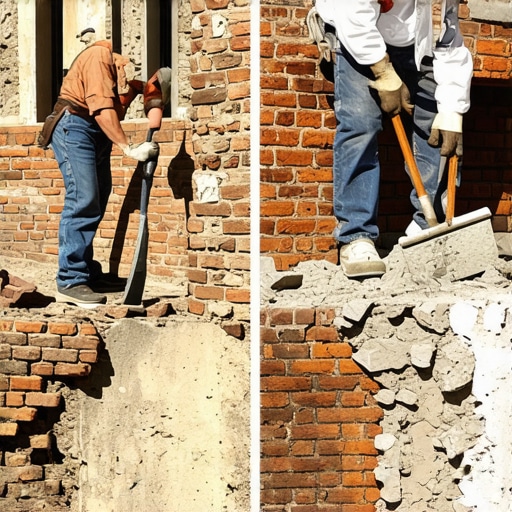
I remember my first real lesson in forensic masonry. My mentor, an old-timer who had spent forty years on a scaffold, took me to a 1920s schoolhouse. He pointed to a section of the wall where the mortar was falling away in thin, brittle flakes, like a snake shedding its skin. He didn’t just tell me it was a bad job; he made me climb up and touch it. ‘That’s what happens when you butter a dead joint,’ he said. He used to say that if you don’t hear the grinder bite into the brick, you aren’t doing masonry water damage repair—you’re just painting with mud. Most guys today want to ‘smear’ a new layer of Type S over a failing joint because it’s fast. But that ‘lick-and-stick’ mentality is why I spend half my year performing brick veneer detachment repair on buildings that should have lasted another century.
The Physics of the Sacrificial Joint
To understand why grinding is non-negotiable, you have to understand the ‘Sacrificial Principle.’ In historic masonry, the mortar is the sponge and the shock absorber. It is designed to be softer than the brick. This ensures that when the building breathes—expanding and contracting with the seasons—the stress is taken by the mortar, not the clay.
“Mortar should be weaker than the masonry units so that any cracks occur in the mortar joints where they can be easily repaired.” – ASTM C270
When you patch over old, crumbling mortar with a thin ‘shave’ of new material, you create a cold joint. There is no chemical bond. Water enters the micro-gap between the new patch and the old mud. In the northern freeze-thaw cycles, that water expands by 9%. Since the patch is too thin to resist the pressure, it pops off, often taking the face of the brick with it. This is called spalling, and it’s the primary driver behind expensive chimney rebuild services.
The Anatomy of the Grind: Depth Matters
Proper tuckpointing curved walls or even a standard soldier course requires a depth of at least 3/4 of an inch, or twice the width of the joint. We use a diamond-blade grinder or a pneumatic chisel to reach that ‘clean’ masonry. We are looking for the ‘tooth’—a raw, dust-free surface where the new lime-based mortar can achieve a mechanical interlock. If you’re dealing with commercial smokestack repair, this depth is even more critical because of the harmonic vibrations and thermal shifts the structure undergoes. Without that deep ‘key,’ the new mortar has no structural mass to resist the lateral forces of the wind.
“Water penetration is the single greatest threat to masonry durability.” – BIA Technical Note 7
When we grind, we aren’t just removing the bad stuff; we are creating a reservoir for the new mortar to hydrate properly. We use a hawk and a slicker to pack that mud in tight, eliminating honeycombing—those nasty air pockets that trap moisture.
Historic Pointing Styles and the Chemistry of Suction
In historic pointing styles, the mix is everything. If you’re working on a pre-1940s home, you cannot use modern Portland cement. You need a high-lime mix. Lime mortar doesn’t just ‘dry’; it carbonates. It pulls CO2 from the air to harden, a process that can take months. This allows the wall to remain flexible. When we perform chimney leak detection, we often find that the leak isn’t a hole, but a lack of ‘breathability.’ A wall sealed with hard, non-porous patch-work traps moisture inside the brick. The brick then rots from the inside out. For complex geometries, we are even seeing 3D printed masonry repairs used to recreate custom ornamental pieces, but even those high-tech solutions require a deep, ground-out joint to sit in. Whether it’s retaining wall capstone replacement or a standard brick veneer installation, the rule is the same: the bond is only as good as the preparation. You grind to the sound of the ‘ring’ in the brick, you clean the dust, and you pack the mud. Anything less is just a countdown to the next failure.