
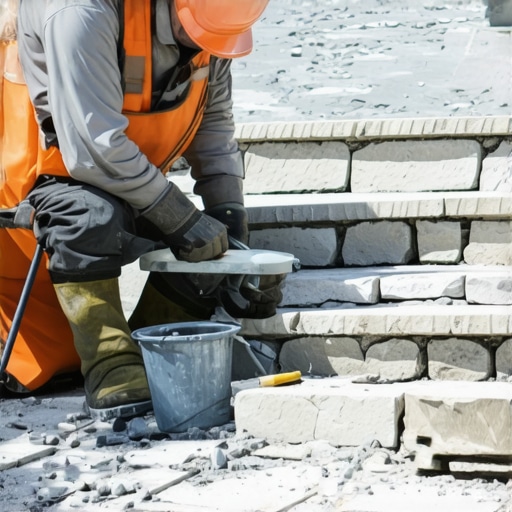
The Forensic Scene: When ‘Just a Loose Step’ Is a Structural Warning
I was called out to a job last October where the homeowner complained about a slight wobble in his front porch stairs. He thought it was a minor annoyance. But when I slid my inspection mirror into the gap under the limestone tread, I didn’t just see a loose stone; I saw a disaster in slow motion. The previous installer had used a cheap, silicon-based caulk to ‘tack’ the stone down, thinking the weight would do the rest. Below that, the concrete block foundation repair that had been done five years prior was already failing because water had been trapped in the honeycombing of the poorly vibrated pour. The ‘ring’ of the stone was dead—it sounded like thumping a piece of wet cardboard. This is the reality of modern masonry: if you don’t understand the chemistry of the bond, you’re just stacking rocks and waiting for gravity to win.
“Water penetration is the single greatest threat to masonry durability.” – BIA Technical Note 7
The Physics of the Failure: Why Your Steps Are Dancing
In our northern climate, we deal with the brutal reality of the freeze-thaw cycle. When water gets behind a stone coping installation or underneath a step, it doesn’t just sit there. It undergoes a phase change. As that liquid becomes ice, it expands by approximately 9% in volume. This exerts thousands of pounds of pressure per square inch—hydrostatic pressure that can snap structural brick ties replacement or heave a modular retaining wall. If your steps are loose, it’s usually because the mechanical bond between the masonry units has been pulverized by this internal expansion. Traditional mortar, or ‘mud’ as we call it on the job site, is excellent for compression, but it has almost zero tensile strength when it’s thin-set. This is why buttering a thin layer of mortar on a loose step rarely works for more than one season; the material is too brittle to handle the vibration of foot traffic combined with thermal expansion.
The Solution: High-Strength Masonry Glue vs. Traditional Mud
When we talk about a ‘mess-free’ fix, we aren’t talking about craft store glue. We are talking about high-viscosity, polyurethane-based structural adhesives that have a higher tensile strength than the stone itself. Unlike mortar, which requires a specific thickness to maintain structural integrity, these adhesives work through chemical fusion. When you apply this to stone wall repair or when securing stone coping, you are creating a flexible, waterproof gasket that moves with the stone rather than cracking under it. The key is the ‘tooth’ of the surface. Masonry is porous. At a microscopic level, it’s a forest of tiny peaks and valleys. A high-strength glue penetrates these pores, creating a mechanical lock that is nearly impossible to break without taking part of the stone with it.
The Step-by-Step Forensic Fix
First, you have to strip it back. You can’t bond to dust. I use a wire brush or a small grinder to remove the laitance—that weak, milky layer of cement that rises to the surface of old concrete. If you’re dealing with a concrete block foundation repair area, ensure the block is structurally sound before even thinking about the aesthetics. Once the surface is clean, you ‘butter’ the back of the stone. But here is the trick: do not create a closed loop of glue. If you trap air or water inside a ring of adhesive, the next freeze will pop the stone right back off. Apply the adhesive in vertical beads. This allows for drainage—a chimney effect for moisture to escape. Use a hawk to hold your tools and keep the ‘mud’ off the finished surfaces. If you are working on a retaining wall installation, this same logic applies to the capstones.
“The bond strength of the mortar to the masonry unit is the most important factor in the water penetration resistance of the wall.” – ASTM C270 Standards
Beyond the Steps: Modular Walls and Metallic Finishes
This forensic approach isn’t limited to just stairs. When we look at modular retaining walls, the failure point is almost always the lack of proper compaction or the failure of the capstones to stay put. Once a capstone goes missing, water enters the core of the wall, leading to efflorescence and eventually total collapse. For those looking at modern aesthetics, like metallic masonry finishes or masonry staining, the prep work is even more critical. You cannot apply a stain or a metallic finish to a wall that is ‘breathing’ too much moisture from a failing foundation. The salts will push the finish right off the face of the brick. Even in an outdoor kitchen masonry build, where heat is a factor, the thermal expansion of the stones requires a bond that can flex without snapping.
The Professional Edge: Why Craftsmanship Still Matters
I’ve spent thirty years watching ‘handyman specials’ crumble because people think masonry is just about the look. It’s not. It’s about moisture management and structural load paths. Whether you are doing tuck pointing services to save a 100-year-old chimney or installing a complex soldier course on a new build, you have to respect the materials. The mess-free way to fix steps using high-strength masonry glue is a valid, professional technique, but only if the substrate is prepared with the same rigor as a cathedral foundation. Don’t be the guy I have to visit in two years with my forensic scope, showing you where the rust has eaten your ties because you skipped the drainage.