
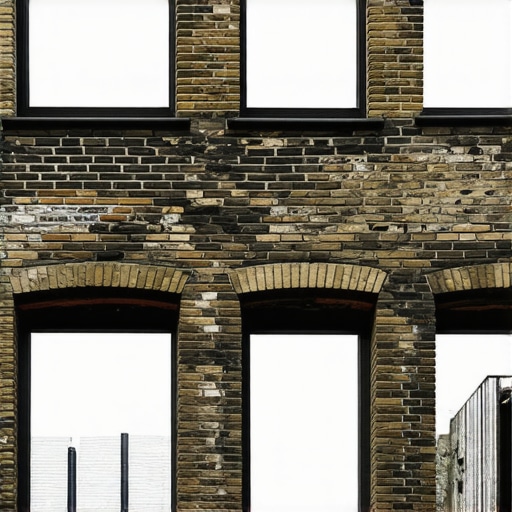
The Scar Across the Facade
Walk down any historic street in an old industrial corridor and you will see them: the ghosts of windows past. They look like jagged, poorly healed surgical scars. A hole where a majestic six-over-six sash once lived, now crudely stuffed with mismatched red blocks and thick, grey, smeared joints. It is the hallmark of a contractor who understands profit margins but has no concept of the chemistry of a wall. When I perform a structural masonry inspection on these aging beasts, I am not just looking for cracks. I am looking for the story of the building. Most of the time, the story of an infill is a tragedy of incompatible materials. Modern Portland cement is a bully. It is hard, brittle, and impermeable. Old brick, fired in coal kilns a century ago, is soft, porous, and needs to breathe. When you shove a stiff concrete patch or modern hard-fired brick into a soft historic opening, you aren’t fixing a wall; you are starting a countdown to structural failure.
The Lesson of the Thirsty Clay
My uncle used to keep a bucket of water on the scaffold, but not for drinking. Before he laid a single unit into a repair, he would submerge the brick. He called it ‘checking the thirst.’ If the brick hissed and bubbles raced to the surface, it had a high initial rate of suction. He knew that if he ‘buttered’ a dry, thirsty brick with wet ‘mud,’ the brick would instantly suck the moisture out of the mortar before the chemical bond could form. The result is a ‘dry bond’—a joint that looks fine for a month but will pop out with the first hard freeze. This tactile understanding of the suction rate is what separates a professional masonry restoration specialist from a guy with a trowel and a truck. You have to match the thirst of the new material to the old, or the wall will reject the transplant like a bad organ.
“Water penetration is the single greatest threat to masonry durability. Proper selection of mortar type and joint profile is essential to ensuring a weather-resistant envelope.” – BIA Technical Note 7
The Chemistry of the ‘Sacrificial’ Joint
To do an invisible repair, you must first understand the physics of the freeze-thaw cycle. In northern climates, water is the primary architect of destruction. Water expands roughly 9% when it turns to ice. In a historic wall, the mortar is designed to be the ‘sacrificial’ element. It is supposed to be softer than the brick so that when the wall shifts or water expands, the mortar takes the stress and cracks, rather than the brick face spalling off. Using a modern Type S mortar—essentially liquid rock—on a 19th-century facade is a death sentence for the surrounding masonry. During freeze-thaw damage restoration, we see the results of this mistake constantly: the faces of the original bricks have popped off because the hard mortar wouldn’t give an inch. For an infill that lasts a century, we go back to the old ways: lime putty and sand, perhaps a hint of Type O masonry cement for a bit of ‘set,’ but never enough to make it harder than the ‘host’ wall. The mortar must be the lung of the building, allowing moisture to migrate out through the joints, not trapping it behind a wall of hard cement.
The Mechanics of the ‘Tooth-In’
A ‘seamless’ repair is a lie—it is actually an intricate puzzle of ‘toothing.’ You cannot just build a new wall inside an old frame. You have to ‘cut out’ the half-bricks on the vertical edges of the opening, creating a jagged edge that allows the new work to interlock with the old. This prevents a vertical ‘cold joint’ that would surely crack from top to bottom due to settlement. When we analyze these openings during BIM masonry projects, we map the exact bond pattern—whether it is a Flemish bond with its alternating headers and stretchers, or a common bond with a soldier course every sixth row. If you don’t match the pattern, the eye catches the disruption instantly. We also look at the ‘strike’ of the joint. Most modern guys use a round ‘slicker’ because it is fast. But old walls often have a ‘grapevine’ joint or a weathered joint. If the shadow line doesn’t match, the repair will scream its presence from a block away.
The Geotechnical Reality of Infilling
When you close a window opening, you are changing the weight distribution of the wall. It sounds minor, but on a five-story masonry load-bearing structure, that added weight of solid brick where a hollow window used to be can cause micro-settlement. This is where retaining wall geogrid installation logic actually crosses over into vertical masonry. We have to ensure that the foundation below can handle the new localized load. In more complex cases, like when we are doing green roofing masonry integration, the moisture levels in the wall change entirely. A window allowed for air exchange; a solid wall does not. This is why chimney flue liner installation and proper ventilation are often discussed in the same breath as masonry repairs—the whole house is a breathing organism. If you plug a hole in the skin, you have to know how the internal organs are going to react.
“The architect should ensure that the mortar is never stronger than the stones, for if the mortar be too hard, the stones will crack.” – Vitruvius, De Architectura
Modern Tech Meets Ancient Craft
We are seeing a rise in robotic masonry repair for large-scale industrial stabilization, but for the delicate art of the window infill, nothing beats the human eye. We now use spectral analysis to match the sand color. People think mortar is white or grey; it isn’t. It is the color of the sand used from the local pit 100 years ago. We find sands with flecks of orange, black, or tan to recreate that specific ‘warmth’ of the original mud. We also have to account for carbonation. Lime mortar cures by absorbing CO2 from the air over decades. A fresh repair will always look a bit ‘bright’ until it has had a few seasons of acid rain and city soot to take the edge off. For clients who can’t wait, we use ‘aging washes’ made of diluted soot and iron oxides to ‘burn’ the new brick so it matches the weathered patina of its neighbors.
The Final Strike
To finish a job properly, you have to be obsessed with the ‘finish’ of the brick itself. New bricks are often too smooth, lacking the ‘tooth’ of hand-molded units. We sometimes have to manually distress the bricks or use a specific concrete patch technique on the edges to mimic the slight crumbling of age. It isn’t about making it look new; it is about making it look like it was always there. Whether we are doing a brick patio restoration or a massive window infill, the goal is the same: the forensic evidence of the repair should be invisible to everyone but another master mason. Do it once, and do it with the right chemistry, or you’ll be back in five years with a hawk and trowel, scraping the failure of your own making off the pavement. Masonry is the art of managing gravity and water; ignore either, and the building will eventually win the argument.