
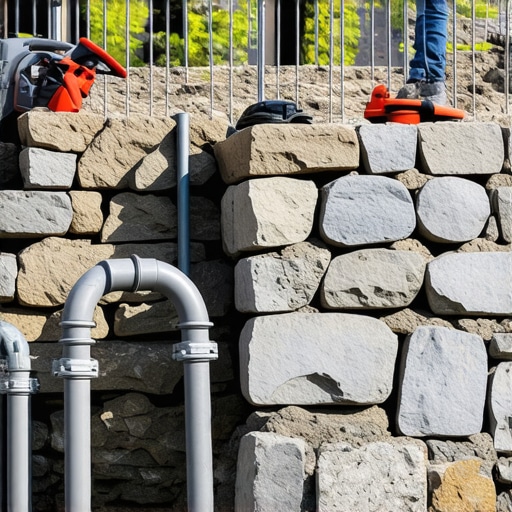
The Silent Groan of 100 Tons of Wet Earth
I stood looking at a $50,000 retaining wall in the rolling hills of the Northeast that lay in a pile of rubble because the contractor forgot one thing: drainage. It wasn’t a sudden explosion. It was a slow, agonizing death by inches. You could see the ‘weeping’ of the stone for months—not the healthy kind of drainage, but a muddy slurry bleeding through the joints, staining the expensive fieldstone a sickly orange. The homeowner thought it was just ‘character’ until the middle section of the wall bowed like a pregnant belly and finally gave way at 3:00 AM on a Tuesday. The physics of failure don’t care about your budget or the aesthetics of your ‘lick-and-stick’ veneer. When water has nowhere to go, it creates its own path, and usually, that path is straight through your masonry. This is a forensic look at the retaining wall drainage upgrade—a surgical procedure for a dying structure.
The Physics of Hydrostatic Pressure: The Invisible Hydraulic Ram
To understand why a wall fails, you have to understand pore water pressure. Imagine the soil behind your stone wall as a giant sponge. When it’s dry, it has internal friction; the particles lock together and support some of their own weight. But when that sponge saturates, every cubic foot of water adds 62.4 pounds of weight. Multiply that by the volume of a ten-foot-deep backfill area, and you aren’t just holding back dirt anymore; you’re holding back a liquid tank. In my forty years of tuckpointing brick walls and inspecting commercial smokestacks, the most common killer I see is the lack of a ‘relief valve.’ In the North, we deal with the brutal freeze-thaw cycle. Water expands 9% when it turns to ice. If that water is trapped in the ‘tooth’ of your stone or behind a dense, non-breathable mortar, it acts like a million tiny jackhammers. It pops the faces off your stones (spalling) and shoves the entire mass forward. This isn’t just a cosmetic issue; it’s a structural catastrophe.
“Water penetration is the single greatest threat to masonry durability. Without proper management of hydrostatic pressure, structural integrity is mathematically impossible over a fifty-year lifecycle.” – BIA Technical Note 7
The Anatomy of a Failing Wall: Diagnosing the ‘Stair-Step’ and the ‘Belly’
Before we talk about the fix, we look at the crack. A vertical crack usually tells me about settlement—the ground under the wall is soft. But a horizontal bulge? That’s the ‘belly’ of the wall telling me it’s drowning. I’ve seen this in everything from simple garden walls to complex commercial smokestack repair jobs where the base wasn’t properly diverted. When the soil heaves, it applies lateral pressure that the stone wasn’t designed to handle. Stone is great in compression—you can stack it to the moon—but it’s weak in tension. As a third-generation mason, I can smell the dampness in a basement or behind a wall before I even see the mold. It’s a heavy, metallic scent of anaerobic earth that hasn’t seen oxygen in a decade. If you see ‘honeycombing’ in the mortar or white, crusty efflorescence, your wall is screaming for help.
The Surgical Retrofit: How to Install Drainage Without Demolition
Most ‘experts’ will tell you to tear the wall down. I say that’s often a waste of good stone. A retaining wall drainage upgrade can be done through a process we call horizontal core drilling. We use diamond-tipped bits—the kind that cost $400 a pop and can chew through granite like butter—to create weep holes at the lowest point of the wall. These aren’t just holes; they are the start of a new circulatory system. We drill at a slight upward angle, maybe 5 degrees, to let gravity do the heavy lifting. Once the core is out, we insert a perforated sleeve and a non-woven geotextile filter. This prevents the ‘fines’ (tiny soil particles) from clogging the new artery. For larger walls, we might use self-leveling masonry lifts to stabilize the base before we start drilling, ensuring the wall doesn’t shift while we’re performing surgery. It’s a gritty, wet job, but it saves the structure.
“Provision for drainage of water from the backfill shall be made to prevent the accumulation of water behind the wall.” – ASTM C1771 – Standard Manual for Masonry Foundations
The Geotechnical Reality: Soil Chemistry and Aggregate Selection
You can’t just throw any gravel behind a wall. In my grandfather’s day, they used clean river stone because it had no ‘fines.’ Today, people use ‘crusher run’ because it’s cheap. That’s a mistake. Crusher run has dust that, when wet, turns into a waterproof paste—exactly what you don’t want. When we retrofit, we often have to excavate a narrow trench behind the wall and replace the top three feet of ‘junk’ soil with #57 clean stone. We wrap that stone in a ‘burrito’ of silt-filter fabric. This ensures that when the rain hits, it drops straight down to our new pipes instead of turning the backfill into a slurry. I’ve applied this same logic to outdoor masonry fountain restoration; if you don’t control the water, the water will control the masonry. Whether you’re doing a chimney flue liner installation or an outdoor fireplace rebuild, the management of moisture and thermal movement is the same fundamental science.
Tools of the Trade: Beyond the Trowel
A real mason doesn’t just use a hawk and trowel. For a drainage retrofit, we’re talking about rotary hammers, borescope cameras to look behind the stone, and hydrostatic pressure gauges. When we’re finishing the joints after the retrofit, we use a ‘slicker’ or a jointer tool to compress the ‘mud’ (mortar). You want that mortar to be ‘Type N’ for most stone walls—hard enough to hold, but soft enough to breathe. If you use a high-strength Portland cement on old, soft fieldstone, you’ve just signed its death warrant. The cement will stay hard while the stone expands, and the stone will be the one to break. It’s a sacrificial principle: the mortar should be the weakest link, not the stone. This is the same reason why tuckpointing cost estimation varies so wildly; you’re paying for the knowledge of the mix, not just the labor of ‘buttering’ the joints.
The Hardscape Truth: Maintenance and Longevity
A wall is a living thing. It breathes, it moves, and it reacts to the seasons. If you’ve just finished a brick patio restoration or a brick veneer installation, don’t think you’re done. You need to check those weep holes every spring. Poke a wire up there. Make sure the ‘mud’ isn’t cracking. If you see a new ‘stair-step’ crack, don’t just slap some caulk in it. That’s a ‘handyman special’ that traps more water and accelerates the rot. Call someone who knows the difference between a cosmetic crack and a structural failure. We are the forensic investigators of the built environment. We look at the stains, the salts, and the tilt of the stone to tell the story of what’s happening underground. Do it once, do it right, or you’ll be doing it twice at triple the price. That is the only law in the world of masonry.