
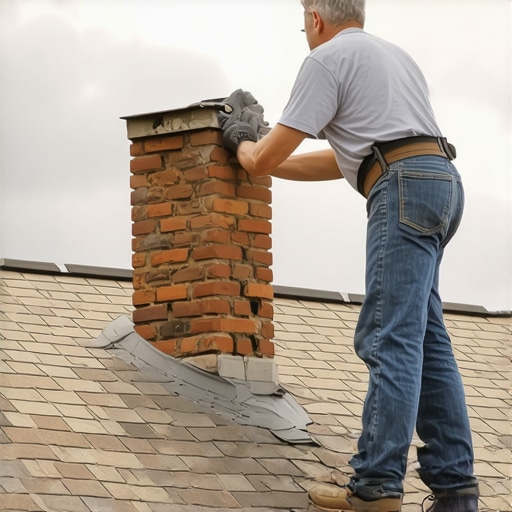
The Forensic Scene: A Microscopic Ecosystem Behind the Brick
The homeowner thought it was just a hairline crack near the ceiling. A nuisance, perhaps, but not a disaster. But when I put my borescope inside the cavity behind the chimney breast, the reality was grim. I saw structural steel that had been rusted to dust, and a roof deck that felt like wet cardboard. The culprit wasn’t a hole in the roof; it was a failure of the chimney flashing so subtle that it had been slowly siphoning water for five years. This is the reality of masonry forensics: water doesn’t just fall; it migrates, it clings, and it destroys from the inside out. When we talk about tuckpointing and chimney health, we aren’t just talking about aesthetics; we are talking about the hydrodynamics of a vertical structure exposed to the elements.
“Water penetration is the single greatest threat to masonry durability. Moisture entering a chimney system can cause structural damage through freeze-thaw cycles and internal corrosion of support elements.” – BIA Technical Note 7
The Physics of the ‘Drip’: Capillary Action and Surface Tension
To understand why your chimney is leaking, you have to understand the ‘tooth’ of the masonry. A brick isn’t a solid block; it’s a network of microscopic pores. When water hits the face of a chimney, it doesn’t always run down. Through capillary action, it can be sucked into the brick itself. This is why commercial masonry facade maintenance is so critical. If the tuck pointing services used a mortar that is too dense—like a high-Portland cement mix—the water gets trapped. In northern climates, that trapped water expands by 9% when it freezes. This expansion is what causes spalling, where the face of the brick literally pops off, leaving the soft interior exposed to the wind.
The Anatomy of Failure: Flashing and the Counter-Flashing Dance
The flashing is the transition zone between the rigid masonry and the flexible roof. A proper setup requires a ‘step flashing’ integrated into the shingles and a ‘counter-flashing’ embedded into the mortar joints. I often see ‘handyman specials’ where someone has just smeared a thick bead of silicone caulk over the gap. This is a death sentence for the masonry. Over time, the sun’s UV rays bake that caulk until it loses its ‘suction’ and pulls away, creating a hidden trough for water. This is why commercial parapet wall repair techniques are often applied to residential chimneys; we need to grind out the joint with a slicker and properly embed the metal to ensure a mechanical bond that defies the wind.
The Material Science of Sustainable Tuckpointing Mortars
In my three generations of laying brick, the biggest mistake I’ve seen is the use of modern, hard mortars on old, soft bricks. We advocate for sustainable tuckpointing mortars, which are typically lime-based. Unlike modern cement, lime is ‘self-healing.’ As it reacts with CO2 in the air—a process called carbonation—it can actually seal microscopic cracks that form over time. This ‘breathability’ allows moisture to escape the chimney rather than being trapped behind a wall of hard ‘mud.’ For those looking at modern aesthetics, even a metallic brick colors application requires a substrate that can handle thermal expansion without shearing the bond.
From Foundations to the Sky: A Holistic Approach
A chimney’s weight is immense, and any shift in the ground can manifest as a gap in the flashing. This is why concrete block foundation repair is sometimes the first step in stopping a roof leak. If the chimney is leaning even a fraction of an inch, it will pull the flashing away from the roofline. In the most advanced cases, we are now seeing self-healing concrete foundations and robotic masonry repair systems that can precision-inject stabilizers into the soil or the joints. However, for most homeowners, the solution is simpler: a proper chimney cap replacement to keep the water out of the flue and professional tuckpointing to keep the external joints ‘tight.’
“The joints shall be raked to a depth of 1/2 inch and repointed with mortar that matches the original in strength and composition to ensure structural compatibility.” – ASTM C67/C67M Standard
The Master’s Technique: Buttering the Joint
When you see a mason at work, watch how they ‘butter’ the brick. It’s an art of consistency. The ‘mud’ must be just wet enough to have ‘suction’ but dry enough to hold its shape on the hawk. When performing tuck pointing services, we don’t just slap mortar in. We ‘strike’ the joint with a jointer tool to compress the material. This compression is vital; it forces the mortar into the ‘pores’ of the brick, creating a watertight seal. This is especially true for a soldier course—those vertical bricks often seen at the top of a chimney or over a window—where gravity is constantly trying to pull the mortar out of the joint. Do it once, or do it twice; the choice is yours, but the storm won’t wait for you to decide.