
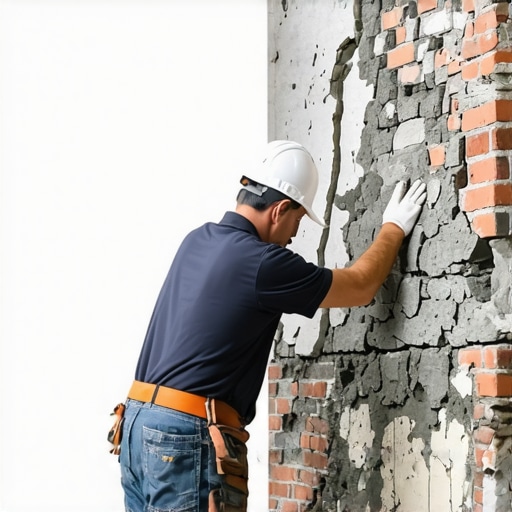
The Forensic Reality of Decaying Masonry
I remember a job site on a humid Tuesday where a homeowner pointed at a hairline fracture running through a soldier course above her garage. She thought it was cosmetic. I pulled out my borescope, threaded it through a failed mortar joint, and showed her the nightmare: the structural steel lintel had oxidized so severely it had expanded to twice its original thickness, literally jack-hammering the masonry apart from the inside out. This is the reality of structural masonry inspection. It isn’t about what you see on the surface; it is about understanding the silent war between moisture, chemistry, and gravity. Most modern contractors treat brick like wallpaper, but to a third-generation mason, it’s a living, breathing system that requires specific physics to survive. When we perform professional masonry restoration, we aren’t just ‘fixing cracks’—we are performing forensic surgery on a building’s skeleton.
“Water penetration is the single greatest threat to masonry durability. Proper drainage and material compatibility are the cornerstones of longevity.” – BIA Technical Note 7
1. The Stair-Step Crack: A Tale of Soil and Subsidence
The most common red flag we hunt for is the diagonal stair-step crack. If the crack follows the mortar joints in a ‘staircase’ pattern, the building is telling you that the footing is failing. This is often due to hydrostatic pressure or poor soil compaction. In regions with heavy clay, the soil expands and contracts like a dry sponge. When it shrinks, the foundation drops, and the masonry must move. Because mortar is the ‘sacrificial’ element in a wall, it breaks first. However, if the crack shears straight through the brick units themselves, you have a much more violent structural shift. This requires immediate intervention, often involving helical piers or deep-soil injection before any mortar repointing services can be effectively applied. If you butter over a settling crack without addressing the movement, you are just throwing money into a hole in the ground.
2. Spalling and Efflorescence: The Chemistry of Internal Pressure
When I see ‘bearded’ brick—covered in white, powdery salt known as efflorescence—I know the wall is drowning. This isn’t just a cleaning issue. It’s a sign that water is migrating through the substrate, dissolving salts, and depositing them on the surface. But the real killer is spalling. In northern climates, the freeze-thaw cycle is a predator. Water expands by roughly 9% when it turns to ice. If a previous ‘handyman’ used a hard Portland-based cement to patch an old lime-mortar wall, that water gets trapped. The hard cement doesn’t breathe, so the water stays inside the soft brick. When it freezes, the face of the brick literally explodes off. This is why tuckpointing weatherproofing must use mortars with lower compressive strength than the masonry units themselves. We use the ‘hawk’ and ‘slicker’ to pack in breathable lime-based mud that allows the wall to aspirate, preventing the ‘face-pop’ that ruins stone balustrade restoration projects.
3. The ‘Wavy’ Wall: Brick Veneer Detachment Repair
If you stand at the corner of a building and look down the plane of the wall, it should be as straight as a laser. If you see a ‘belly’ or a bulge, you are looking at a potential collapse. This is often a sign that the wall ties—the metal pieces connecting the brick veneer to the wood or steel studs—have rusted through or were never installed. Without these ties, the brick is just a heavy curtain held up by its own weight. In brick veneer detachment repair, we have to use stainless steel mechanical anchors to tie the facade back to the structure. This ‘lick-and-stick’ mentality of modern builders, who skip the retaining wall weep hole cleaning or use cheap galvanized ties, leads to walls that can literally peel off during a high-wind event or a minor tremor.
“The compressive strength of the mortar should always be less than that of the masonry units to ensure that any stress-induced cracking occurs in the mortar joints rather than the units themselves.” – ASTM C270 Standards
4. Arch Deflection and Lintel Rot
The arch is one of the most stable forms in architecture, but it relies on ‘thrust.’ When we perform brick arch restoration, we look for a dropped keystone. If the center stone of an arch has slipped even a fraction of an inch, the entire structural integrity is compromised. This usually happens because the mortar has turned to sand due to age and moisture. Similarly, rusted lintels over windows and doors are a primary fail point. As the iron rusts, it creates ‘rust-jacking,’ which lifts the masonry and creates those classic 45-degree cracks at the corners of openings. This isn’t just about ‘mudding’ it; it often requires a full replacement of the steel and a complete outdoor masonry fountain restoration mindset where every joint is sealed against the elements.
5. Clogged Weep Holes and Hydrostatic Failure
Every masonry wall needs to breathe and drain. Weep holes are the small gaps left in the bottom soldier course to let water out. I’ve seen countless homeowners ‘beautify’ their homes by caulking these holes shut. That is a death sentence for the wall. Water builds up behind the brick, creating immense hydrostatic pressure and causing the brick paver driveway repair issues nearby to look like child’s play. If the water can’t get out, it rots the wood sheathing behind the brick and creates a mold factory. Professional restoration always includes retaining wall weep hole cleaning to ensure that the internal drainage plane is functional. Without drainage, the finest craftsmanship in the world will fail within a decade.