How to Fix Bowing Foundation Walls: 3 Proven 2026 Fixes
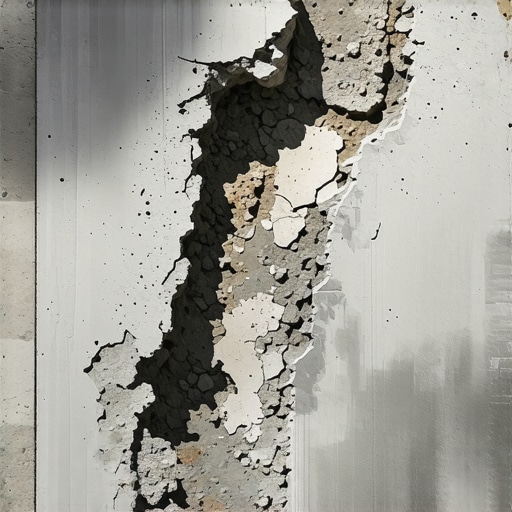
The Forensic Scene: When a Hairline Crack Becomes a Structural Grave
I recently walked into a basement in the humid sprawl of the Great Lakes region. The homeowner, a well-meaning DIYer, thought he could solve his problems with a five-gallon bucket of ‘waterproofing’ paint and some concrete patch. He was proud of how he’d covered a horizontal crack that ran the length of his west wall. But as I pulled my borescope from my kit and inserted it into a pilot hole, the reality was grim. The interior of that 10-inch block was a soup of saturated silt. The vertical steel reinforcement, which should have been the wall’s backbone, had undergone such severe oxidation that it was nothing more than a ghost of rust—flaking away like burnt cedar. That wasn’t just a crack; it was the structural steel being reduced to dust by 100 years of neglected hydrostatic pressure. This is the reality of concrete masonry unit restoration: if you don’t respect the physics of the soil, the soil will eventually reclaim your house.
“The design and construction of masonry walls must account for lateral loads, including hydrostatic pressure, which can exceed the vertical load-bearing capacity of the unit.” – BIA Technical Note 17
When you see a wall bowing inward, you aren’t looking at a ‘settling’ house. You are looking at a failure of the material to resist lateral earth pressure. In northern climates, this is exacerbated by the freeze-thaw cycle. Water trapped in the soil expands by roughly 9% when it turns to ice. That expansion exerts a force that can reach thousands of pounds per square foot. If your wall doesn’t have the tensile strength to fight back, it snaps. Usually, it snaps at the third or fourth course of block, creating that classic horizontal ‘belly’ in the wall. You can’t just ‘butter’ some new mud into those joints and call it a day. You need a forensic approach.
The Physics of the Bow: Hydrostatic Pressure and Soil Heaving
To understand the fix, you have to understand the ‘why.’ Most foundations fail because of the clay content in the soil. Clay is a sponge. When it’s wet, it swells; when it dries, it shrinks. This constant movement creates a rhythmic ‘pumping’ action against your foundation. Over decades, the wall loses its ‘memory’ of being straight. We call this a loss of structural integrity, but I call it a wall that’s tired of fighting gravity. We look at retaining wall batter correction principles even in basements. A wall needs a ‘batter’ or a slight lean against the load, but a basement wall is built vertical. Once it moves past the center of gravity, the weight of the house itself starts to help the soil push the wall in.
This is where digital twin masonry projects are changing the game in 2026. We can now use LiDAR scanning to create a 1:1 digital replica of your foundation. This ‘digital twin’ allows us to simulate different loads and predict exactly where the next failure point will be. We aren’t guessing anymore. We aren’t just ‘tapping the brick’ to see if it rings like my grandfather used to. We are using structural modeling to determine if re-pointing services will suffice or if the wall needs a full self-leveling masonry lift to restore the vertical plane.
Fix #1: Carbon Fiber Reinforcement (The Tensile Shield)
For walls that have bowed less than two inches, carbon fiber is the gold standard of 2026. This isn’t your grandfather’s steel I-beam that takes up six inches of floor space. Carbon fiber straps are thinner than a nickel but have a tensile strength ten times that of steel. We ‘butter’ the back of the strap with a high-strength epoxy resin and bond it directly to the concrete masonry unit restoration site. The magic here is in the chemical bond. The epoxy penetrates the pores of the block, creating a monolithic structure.
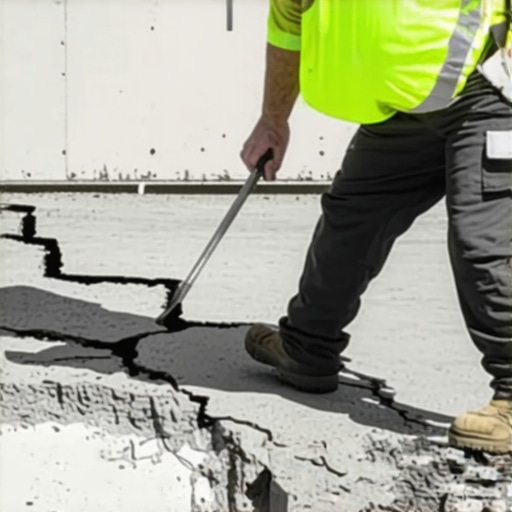
“Cracks in concrete masonry units that exceed 1/16 of an inch are often indicators of structural movement rather than simple shrinkage.” – ASTM C1314 Standard Research
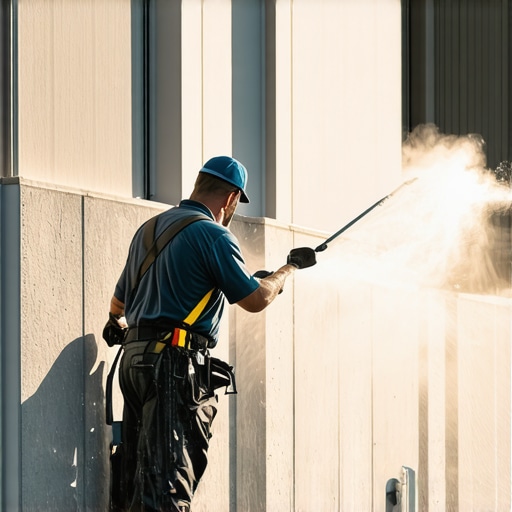
When the soil tries to push the wall inward, the carbon fiber takes the tension. Since the strap cannot stretch, the wall cannot bow. It’s a passive system that requires zero maintenance. However, the preparation is everything. If you have honeycombing in your concrete or if the surface is dusty, the bond will fail. We use facade cleaning techniques to prep the block, ensuring the ‘tooth’ of the concrete is exposed for the resin to bite into.
Fix #2: Helical Tie-Backs and Earth Anchors
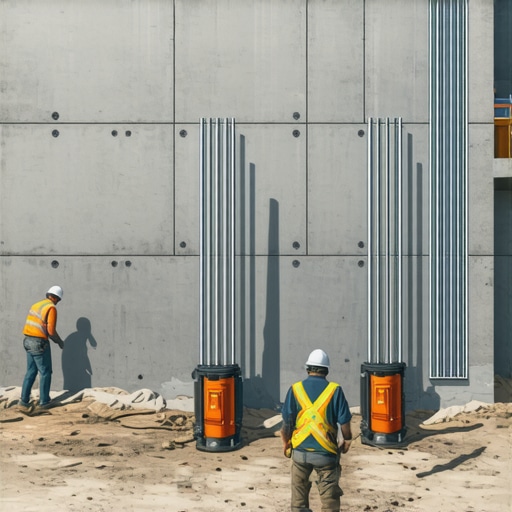
If the wall has moved significantly—more than two inches—straps aren’t enough. You need to reach out into the yard and grab the earth itself. This is where retaining wall batter correction logic comes back into play. We drill a small hole through the wall and drive a helical anchor deep into the virgin soil, far beyond the ‘active zone’ of expansion and contraction. A heavy-duty steel plate is then attached to the interior of the wall. By tightening a nut on the anchor, we can actually pull the wall back toward its original position over time. This is a slow, methodical process. You don’t just crank it down in one day. You give the soil time to relax, similar to how we handle tuckpointing curved walls where the geometry is delicate and requires patience.
Fix #3: Digital Twin-Guided Concrete Masonry Unit Restoration
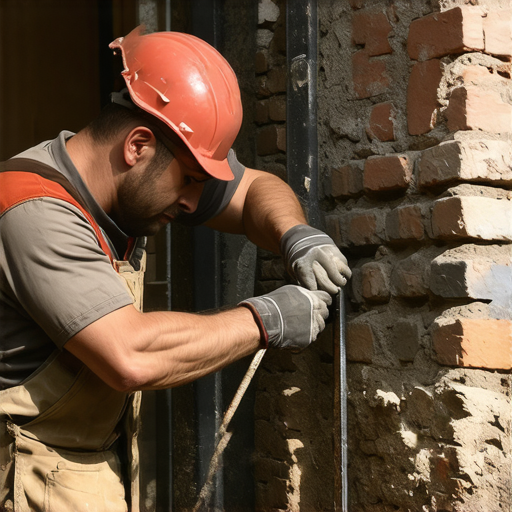
In 2026, the most advanced fix is the hybrid approach using digital twin modeling to guide self-leveling masonry lifts. If the foundation has not only bowed but also sunk, we use high-pressure grout injection (poly-jacking) to lift the footing back to level. The digital twin tells us exactly how many PSI of pressure to apply at specific points to avoid cracking the stone facade restoration above. Once the wall is level, we perform tuckpointing curved walls or standard joints using a slicker to ensure the mud is packed tight. We use Type S mortar for its high lateral strength, ensuring the new joints can handle the pressure that the old ones couldn’t.
The Hard Truth About Maintenance
You can spend $20,000 on helical anchors, but if your gutters are clogged, you’re throwing money into a hole. Water management is 90% of masonry health. If you see honeycombing at the base of your wall or cold joints where the concrete didn’t pour correctly, you’re inviting water to sit. I always tell homeowners: a dry basement is a straight basement. Don’t trust a handyman special for structural work. They’ll give you a concrete patch and a smile, but they won’t be there when the soldier course on your brick veneer starts to peel away because the foundation underneath is folding like a lawn chair. Do it once, do it right, and respect the mud.