Fix Crumbling Arches: 4 Brick Arch Restoration Tips for 2026
The Anatomy of a Dying Arch
I remember a great-uncle of mine, a man whose hands looked like gnarled oak roots and always smelled of lime and damp earth. He wouldn’t just look at a brick; he’d press a wet thumb against the fired clay. If the moisture vanished instantly, he’d mutter that the brick was ‘thirsty’ and would rob the mud of its life. He knew that the ‘suction’ or Initial Rate of Absorption (IRA) determined whether a wall would stand for a century or crumble in a decade. Today, I see arches from the early 1900s failing not because of the brick, but because a modern ‘handyman’ slapped a patch of high-strength Portland cement over a soft lime-mortar joint. It’s a death sentence. When you see a brick arch starting to drop its keystone or show ‘stair-step’ cracking, you aren’t just looking at a cosmetic flaw; you are witnessing a structural tragedy where the physics of gravity are winning over the chemistry of the mortar.
“The durability of a masonry wall is dependent on the compatibility of the mortar with the masonry units. Using a mortar that is harder than the brick leads to irreversible spalling.” – BIA Technical Note 1
1. The Geometry of the Birdsmouth Cut and Skewback Realignment
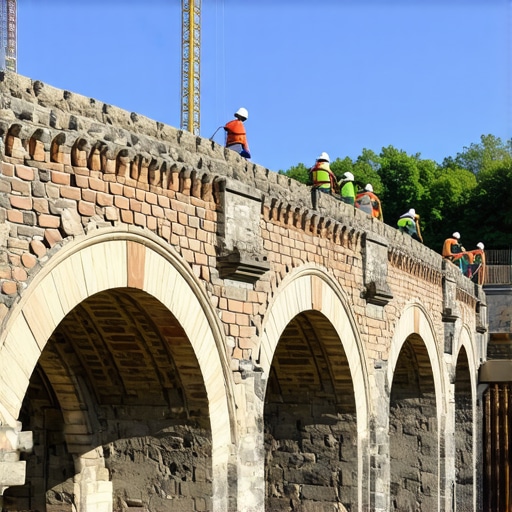
To fix an arch, you have to understand the ‘thrust.’ An arch doesn’t just sit there; it wants to push outward. This is where the masonry birdsmouth cuts and the skewbacks come into play. A birdsmouth is a V-shaped notch cut into a brick to allow it to sit over a corner or change direction, often found where an arch meets a vertical pier. In many ‘masonry rescue after disaster’ scenarios, the original skewback—the angled brick that starts the arch’s curve—has shifted due to foundation settlement. If that angle is off by even a fraction of a degree, the entire load distribution fails. When restoring these in 2026, we don’t just ‘butter’ the brick and shove it in. We use a hawk to hold a specific mix of lime-rich mud, ensuring the joint is packed tight to the back of the arch. If the birdsmouth isn’t cut with a diamond-blade saw for a precise fit, you create a point of high stress that will snap the brick under the weight of the soldier course above it. Micro-zoom into the physics: if the contact area is reduced by 20% due to a poor cut, the localized pressure on that clay unit can exceed its compressive strength, leading to ‘honeycombing’ or internal crushing before the mortar even cures.
2. The Chemistry of Breathability: Moving Beyond Type S
The biggest mistake in modern mortar repointing services is the obsession with strength. In a historic arch, the mortar must be the ‘sacrificial’ element. It should be softer and more permeable than the brick. This allows the wall to ‘breathe.’ When moisture enters a wall—and it always does—it needs to escape. If the mortar is a hard, vapor-impermeable Portland mix, the water gets trapped behind the face of the brick. During a freeze-thaw cycle, that water expands by 9% in volume. This creates internal hydrostatic pressure that literally pops the face off the brick, a process known as spalling. For spalled concrete steps repair or brick arch restoration, we are seeing a shift toward fiber-reinforced mortars that offer high flexural strength without the rigidity of pure cement. These fibers act like microscopic rebar, holding the ‘mud’ together during the carbonation process—where the lime absorbs CO2 from the air to turn back into stone over months, not hours. This slow ‘hydration’ is what gives old arches their resilience.
“Mortar should be designed to be weaker than the masonry units so that any stress-induced cracking occurs in the joints, which are easier to repair than the bricks themselves.” – ASTM C270 Standards
3. Managing the Moisture: Weep Holes and Stone Coping
An arch often fails because of what’s happening above it. If you have a stone coping installation at the top of a parapet that has failed, water is dumping into the core of the wall. This leads to brick efflorescence removal becoming a constant, losing battle as salts are leached out of the masonry and crystallized on the surface. During a chimney rebuild services call or an arch restoration, I always look for the ‘drip edge.’ Without a proper overhang, water clings to the underside of the stone and runs right into the arch’s joints. We also implement retaining wall weep hole cleaning techniques for heavy masonry arches. By installing small, hidden tubes in the vertical joints above the arch, we give trapped moisture an exit path. Without this, the ‘cold joint’—the interface where new mortar meets old—becomes a pocket for ice to form, slowly prying the arch apart from the inside out. I’ve seen arches that looked solid until I hit them with a slicker; the sound was ‘hollow,’ a sign that the mortar had detached from the brick entirely due to internal water pressure.
4. Tuckpointing Cost Estimation and the ‘Slicker’ Finish
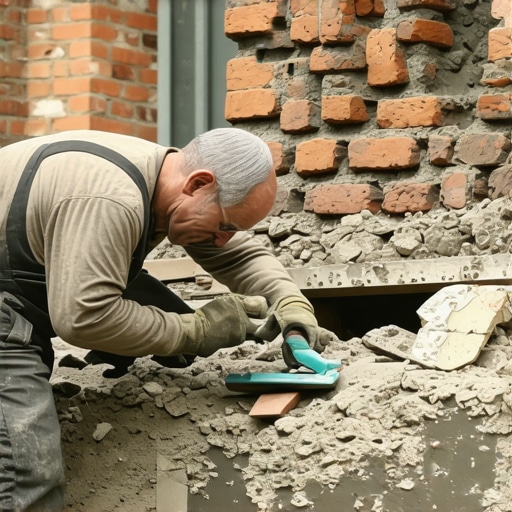
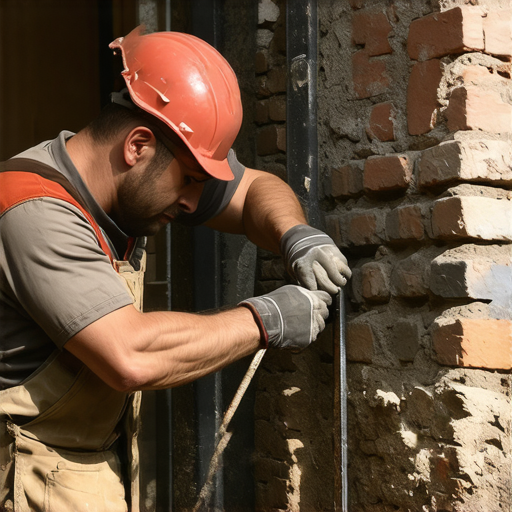
When clients ask for a tuckpointing cost estimation, they often balk at the price of arch work. But you aren’t paying for ‘mud’; you’re paying for the ‘strike.’ A proper restoration involves grinding out the old, failing mortar to a depth of at least one inch, or until we hit sound material. We then ‘butter’ the joints in ‘lifts’—layers—to prevent shrinkage cracks. The final ‘strike’ with a jointer or slicker tool isn’t just for looks. By compressing the mortar into the joint, we are mechanically increasing its density at the surface, creating a ‘skin’ that sheds water. In 2026, we are also seeing more masonry rescue after disaster teams using hydraulic lime (NHL) which sets under water. This is critical for arches in damp environments. If you skip the compression phase, the mortar remains porous, like a sponge, inviting the next freeze to destroy your work. A cheap job today means a total collapse tomorrow. It’s the difference between ‘licking and sticking’ a repair and truly restoring the structural integrity of the home.
![3 Sustainable Block Cutting Tactics to Cut Project Waste [2026]](https://masonryrescue.com/wp-content/uploads/2026/02/3-Sustainable-Block-Cutting-Tactics-to-Cut-Project-Waste-2026.jpeg)