Commercial Tuckpointing: 5 Tactics to Cut 2026 Costs
The Forensic Reality: Behind the Hairline Crack
The facility manager at a mid-century textile mill called me last November. He pointed to a hairline fracture running vertically through a soldier course above the third-floor windows. He thought a bit of caulk would settle it. I didn’t. When I deployed the fiber-optic scope into the cavity, I didn’t see structural integrity; I saw a ‘rust blossom.’ The steel lintel, neglected for decades, had oxidized. When steel rusts, it expands up to ten times its original thickness. This phenomenon, known as ‘pack rust,’ generates internal pressures exceeding 9,000 PSI—far greater than the 2,000 PSI tensile strength of the surrounding clay units. That ‘hairline crack’ was the final scream of a wall about to fail. This is the reality of commercial masonry: by the time you see the damage, the bill has already doubled. To cut your 2026 expenditures, you have to stop looking at masonry as a static skin and start seeing it as a living, breathing chemical system.
“Water penetration is the single greatest threat to masonry durability, leading to efflorescence, spalling, and the eventual degradation of the structural assembly.” – BIA Technical Note 7
Tactic 1: Prioritize Laboratory-Grade Mortar Matching over Generic ‘Mud’
In the world of mortar repointing services, the biggest mistake is the ‘Type S Trap.’ In Northern freeze-thaw climates, contractors often want to use high-strength Portland cement mixes because they get hard fast. But masonry is a game of sacrificial components. Your mortar must be softer (lower compressive strength) than the brick. If you use a rigid, high-cement mud on 19th-century common bricks, the brick becomes the weakest link. When the wall expands in the summer heat or contracts in the winter, the mortar won’t give. Instead, the brick face will pop off in a process called spalling. For 2026, mandate a petrographic analysis. We micro-zoom into the sand gradation and the binder-to-aggregate ratio. We look for the calcium silicate hydrate (C-S-H) crystals. If your re-pointing services aren’t matching the Young’s Modulus of the existing wall, they aren’t repairing it; they are installing a time bomb.
Tactic 2: Addressing the ‘Tooth’ and Suction of the Joint
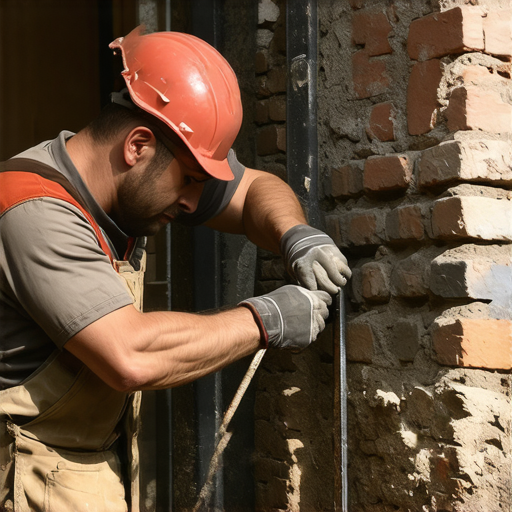
When we talk about historic pointing styles, we aren’t just being fancy with a slicker. The shape of the joint—whether it’s a grapevine, weather-struck, or concave—dictates how water sheds. In my grandfather’s day, they understood the ‘Initial Rate of Absorption’ (IRA). If you slap fresh mortar onto a dry, thirsty brick without pre-wetting it, the brick will suck the water out of the mortar instantly. This ‘flash sets’ the mud, preventing the chemical hydration needed to create a bond. You end up with a cold joint where the mortar just sits in the gap without any ‘tooth’ or mechanical bond. For your 2026 projects, ensure your crews are practicing ‘Saturated Surface Dry’ (SSD) techniques. This ensures the mortar cures slowly, allowing the lime and cement to grow into the pores of the brick. [image_placeholder_1]
Tactic 3: Forensic Foundation Wall Bowing Repair and Hydrostatic Management
I’ve walked into basements where the foundation wall bowing repair consisted of some ‘handyman special’ carbon fiber strips slapped over a wall that was leaning six inches inward. That’s like putting a band-aid on a compound fracture. In commercial structures, bowing is usually a result of hydrostatic pressure—water-logged soil pushing against the masonry. The physics are relentless: water weighs 62.4 pounds per cubic foot. If your drainage is shot, that’s thousands of pounds of lateral force. Before you spend a dime on advanced masonry adhesives or interior bracing, you have to fix the soil mechanics. We look for honeycombing in the concrete or mortar joints that have turned to mush. True 2026 cost-cutting involves excavating the exterior, applying a crystalline waterproofing membrane, and installing proper drainage. You fix the pressure, or the wall will eventually win.
Tactic 4: The Quoin and Corner Audit
The brick quoin repair is often neglected because people think quoins are just decorative. In reality, the corners of a building are the structural anchors that handle the most intense wind-driven rain and thermal stress. If the quoins are failing, the entire ‘envelope’ is compromised. We see this often in stone veneer repair where the ‘lick-and-stick’ method was used. The mortar fails at the corner, water gets behind the stone, and the freeze-thaw cycle kicks in. Water expands 9% when it freezes. In a tight corner, that expansion has nowhere to go but out. This is why we are seeing a shift toward mortarless masonry systems for certain non-load-bearing commercial accents; they allow for internal drainage that traditional ‘wet’ systems simply can’t match.
“Mortar shall be specified by either the proportion specifications or the property specifications of this standard.” – ASTM C270 Standard Specification for Mortar for Unit Masonry
Tactic 5: Hardscape Integrity and the ‘Wicking’ Effect
Finally, look down. Your brick paver driveway repair is connected to your building’s health. When pavers settle and trap water against the foundation, that moisture ‘wicks’ up through the masonry via capillary action. This is the ‘wicking’ effect, where salt-laden water travels through the mud and evaporates, leaving white crusty efflorescence behind. These salts expand as they crystallize, blowing the mortar apart from the inside out. Don’t let your 2026 budget be consumed by rising damp. Re-level your pavers, ensure a 2% slope away from the structure, and use high-quality polymeric sands that act as a barrier rather than a sponge. Stop buying tuckpointing tools for DIY and thinking your maintenance guy can fix a three-story facade. Masonry is a forensic science of heat, moisture, and chemistry. If you don’t respect the physics, the physics will respect your bottom line by destroying it.