
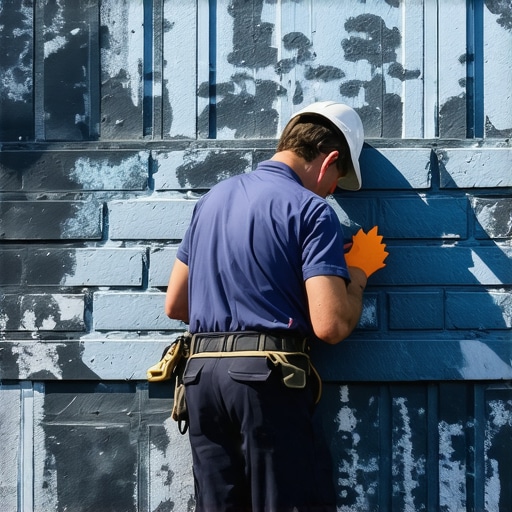
The first time I saw the failure of a metallic glazed facade, it wasn’t a slow decay; it was a structural shedding. The homeowner called me out to a 1920s custom build that had been ‘modernized’ in the late 90s with a high-end metallic-coated brick. To the untrained eye, it looked like the building was simply dirty. But when I pulled my magnifying scope from my kit and pressed it against a quoin, I didn’t see soot. I saw the architectural equivalent of a Stage 4 melanoma. The metallic finish—that expensive, shimmering skin—was lifting in microscopic sheets. Behind it, the structural steel lintels were weeping rust, and the brick itself was turning into a damp, red powder. The owner thought a power wash would fix it. I had to tell him that his building was essentially suffocating under its own skin.
The Physics of the Metallic Failure
When we talk about metallic brick finishes, we are usually dealing with one of two things: a ceramic glaze fired into the clay, or a secondary metallic coating applied to the surface. In the world of masonry forensic work, we look at the ‘Coefficient of Thermal Expansion.’ Every material expands and contracts when the sun hits it. Brick is a heavy, porous animal; it breathes and moves slowly. Metallic coatings, especially those poorly bonded, are rigid and fast to react to heat. When that sun beats down on a south-facing wall in July, the metal skin wants to expand at a rate that the clay body simply cannot match. This creates a shear force at the molecular level, right at the bond line.
“Water penetration is the single greatest threat to masonry durability, specifically when surface coatings inhibit the natural vapor transmission of the substrate.” – BIA Technical Note 7
This is where the ‘micro-zooming’ into the chemistry matters. Brick is naturally vapor-permeable. It sucks in moisture from the humid air or through capillary action from the ground. That moisture needs to get out. In a traditional brick wall, the water evaporates through the face. But a metallic finish acts like a plastic wrap. The vapor reaches the back of the metallic skin, hits a wall, and then the physics of ‘Vapor Pressure’ takes over. As the temperature rises, that trapped water turns to vapor, expanding its volume significantly and literally pushing the metallic finish off the brick from the inside out. This is the root cause of brick spalling prevention failures.
Restoration Protocols: Saving the Facade
If you’re seeing flaking, the first step is a forensic ‘tap test.’ I take my hammer and lightly drag the handle across the surface. A healthy bond sounds like a sharp ‘tink.’ A delaminated metallic finish sounds hollow, like a drum. Once we identify the failure zones, we look at masonry repair services that understand the ‘sacrificial’ nature of restoration. You cannot simply butter some new mortar over a flaking metallic brick and call it a day.
For brick quoin repair or brick arch restoration, we often have to strip the failing finish back to the raw clay. This is where the ‘tooth’ of the masonry comes in. If the brick face is too smooth—what we call ‘fire-flashed’—the new bond won’t hold. We have to mechanically or chemically etch the surface to create a profile that the new ‘mud’ can grab onto. When we talk about the ‘mud’ (our trade term for mortar), we aren’t just mixing sand and cement. We are looking at the hydration curve. If the mortar dries too fast, a process known as ‘flash setting,’ it won’t form the chemical needles that interlock with the brick’s pores. It just sits on top like a dry cracker.
Tuckpointing and the Art of the Bond
Many homeowners think tuckpointing tools for DIY are all they need to fix a flaking facade. They buy a cheap slicker and a hawk from a big-box store and start stuffing Type S mortar into the joints. This is a death sentence for old brick. Type S is too hard. It’s high in Portland cement and has no ‘give.’ When the wall moves, the mortar stays rigid and the brick—being the softer material—is the one that breaks. This is why tuckpointing cost estimation should always include a mortar analysis. You need a mix that is softer than the brick itself. We use Type N or even Type O lime-based mortars for historic brick arch restoration because lime stays flexible and actually has ‘self-healing’ properties. When a micro-crack forms in lime mortar, rainwater dissolves a bit of the free lime and redeposits it into the crack. It’s a living material.
“The mortar should always be sacrificial to the masonry unit. It is easier and cheaper to repoint a wall than to replace the brick.” – ASTM C270 Standards
The Modern Frontier: BIM and Self-Healing Concrete
While I love the old ways, I’m not blind to progress. BIM masonry projects (Building Information Modeling) are changing how we track these failures. We can now map every single brick in a high-rise and track its moisture content over time using embedded sensors. We are even seeing the rise of self-healing concrete foundations that use calcifying bacteria to plug leaks before they can cause the hydrostatic pressure that leads to masonry disaster. But even with all this tech, if the man on the wall doesn’t know how to butter a brick correctly, the system fails. You have to ensure ‘full head and bed joints.’ If you leave gaps—what we call honeycombing—you are just creating little buckets for water to sit in and freeze.
The Cost of Doing it Twice
When customers ask about stone veneer repair or metallic brick fixes, they often balk at the price of a professional. But consider the physics of the cold joint. If you patch a wall and don’t manage the suction of the existing brick, the old brick will suck the water out of your new mortar instantly. The bond fails before it even starts. You end up with a ‘cold joint’ where the two materials are touching but not shaking hands. A year later, you’re back at square one, but now with more damage from the failed patch. Masonry rescue after disaster isn’t just about making it look pretty; it’s about restoring the structural integrity of the envelope.
A Final Forensic Word
If your metallic finish is flaking, stop the water first. Check your gutters, your flashing, and your sills. If you don’t stop the ‘bulk water’ from entering the system, no amount of high-tech bonding agent will save your facade. Masonry is a game of managing moisture. Respect the breathability of the stone, use the right ‘mud,’ and for the love of the craft, stay away from the ‘lick-and-stick’ solutions that promise a quick fix. You do it once, or you do it twice. I prefer to do it once and let it stand for a hundred years.