
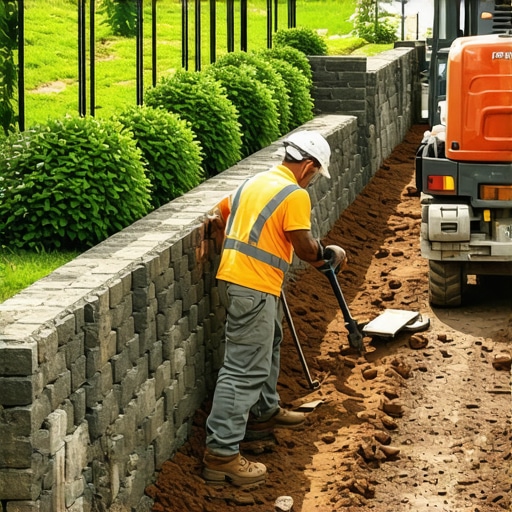
The Forensic Scene: When Gravity Wins
I remember a job in the hills of the Hudson Valley last November. I was looking at a gravity wall, sixty feet long and built from hand-chiseled granite, that had developed a belly like a middle-aged mason. It hadn’t just moved; it was groaning. The homeowner thought a few bags of quick-set mud and some repointing would fix it. I had to be the one to tell him that his $120,000 investment was essentially a slow-motion landslide. The original contractor had built it plumb—perfectly vertical—instead of with a proper batter, and he had completely ignored the hydrostatic pressure building up behind those stones. When I excavated a test pit, the soil was a slurry of grey clay that smelled like a swamp. That wall wasn’t just leaning; it was drowning. In this trade, you learn quickly that if you don’t give water a place to go, it will make its own path, usually right through your foundation.
“Proper drainage is the most important factor in the design and construction of retaining walls. Without it, the accumulation of water behind the wall can significantly increase the lateral earth pressure.” – BIA Technical Note 7
The Physics of the Lean: Understanding Lateral Earth Pressure
To understand why a wall leans, you have to look at the physics of the soil. We talk about the ‘angle of repose’—the steepest angle at which a material remains stable without sliding. When you cut into a slope to build a driveway or a patio, you are fighting that natural angle. The soil wants to slump back to its comfort zone. This creates active earth pressure. In a Northern climate, this is compounded by the freeze-thaw cycle. Water expands by roughly 9% when it turns to ice. If that water is trapped in the pore spaces of the soil behind your wall, it exerts a force that can reach thousands of pounds per square foot. This isn’t just a nudge; it’s a sledgehammer blow delivered from the inside out. We see this often in foundation failures where the foundation waterproofing has failed, allowing moisture to saturate the backfill. The result is often honeycombing in the concrete or a slow, agonizing tilt of the masonry units.
The Importance of Batter and Geometric Stability
In the old days, we never built a wall ‘plumb.’ We built with a batter—a deliberate lean back into the hill. A standard rule of thumb is a 1:6 ratio. For every six inches of height, the wall should set back one inch. This shifts the center of gravity and allows the weight of the wall to work with the soil rather than against it. When a wall is built perfectly vertical, any slight movement forward puts the center of mass over the ‘toe’ of the footer, and once that happens, gravity takes over. Correcting this usually requires more than just a slicker and some fresh mortar. If the tilt is significant, we look at foundation slab jacking or the installation of helical anchors to pull the structure back into alignment. This is forensic work; we are looking for the ‘slip plane’ where the wall has lost its grip on the earth.
“The angle of internal friction of the backfill material governs the lateral pressure exerted against the wall, necessitating precise calculation of gravitational loads.” – ASTM D2487
Drainage: The Lifeblood of Masonry Longevity
The most common failure I see in modern hardscaping is the lack of retaining wall weep hole cleaning or, worse, the complete absence of weep holes. Weep holes are the escape valves for hydrostatic pressure. Without them, the wall becomes a dam. A proper drainage system involves a perforated pipe at the base, wrapped in a geotextile fabric, and a ‘chimney’ of clean gravel extending almost to the surface. This ensures that water dropping through the soil hits the gravel and falls straight to the pipe rather than pushing against the back of the stones. In chimney structural repair and chimney interior parging, we see similar issues where moisture trapped inside the masonry causes the chimney crown repair to fail because the internal pressure has nowhere to go. Whether it is a chimney heat shield installation or a stone wall, you must manage the thermal and hydraulic energy.
Restoration Techniques: Beyond the Band-Aid
When we talk about brick arch restoration or saving a leaning stone facade, we have to respect the materials. Using a high-strength Portland cement on old, soft bricks is a recipe for disaster. The mortar must be the sacrificial lamb; it should be softer than the masonry unit itself. This allows for microscopic movement without cracking the bricks. We use sustainable block cutting techniques to salvage as much original material as possible, ensuring that the ‘tooth’ of the new mortar bed grabs the old stone effectively. When buttering the joints, the mason must ensure full coverage to prevent cold joints where water can seep in. It is about the ‘suction’ of the stone—the way it pulls the moisture from the mud to create a monolithic bond. If the stone is too dry, it steals the water from the mortar before it can hydrate, leading to a ‘flash set’ that will crumble within a season.
The Master’s Verdict on Structural Intervention
If you see a crack that follows the mortar joints in a ‘stair-step’ pattern, that is usually settlement. If the crack cuts through the bricks themselves, that is a structural shear—and that is when you should worry. Saving a leaning wall is an exercise in patience. It often requires excavating the backfill, installing foundation waterproofing, and perhaps even brick arch restoration if the wall incorporates spans. We look for signs of honeycombing in the original pour, which suggests the concrete wasn’t vibrated properly, leaving air pockets that weaken the structure. For chimney structural repair, we might use a hawk and trowel to apply a parge coat that seals the interior against flue gases, but for a retaining wall, the fix is always at the base. You can’t fix a leaning wall by working on the top; you fix it by stabilizing the ground it stands on. It is the difference between a ‘handyman special’ and a legacy repair that will last another three generations.