
Tuckpointing Machine Services: 4 Tactics for Faster 2026 Repairs
The Ghost of Mortar Past: Why Modern Shortcuts Kill Historic Walls
I remember a job back in the late nineties where a young buck tried to butter a joint using a high-PSI power washer and a bag of cheap, off-the-shelf masonry cement on a 1920s bungalow. My mentor, an old Italian fellow who could read a wall like a priest reads a Bible, grabbed the guy’s hawk and threw it into the mud tub. He told him that if he couldn’t feel the ‘suction’ of the clay, he was just painting a corpse. That’s the problem with most chimney repair services today—they treat a living, breathing structural system like a piece of plastic siding. When we talk about historic brickwork repointing, we are talking about a delicate chemical balance that has survived a century of frost and sun. If you get the chemistry wrong, you aren’t fixing the wall; you’re accelerating its funeral.
“Mortar should always be weaker than the masonry units it binds, acting as a sacrificial element that allows for thermal expansion and moisture migration.” – BIA Technical Note 1: All About Mortar
Tactic 1: Pneumatic Precision and the ‘Tooth’ of the Brick
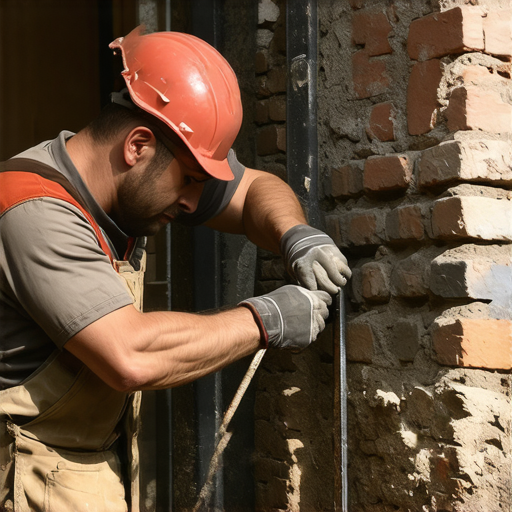
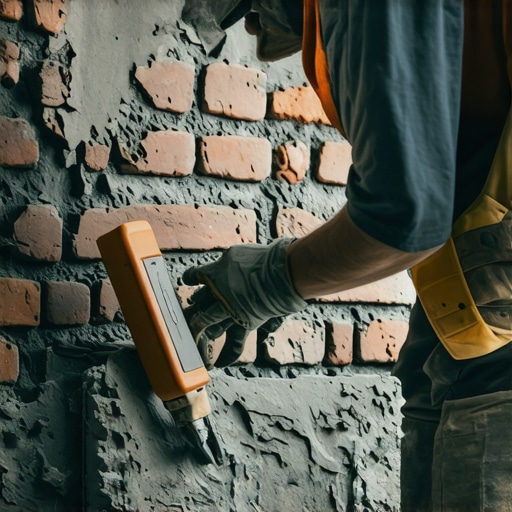
By 2026, the industry is moving away from the violent, dust-choked days of the 4-inch diamond blade grinder. For historic pointing styles, we are now utilizing pneumatic chisels that operate at lower vibrations. Why? Because high-speed grinding often ‘polishes’ the edges of the brick, destroying the ‘tooth’—that microscopic texture that allows the new mud to bite into the old unit. When performing commercial smokestack repair, preserving that edge is the difference between a joint that lasts fifty years and one that falls out in five. We use vacuum-shrouded tools to ensure the joint is cleaned to a depth of at least twice its width, exposing the raw heart of the wall without fracturing the fragile clay faces.
Tactic 2: Thixotropic Mud Injection for High-Volume Facades
The biggest shift in tuckpointing machine services is the refinement of mortar rheology. In the past, machine-applied mortar was often too wet, leading to ‘honeycombing’—air pockets trapped inside the joint that collect water and explode during the freeze-thaw cycle. The 2026 standard involves thixotropic mixes. This ‘mud’ stays stiff on the hawk but turns fluid under the vibration of the injection nozzle. This ensures a 100% fill rate, which is critical for concrete block foundation repair where hydrostatic pressure is constantly pushing against the exterior. If you leave a void, the earth will find it, and your basement will pay for it.
Tactic 3: Forensic Material Matching and the Sacrificial Principle
You cannot put Type S mortar—which is hard as a diamond—into a wall built with soft, lime-based Victorian bricks. When the temperature swings, those old bricks need to expand. If the mortar won’t give, the brick face will pop off in a process we call spalling. For stone veneer repair and historic restoration, we now use forensic analysis to match the original lime-to-sand ratio. We are looking for the ‘breathability’ of the wall. Water must be able to escape through the mortar joint, not get trapped behind it. This is why chimney crown repair often fails; people use straight Portland cement which cracks under the sun’s heat, rather than a flexible, fiber-reinforced mix that handles the thermal shock of a flue heating up to 800 degrees.
“The selection of mortar for restoration must prioritize vapor permeability to prevent the entrapment of moisture within the masonry assembly.” – ASTM C270 Standard Specification for Mortar for Unit Masonry
Tactic 4: Geogrid Integration in Retaining Wall Reconstruction
When we handle retaining wall block replacement, the failure is almost never the block itself—it is the lack of ‘grip’ in the soil behind it. Faster 2026 repairs utilize retaining wall geogrid installation techniques that involve high-tensile polyester mesh sandwiched between courses. This mesh acts as a ‘root system,’ tying the face of the wall into the backfill. Without it, the weight of wet soil acts like a slow-motion wrecking ball. Combine this with chimney flue liner installation logic—where we manage heat and moisture transition—and you start to see that masonry is less about stacking rocks and more about managing the physics of movement and pressure. Whether it’s a chimney repair or a massive commercial stack, the rules of gravity and water never change; they just wait for you to make a mistake.
![4 Signs You Need Structural Repointing in 2026 [Checklist]](https://masonryrescue.com/wp-content/uploads/2026/03/4-Signs-You-Need-Structural-Repointing-in-2026-Checklist.jpeg)

This post really highlights how crucial attention to detail is in masonry work, especially when it involves restoring historic structures. I’ve personally seen how using the right mortar mix not only preserves the aesthetics but extends the lifespan of the repair. The shift towards thixotropic mixes and pneumatic tools makes a lot of sense—reducing damage while ensuring a solid, long-lasting bond. I’ve always wondered how much the skill and experience of the mason influence the success of these advanced techniques. Has anyone encountered situations where a skilled operator made a significant difference in the outcome? It seems like so much of modern repair is about managing subtle physical and chemical interactions, which really underscores the importance of ongoing training and craftsmanship in this field.