Is Foundation Slab Jacking Better Than Mudjacking in 2026?
The Anatomy of a Hidden Failure
The homeowner pointed to a hairline crack snaking across the patio, barely wide enough to fit a nickel. He called it a nuisance; I called it a warning. When I fed my fiber-optic scope into a weep hole near the foundation, the truth revealed itself. The structural steel behind the brick was no longer steel. It was a bloated, orange ghost of its former self, rusted to dust because water had been trapped in a void beneath the slab for five winters. That hairline crack wasn’t just a cosmetic blemish; it was the exhale of a dying foundation. In my forty years of dragging a hawk and trowel across jobsites from Chicago to Toronto, I’ve seen this story end in a pile of rubble more often than I’d like to admit. When you’re looking at a sunken walkway or a sagging garage floor in 2026, the question isn’t just about ‘lifting’ the concrete. It’s about the physics of the soil and the chemistry of the void-fill.
“Water penetration is the single greatest threat to masonry durability and structural stability, often manifesting as sub-surface erosion long before surface cracks appear.” – BIA Technical Note 7
We are currently witnessing a civil war in the concrete flatwork services industry. On one side, you have the traditionalists clinging to mudjacking. On the other, the tech-heavy crews pushing polyurethane slab jacking. To understand which is better, you have to look past the surface and zoom into the geotechnical reality of the soil. In the frozen North, where the freeze-thaw cycle is the undisputed heavyweight champion, the ‘mud’ in mudjacking—a heavy slurry of topsoil, sand, and Portland cement—is often its own undoing. It weighs nearly 100 pounds per cubic foot. When you pump that much mass under a sinking slab, you’re essentially doubling the load on already failing, saturated soil. It’s like trying to help a drowning man by throwing him a heavier life vest.
The Physics of the Lift: Slurry vs. Polymer
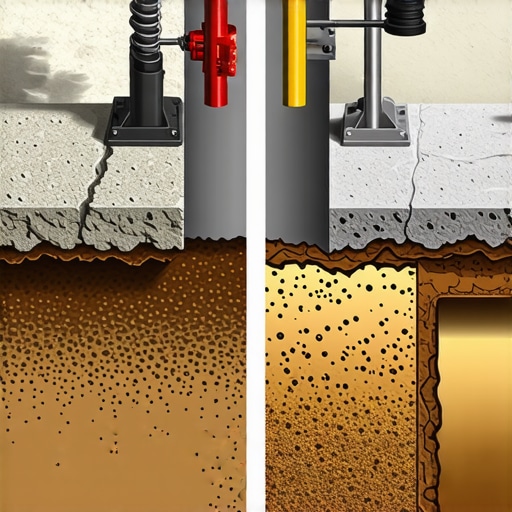
Mudjacking is a brute-force method. You drill large, two-inch holes—what we call ‘eyesores’—and pump in the mud. The suction of a dry brick or the porosity of old concrete will often pull the moisture out of that slurry before it can even level out, leading to honeycombing. These air pockets become tiny reservoirs for water. When the temperature drops, that water expands by 9%, and the pressure pops the concrete from the inside out, leading to spalled concrete steps repair jobs that could have been avoided. By 2026, the smart money has moved toward high-density, closed-cell polymers. Slab jacking with foam involves drilling holes no larger than a dime. The material is an exothermic reaction in a bucket; two liquids meet, expand, and harden into a lightweight, waterproof structural foam that weighs only 3 to 4 pounds per cubic foot. It doesn’t just lift the slab; it densifies the soil beneath it without adding a massive weight load.
“The bond strength and dimensional stability of repair materials must be compatible with the thermal expansion coefficients of the existing substrate to prevent delamination.” – ASTM C91 Standards
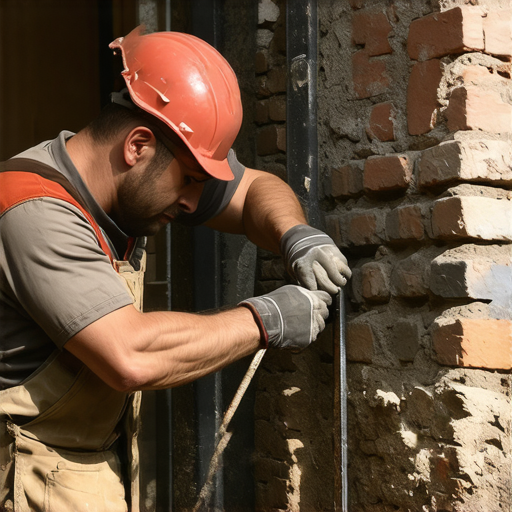
In the context of BIM masonry projects, we are now using digital twins to map these voids before we even mix the mud. Building Information Modeling allows us to see exactly where the hydrostatic pressure is building up behind modular retaining walls. If you’re dealing with a failing wall, simply buttering the joints with new mortar is a death sentence for the structure. You need to address the drainage. Without proper ‘weeps,’ the soil behind the wall becomes a heavy, liquid soup that will push over even the thickest stone veneer. I’ve seen ’emergency masonry repair’ crews try to fix these with simple epoxy injections, but that’s a band-aid on a bullet wound. If the base isn’t stabilized through proper jacking or excavation, the wall will just crack again three feet further down the line.
The Micro-Zoom: Why 2026 Technology Changes the Game
We’re also seeing the rise of 3D printed masonry repairs for historic restorations where the original stone is no longer quarried. When a chimney cap replacement is needed on a 1920s Tudor, we can now scan the remaining fragments and print a replacement that matches the ‘tooth’ and texture of the original lime-based masonry. But even the best 3D print won’t save a chimney if the flue is venting heat into the structure because of a failed chimney damper repair. The heat causes the masonry to expand at a different rate than the surrounding timber, leading to vertical ‘thermal’ cracks. The same logic applies to slab jacking. If the polymer isn’t injected at the right ‘flash point’—the temperature at which it begins to expand—it won’t create an uninterrupted bond with the concrete. You’ll end up with a ‘cold joint’ where the foam meets the dirt but doesn’t actually grip it.
The Restoration Reality: Mortar and Movement
I’m cynical about ‘handyman specials’ that use Type S mortar for everything. Type S is hard. It’s stiff. It’s great for a modern foundation wall, but it’s a disaster for stone veneer repair or old brick. You need mortar matching services that understand the ‘sacrificial principle.’ The mortar should always be slightly softer than the brick. If the foundation shifts—and in 2026, with our volatile weather patterns, it will shift—you want the mortar to develop a hairline crack, not the brick to shatter. This is why we use Type N or even Type O lime-putty mixes for older homes. It allows the building to ‘breathe’ and move. When we lift a slab using poly-jacking, we are essentially performing a surgical correction that respects this need for movement. The foam has a slight ‘give’ to it, acting as a cushion against the rigid earth.
When to Panic: Identifying Structural Threats
So, is jacking better than mudjacking? In 90% of cases in 2026, yes. Mudjacking is becoming a relic, reserved for massive industrial fills where weight isn’t an issue. For your home, your driveway, or your spalled concrete steps, you want the precision of polymers. You want the material that won’t wash away when the water table rises. You want the fix that doesn’t involve turning your porch into a Swiss cheese of two-inch drill holes. If you see a stair-step crack in your brickwork, don’t just call a guy with a bag of pre-mix. That crack is a map. It’s telling you exactly where the soil has given up. Whether it’s a chimney cap replacement to stop the water or a full slab lift to restore the grade, do it once, or you’ll be doing it twice. And the second time always costs triple. In this trade, there are no shortcuts—only long walks to the bank to pay for the mistakes of the cheap guy you hired first.
![Fix Shifting Blocks: 4 Signs Your 2026 Foundation Needs Help [2026]](https://masonryrescue.com/wp-content/uploads/2026/02/Fix-Shifting-Blocks-4-Signs-Your-2026-Foundation-Needs-Help-2026.jpeg)